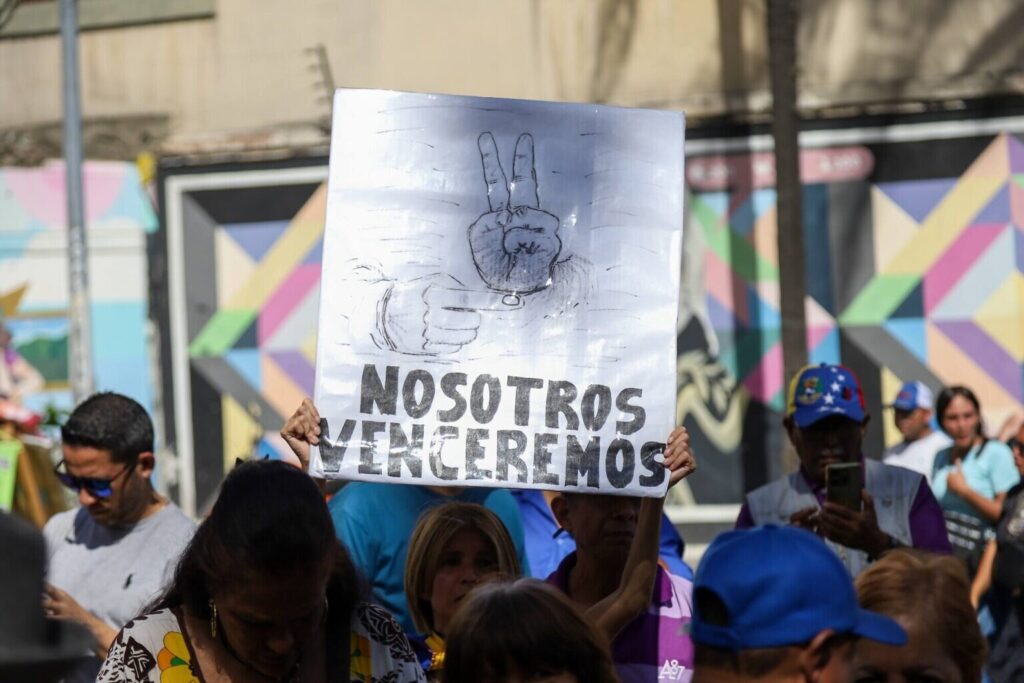
President Maduro's two-handed gesture, which means "Together we will win,” sketched on a placard at a Chavista rally. Photo: Alba Ciudad/File photo.
President Maduro's two-handed gesture, which means "Together we will win,” sketched on a placard at a Chavista rally. Photo: Alba Ciudad/File photo.
By Andreína Chávez Alava — Mar 31, 2026
Venezuelan President Nicolás Maduro and his wife and congresswoman, Cilia Flores, made their second appearance Thursday in a New York court, three months after being abducted by US forces in a large-scale illegal strike against Venezuela that killed at least 100 people.
During Thursday’s hearing, Maduro’s defense team sought to have the charges brought by federal prosecutors dismissed on the grounds that the president cannot pay his legal fees due to US sanctions preventing the Venezuelan state from making these payments. Senior US District Judge Alvin Hellerstein rejected the motion to dismiss the case, but said he would soon decide whether to order the Trump administration to allow Caracas to pay the legal fees. He noted that “the right to defense is paramount.” Both Maduro and Flores testified that they were unable to pay the fees themselves. A trial date has not yet been set.
International law experts concur that the trial against President Maduro lacks legitimacy, but more importantly, it constitutes the extension of an act of war that took place on January 3 with a US military operation against Venezuela that flagrantly violated international law. It is impossible to talk about justice when the starting point of what is happening in the Manhattan courthouse is the illegal abduction of a sovereign head of state.
“Under international law, the trial is illegal and should not be taking place,” said Cristian Ortiz, a young Venezuelan activist. “Nicolás Maduro and Cilia Flores enjoy immunity, especially before a judicial system that lacks jurisdiction over them.”
That is why the debate at hand is not so much about the legality of President Maduro’s trial. We already know that it is not, and we also know that the Venezuelan government should be allowed to pay for its abducted president’s legal defense. This trial will not deliver justice; rather, it will dismantle a judicial system that is riddled with legal contradictions, political interference, lack of jurisdiction, and evidence, and where Trump’s political will and US geopolitical and financial interests stand above justice.
All of this is happening in front of millions of people watching the trial worldwide.
The not-so-subtle oil objective
The Trump administration presented President Maduro’s abduction as a law enforcement operation. However, all references to alleged “narco-terrorism” were removed from its public statements as soon as Maduro had been forcibly removed from Venezuela. From that point on, oil interests dominated all discussions about what the US wanted from Venezuela.
Since President Maduro and Flores were forcibly abducted, Trump has effectively seized control of Venezuela’s oil exports and revenue. This was the result of demands made at gunpoint. Following the bombings on January 3, Trump threatened further strikes and the killing of the remaining Venezuelan Chavista leadership while maintaining a naval blockade in the Caribbean to prevent any Venezuelan oil shipments from leaving the country, unless Acting President Delcy Rodríguez complied. Once these demands were met, Trump recognized Rodríguez, the same woman who had previously served as vice president under President Maduro, despite having previously alleged that his government was illegitimate.
The picture was an example of peak imperialist fascism. Venezuela’s response has been resistance through diplomacy and compromising on less-than-ideal oil sales to guarantee peace and fight for the return of President Maduro and Flores, while demonstrating that Washington’s narcoterrorist narrative was always a facade to take the one drug it cares about: oil.
“She [Rodríguez] has to make concessions to the US that she otherwise wouldn’t do because she’s dealing with an opponent that has openly and brazenly kicked international law and has shown its willingness to use its vast military power to cause grave harm to Venezuela,” Venezuelan political analyst Clodovaldo Hernández explained.
The grotesque way in which the takeover of Venezuelan oil exports immediately replaced any argument about “narco-terrorism” revealed the true nature of President Maduro’s trial and the bogus charges: a strategy aimed at justifying forcefully regaining geopolitical control over a country’s strategic natural resources. It also seeks to discipline any political project that challenges US hegemony in the region through “exemplary punishment.”
The paradox becomes even more grotesque when one recalls that Donald Trump himself granted a pardon to Juan Orlando Hernández, the former president of Honduras, whose involvement in drug trafficking networks has been widely documented.
Even if we set aside the geopolitical context and US oil interests, which we should not, President Maduro’s trial itself is riddled with irregularities and with charges that have been modified as needed, which makes it very clear that the US is incapable of due process.
United States v. President Maduro
President Maduro and his wife are currently being held at the Metropolitan Detention Center in Brooklyn, New York, USA. He faces counts of “narco-terrorism” conspiracy, cocaine importation conspiracy, possession, and conspiracy to possess machine guns and destructive devices. Although US Attorney General Pam Bondi presented a new indictment the day of the abduction, the charges largely stem from a 2020 New York indictment that was used as justification for crippling US sanctions and President Maduro’s abduction.
Notably, the new indictment against President Maduro made no mention of the so-called “Cartel de los Soles,” an alleged drug trafficking organization that US officials had claimed was entrenched in the Venezuelan government in its 2020 charges. Shortly after President Maduro’s abduction, the US Department of Justice admitted that the cartel supposedly led by President Maduro had never existed, as reported by the New York Times. It is one thing to use an alleged cartel to manufacture consent for a military attack and kidnapping because it only requires scary rhetoric that the corporate media willingly repeats, but it is another thing entirely to have to prove the existence of said cartel in court.
Experts on Latin American crime had long stated that the “Cartel de los Soles” was never a real organization, that Venezuela does not produce fentanyl, and that it is an insignificant player in global cocaine trafficking, with most of the latter destined for Europe.
A leaked US intelligence memo from April 2025 also revealed that US officials had found no links between the Tren de Aragua gang and drug trafficking operations in US territory, nor any connection between the gang and the Venezuelan government, another one of the accusations against President Maduro that was rehashed for the 2026 indictment.
In the first arraignment in front of Judge Hellerstein’s court on January 5, President Maduro said he was a “prisoner of war,” stating that he was innocent, a decent man and that he was still the president of Venezuela. His wife, who faces the same charges, except for “narco-terrorism,” also pleaded not guilty. President Maduro’s lawyers have maintained that he is entitled to immunity as a sitting head of state abducted from his own country in a military incursion that violated the prohibition on the use of force, the principle of non-intervention, and the immunity of heads of state enshrined in the UN Charter and recognized by the US legal system.
President Maduro’s second hearing on Thursday has further revealed the fragility of the entire case, with Washington openly interfering because the falsity of the charges is becoming too apparent. On February 9, just three hours after it was initially granted, the US Office of Foreign Assets Control (OFAC) revoked a license allowing Venezuelan state funds to pay for the legal fees of President Maduro and Flores. Federal prosecutors claimed that the OFAC could not lift sanctions to allow access to Venezuelan government funds because Venezuela represented a threat to the US, to which Hellerstein responded that the Trump administration has resumed diplomatic ties and business with Caracas; therefore, the threat argument was invalid.
Two days after the second hearing, the argument against freezing Venezuelan funds was further shut down when the Venezuelan-appointed ambassador to the US, Félix Plasencia, and his delegation reclaimed the Venezuelan embassy building in Washington, DC.
In 2019, Caracas severed ties with the US after the Trump administration recognized opposition figure Juan Guaidó’s unelected “interim government,” claiming that the 2018 presidential elections which saw President Maduro elected for a second term were fraudulent. The same embassy building that was the target of a failed coup attempt by the Venezuelan far right is now back in the hands of the rightful Venezuelan government.
The narrative of Maduro’s alleged illegitimacy was also used to impose an oil embargo, which devastated the country’s economy, and to seize CITGO, the US-based Venezuelan oil refinery network worth billions of dollars. CITGO is currently being sold at a court-mandated auction to pay for international arbitration awards.
Caracas’ decision to prioritize diplomacy has been vindicated, as the US has irrevocably recognized the Chavista leadership. Judge Hellerstein himself has highlighted the absurdity of Washington’s attempt to maintain two conflicting narratives: partially lifting sanctions on Venezuela’s oil industry and restoring diplomatic ties to fulfil US geopolitical interests, while simultaneously keeping them in place to prevent the Venezuelan state from funding the legal defense of its president, who is being held captive in the United States.
The trial circus became even more transparent when Trump attempted to influence public opinion during President Maduro’s second hearing. During a cabinet meeting on Thursday, Trump said he expected more charges to be brought against the Venezuelan president. He reiterated his long-standing allegation that President Maduro had emptied Venezuelan prisons and sent criminals to US territory. He hoped that adding more charges would extend the trial.
The narrative that President Maduro sent prisoners to the US is not a new one. Since last year, it has been used to demonize Venezuelan migrants and deny them due process as part of Trump’s mass deportation campaign. For example, in March 2025, Trump sent 252 Venezuelan migrants to El Salvador’s CECOT prison after they were forcibly expelled from the US under the 1798 Alien Enemies Act on the basis of alleged gang membership in the Tren de Aragua.
The 252 men were never formally charged. Independent investigations revealed that most of them had no criminal record and had been racially profiled based on their tattoos and social media posts. Under a Washington–San Salvador agreement, they were detained at a cost of US $20,000 per detainee per year. In July, President Maduro secured their release.
“I am living proof of how the US lies,” Arturo Suárez, one of 252 Venezuelan men wrongly imprisoned and tortured at CECOT, told the local media at a pro-Maduro rally in February. They were all pawns to justify inhumane deportations and the narrative that “dangerous criminals” had been sent to the US by President Maduro.
For the young activist and Bolivarian idealist Ortiz, the US judicial system is an extension of imperialist crimes against humanity. He recalls that it “does not serve the interests of any people in the world, not even its own.” The US is often referred to as the “great prison of nations” due to its high incarceration rate, its police-judicial system that disproportionately targets black people, and its immigration policy that involves detaining children and kidnapping people from their homes.
President Maduro’s abduction and illegitimate trial followed a series of crimes, including a decade of US economic sanctions that killed hundreds of thousands of Venezuelans, a naval blockade during which US forces stole Venezuelan oil shipments, and the killing of over 150 fishers in the Caribbean Sea and the Pacific Ocean during an alleged counter-narcotics operation.
The trial of President Maduro and Flores is just another manifestation of US fascism, which is why it cannot be combatted solely within the confines of a courtroom. The mainstream media that enables US crimes knows that they also need to discredit President Maduro’s image and name and distance him from the Bolivarian process that continues under the Rodríguez administration.
The isolated Maduro narrative
Initially, the mainstream media played down the international condemnation of President Maduro’s abduction by US forces, instead circulating the story of alleged internal treason in Caracas that supposedly facilitated his capture. This blame shift was necessary because the kidnapping operation was met with widespread opposition inside Venezuela rather than with celebratory rallies. Furthermore, rather than self-immolating, the Chavista government chose to fight back with its most potent weapons: truth, sovereignty, and diplomacy.
Acting President Rodríguez has continued to openly recognize President Maduro as the legitimate president, pledging to prioritize securing his and Flores’ return through diplomacy. Meanwhile, she has been actively visiting communes across Venezuela. These self-governing, grassroots organizations are one of the pillars of the country’s socialist project.
The betrayal storyline has not diminished; instead, it now relies on cabinet reshuffles to demonstrate that the Rodríguez administration has marginalized President Maduro. This stems from the recent replacement of high-level government officials such as the defense minister and attorney general. These posts were previously occupied by Vladimir Padrino López and Tarek William Saab for a considerable amount of years.
Outlets such as El País, the Associated Press (AP), and National Public Radio (NPR) have speculated that these changes are a way of removing key figures from the Maduro era to positions with less political or judicial power. In reality, however, those being appointed had already held positions under the President Maduro government, so they are not newcomers or US sympathizers. Some of them have a long history of militancy in the Chavista movement.
The new defense minister, Gustavo González López, previously served as interior minister from 2015 to 2016, as well as serving as chief of the SEBIN intelligence agency from 2014 to 2018. He was appointed to both positions by President Maduro himself. The current acting general attorney, Larry Devoe, has been around since the Hugo Chávez government and presided over the National Human Rights Council under President Maduro.
Government reshuffles are completely normal in Venezuela. These usually occur annually, either to reorganize forces for electoral purposes or to adjust to new national political or socioeconomic strategies. In 2025, President Maduro appointed three new ministers: one for sports, one for agriculture, and one for ecosocialism. The previous year, he appointed new people to five key ministries, including veteran Chavista leader Diosdado Cabello as interior minister (who is still in office) and Delcy Rodríguez, then vice president, as oil minister.
The intention behind the idea that President Maduro is being erased from Venezuela’s political life is to create division and distrust among grassroots Chavistas towards government leaders. The intention is to undermine Venezuela’s political project and portray President Maduro as an isolated figure who has fallen from grace.
Hernán Vargas, a spokesperson for Alba Movimientos and a housing rights activist, recalled that imperialism has always sought to “erase the history of the Bolivarian Revolution and rewrite it from an imperialist, neo-fascist, neo-Nazi perspective,” with the current narrative aiming to defeat Chavismo morally.
“Their core strategy is to sow division and foster mistrust so that people say: ‘There’s no revolution; just corruption, and Maduro has been left behind.’” Vargas added that the President Maduro who appeared in court in January and March was not the defeated figure with his head bowed that Washington had expected. Instead, he was “a man who carried himself with dignity,” sending a clear message to his people that Venezuela will prevail.
The grassroots Chavista movement has not been defeated. It is fighting against US control in the hope of achieving better conditions, albeit under different circumstances. The trial of President Maduro and his wife is yet another battle that the US is losing, as public opinion has already turned against them amid growing awareness of US crimes in Gaza and Iran.
ACA/OT/SL

Andreína Chávez Alava is a Caracas-based Venezuelan journalist with over a decade of experience reporting on Venezuela's political landscape and its stance against US intervention. She has contributed to anti-imperialist narratives while working and colaborating with news outlets like Telesur, Venezuelanalysis, and Orinoco Tribune.