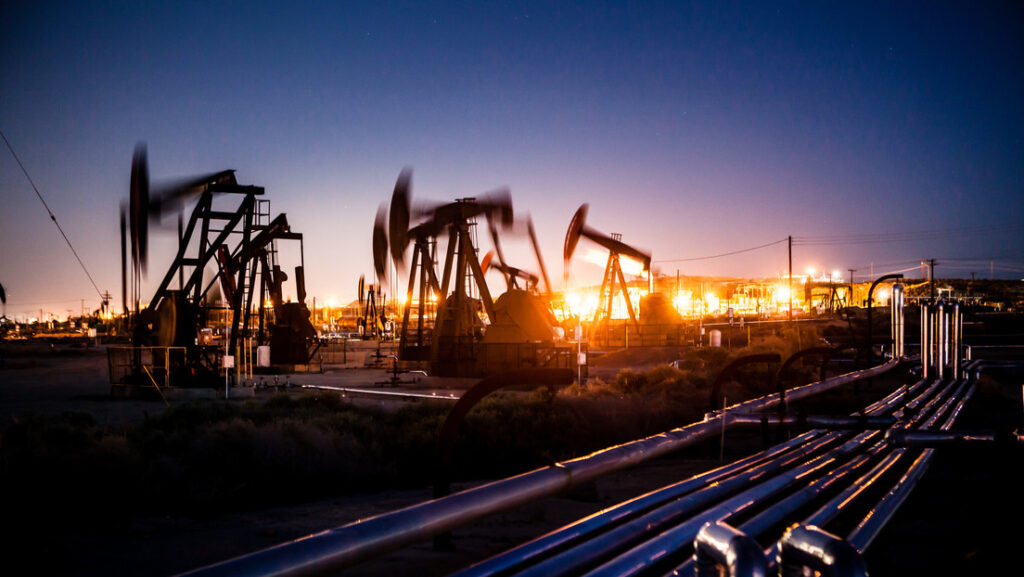
Illustrative image of an oilfield. File photo/Getty Images.
Illustrative image of an oilfield. File photo/Getty Images.
The price of oil rose by 10% on Thursday, April 2, after US President Donald Trump warned of a possible escalation of military action against Iran in the next two or three weeks, which reduced expectations of an immediate de-escalation of the conflict.
The price of West Texas Intermediate (WTI) increased by 10%, reaching $110.21 per barrel, while Brent rose by 8%, reaching $109.25 per barrel.
In a speech, Trump attributed the price surge to what he called “crazy terrorist attacks that the Iranian regime is launching against commercial oil tankers and neighboring countries that have nothing to do with the conflict.” He did not offer a clear date for the end of hostilities in the Middle East.
The US president stated that Washington is close to achieving its strategic objectives in Iran and warned that military operations could intensify in the next two or three weeks. He also noted that the US could strike Iran “extremely hard,” sending it “back to the Stone Age,” which raised concern in the markets, increasing worries about potential additional damage to the energy infrastructure in the region.
Trump’s Iran Gamble Is Spiraling Out of Control: From Shock & Awe to Strategic Failure
Aggression against Iran
In the early hours of February 28, Israel and the US launched a joint aggression against Iran with the declared aim of “eliminating the threats” from the Islamic Republic.
The bombings resulted in the murder of Iran’s supreme leader, Ayatollah Ali Khamenei, and several high-ranking military officials, including the secretary of the Supreme National Security Council, Ali Larijani; the commander of the Basij militia, Gholamreza Soleimani; and the minister of Intelligence, Esmaeil Khatib. Mojtaba Khamenei, son of the deceased supreme leader, was selected as his successor.
As retaliation for the attacks, Iran has launched numerous waves of ballistic missiles and drones against Israel and against US bases in Middle Eastern countries. Additionally, the Islamic Republic carried out a series of massive attacks, targeting “oil facilities linked to the United States” in several Gulf countries, in response to the attacks on its energy infrastructure.
Furthermore, Iran has almost completely blocked the Strait of Hormuz, a maritime route through which around 20% of all the oil and gas traded in the world passes, causing fuel prices to soar.
(RT)
Translation: Orinoco Tribune
OT/SC/DZ