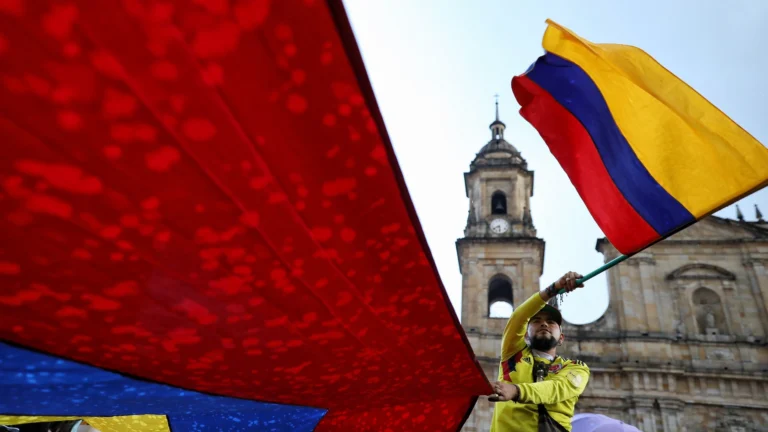
Supporters of Colombian President Gustavo Petro attend a rally he called to protest comments by US President Donald Trump, in Bogota, Colombia, Wednesday, Jan. 7, 2026. Photo: Santiago Saldarriaga/AP.
Supporters of Colombian President Gustavo Petro attend a rally he called to protest comments by US President Donald Trump, in Bogota, Colombia, Wednesday, Jan. 7, 2026. Photo: Santiago Saldarriaga/AP.
By Silvana Solano – Apr 15, 2026
A deep dive into Colombia’s struggle between continuity and restoration.
Colombia faces one of its most important elections in modern history. After four years of the country’s first progressive government under President Gustavo Petro, voters now choose between building on social reforms or returning to the conservative ways that have shaped the nation for decades.
With tensions high, the May 2026 presidential election tests the country’s identity, security, and place in Latin America.
The National Registry sets a clear path to the presidency. The first round happens on Sunday, May 31, 2026. If no one gets more than 50 percent plus one of valid votes, a runoff follows on June 21, 2026. This comes after March legislative elections that changed Congress and built today’s alliances.
Voters are not just picking a leader. They are deciding the future of the “Total Peace” policy, which aims to end decades of conflict by talking with armed groups.
The next government will also handle hotly debated reforms in health, pensions, and labor. Official records show 14 candidates registered for the first round, reflecting a wide, divided range of views.
Colombia’s two top presidential candidates — conservative lawyer Abelardo de la Espriella and leftist senator Iván Cepeda — are statistically tied in the latest poll ahead of Election Day on May 31. https://t.co/RHMCTO51ef
— Bloomberg (@business) February 7, 2026
A Divided Political Landscape in the 2026 Election
The candidates show a deeply split electorate in three main groups: left-wing continuity, traditional center-right, and a rising far-right outsider wave.
On the left, Iván Cepeda leads for the Pacto Histórico. This veteran senator and human rights advocate carries forward the current government’s ideas. His running mate, Aída Quilcué, helps focus on land reform, indigenous rights, and green changes. For workers and rural communities, Cepeda offers the best chance to keep recent social wins.
The right splits into two strong camps. Paloma Valencia, a Centro Democrático senator and ally of former President Álvaro Uribe, stands for the old conservative guard. She pushes “Democratic Security” and private property rights, drawing voters who see public order slipping under the current team.
But Abelardo de la Espriella challenges her. This famous criminal lawyer runs as an outsider with “Defenders of the Homeland.” He takes a “Bukele-style” tough stance on crime, wants to restart coca crop fumigation from the air, and shift hard to neoliberal economics.
In the middle, a shaky center features former Bogotá Mayor Claudia López and repeat candidate Sergio Fajardo. López runs with “Con Claudia Imparables,” trying to avoid left-wing “chaos” and right-wing “authoritarianism.” She presents herself as a practical manager, stressing urban safety and anti-corruption. Centrists hope to win over undecided middle-class voters, but in a race pulling toward extremes, they struggle for support.
🚨🇨🇴 | AHORA/SOUTH AMERICA: At least 40 million Colombian voters will head to the polls for Colombia’s 2026 Congressional elections, to determine what the May 31 presidential election could look like as polls are expected to close at 4:00 p.m.
What will the results show? A… pic.twitter.com/fJTvcud1ui
— Sociedad Media (@sociedadmedia) March 8, 2026
Divergent Platforms: Two Visions for Colombia’s Future
Campaigns heat up, and leading candidates’ plans dominate talks. The big question: Should Colombia push a green, social economy or return to security-first and mining-based growth? These are not just policies; they reflect deep views on the government’s role.
Iván Cepeda and Pacto Histórico emphasize “Energy Transition” as their economic core. They call for quick moves from oil and coal to big public spending on wind, solar, and green hydrogen.
This pairs with “Social Justice,” like a 23% minimum wage increase and health reform to grow rural primary care via public agency ADRES. Cepeda sees stability in cutting Colombia’s high inequality, one of Latin America’s worst, through mixed public-private health and new ICES funding for education.
Paloma Valencia and Abelardo de la Espriella target a “Security Crisis.” Valencia’s “Plan Colombia 2.0” boosts troops in areas where illegal groups control. For the economy, she promises “Regulatory Stability” to keep investors happy in energy by stopping fossil fuel cuts.
De la Espriella goes further with market ideas, like “Criminal Justice Reform,” letting crime bosses keep some illegal gains for disarming and sharing info. His mix of extreme free-market economics and strict control appeals to those tired of endless rebellions.
🇨🇴🗞️ | SOUTH AMERICA | Colombia’s New Congress Takes Shape & Paloma Valencia Emerges as the Right’s Standard-Bearer
The results give an inside peek into what to expect in the May 31 presidential showdown to determine whether Colombia will elect for left-wing continuity, or a… pic.twitter.com/gdFAANfWif
— Sociedad Media (@sociedadmedia) March 9, 2026
Campaign Strategies and the Shadow of Violence
The 2026 race plays out on streets and online amid sharp divides and growing violence. The government stations over 120,000 security forces at candidate sites and polls, but risks linger. Recent killings of key figures have put public events in danger spots like Arauca, Meta, and the Pacific coast.
Abelardo de la Espriella, nicknamed “The Tiger,” uses media and “culture-war” tactics. His viral social posts and attacks on elites help him lead conservatives, especially young urban voters in Bogotá.
Iván Cepeda chooses steady, community roots. He holds “Territorial Dialogues” with unions, indigenous guards, and farmers to hold the base that elected the current leaders.
Claudia López builds on “Pragmatic Governance,” highlighting her Bogotá mayor days with “Execution, Not Ideology.” She pushes decentralization for regional funding power. As a bold leader against “Petristas” and “Uribistas,” she seeks the quiet middle.
Yet in a security-driven race, moderates like López and Fajardo wonder if “management reform” can match the right’s tough promises or the left’s big changes.
Both of Colombia’s conservative presidential candidates would hold sizable leads over leftist Senator Ivan Cepeda in a potential runoff election, a new poll found, suggesting the nation is set to swing to the right this year https://t.co/gNyrXAAjXj
— Bloomberg (@business) April 9, 2026
Democracy in the Crosshairs
Violence clouds the 2026 cycle, testing Colombia’s democracy. The worst blow: the assassination of senator Miguel Uribe Turbay, shot at a Bogotá rally. It highlights politics’ dangers as “Total Peace” faces questions.
The world reacted with shock, prompting candidates to ramp up protection; many now use bulletproof gear and heavy guards.
Threats hit all sides. Paloma Valencia got death threats, like funeral wreaths, at her office. Abelardo de la Espriella faced intimidation, too. Progressives see ongoing risks to rural leaders and activists, tilting the field.
🇨🇴🗞️ | SOUTH AMERICA | Colombia’s Presidential Campaign is Off to the Races: A Guide to the Three Candidates Who Could Define the Country’s Next Four Years
Colombia votes May 31. Cepeda leads the left, De la Espriella the far right, and Valencia the center-right 🗳️
One of them… pic.twitter.com/j0X8dAN9E4
— Sociedad Media (@sociedadmedia) March 31, 2026
Projections and the Road to the Runoff
Mid-April 2026 polls show a tight, split race. AtlasIntel’s latest has Iván Cepeda leading first-round intent at 37%. He unites the left and Pacto Histórico base.
He might take May 31, but a runoff looks tough; de la Espriella or Valencia could win by rallying anti-government voters.
Opposition math needs unity. A single right-center pick for June 21 could hit 50% and take the Casa de Nariño. De la Espriella has 27%, Valencia 22% now. Undecideds and centrists like López could decide it all.
A Definitive Choice for Colombia
The 2026 presidential election is far more than a routine change of administration; it is a fundamental test of Colombia’s democratic resilience and its social trajectory. After four years of unprecedented progressive governance, the nation stands at a crossroads.
Voters are being asked to decide whether to double down on the structural shifts toward social equity and environmental sustainability championed by Iván Cepeda, or to embrace a sharp pivot toward the hard-line security and “law and order” promises of Abelardo de la Espriella and Paloma Valencia.
Ultimately, the results on May 31, and the likely runoff in June, will ripple far beyond Colombia’s borders. The outcome will signal whether the “pink tide” of Latin American progressivism has found a permanent home in the Casa de Nariño or if the continent is witnessing a forceful return to the conservative status quo.
Sources: teleSUR – BBC – The Guardian – Atlantic Council – CELAG – Procuraduria de Colombia – RTVC Noticias – Registraduria de Colombia – El País – Americas Quarterly – AS-COA
(teleSUR)