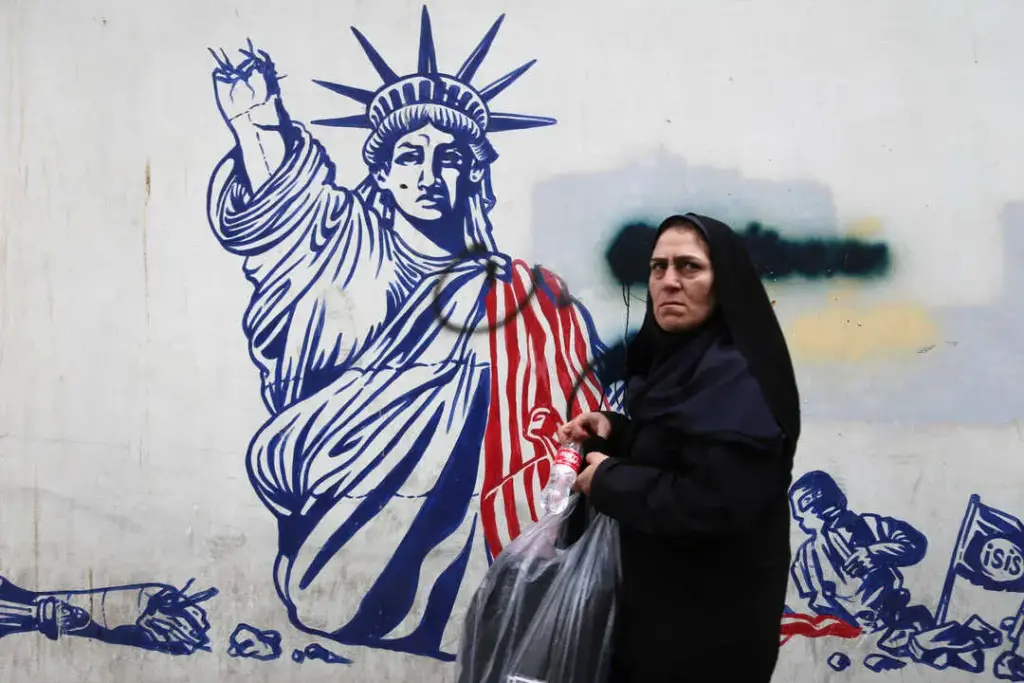
An Iranian woman poses in front of a mural painted on the wall of the former US embassy in Tehran. Photo: Rouzbeh Fouladi.
An Iranian woman poses in front of a mural painted on the wall of the former US embassy in Tehran. Photo: Rouzbeh Fouladi.
By Bruno Sgarzini – May 6, 2026
The momentary strategic victory achieved by Iran against the United States and Israel forces a rethinking of a regional strategy in Latin America that can ensure a minimum of sovereignty and autonomy. Something that seemed unthinkable in times of sieges typical of the Donroe Doctrine in our region, with terrible precedents like the US invasion of Venezuela.
These days there are plenty of people saying that Trump made a mistake because Iran is not Venezuela, however, this is pejorative analysis of the Bolivarian process that overlooks the countless victories of Chavismo against color revolutions and soft coups triggered by sanctions. Chavismo prepared itself to face these offensives, rather than a conventional military invasion. And to suggest that there is another Latin American country with the same capacity to do so is, at best, a fantasy that regional politics of Latin America resembles a story by Homer, like the Odyssey, rather than a Tarantino movie where the villains are bloody, violent, and foul-mouthed. Therefore, to believe that there is a defense policy that can keep an imperialist and decadent United States at bay is a chimera, no matter how much its disorderly brutality resembles that of a gym bro full of steroids, whose torso is enormous, but whose legs are as thin as a dancer’s after suffering from malaria.
There is no military policy Venezuela can implement that can effectively and efficiently recreate a mosaic doctrine, like that of Iran, which decentralizes command and control to increase the costs of an intervention with low-cost drone and missile launches at maritime or geopolitical chokepoints. Nor is there a collective force so disciplined to maintain the extended violence sun subsequent social consequences. Chavismo, in its own way, tried to do it at the cost of sacrificing—due to the sanctions—its legitimacy with a significant sector of the population that had long supported the process.
So what remains? Tactical evil to adapt to the momentary storm, which Trump embodies, until it clears? The problem is that the Orange Agent is the symptom of a chronic imperial disease; it will be quite difficult for a new US administration to abandon the strategic retreat toward Latin America given its decline. This forces us to project a glimpse of strategy to weather these times that threaten to be permanent unless a domestic crisis in the United States implodes what remains of the imperial apparatus, one that can deter extreme US pressures against the autonomous partnerships that remain in the region, such as infrastructure projects with China and other multipolar powers, or improve the terms of trade for the region, as Lula Da Silva outlined when discussing the need to develop critical minerals with better returns for Latin American countries. However, experience shows that initiatives to create alliances of countries or organizations of raw material producers to improve the income of countries and distribute it in society and the industrial apparatus are met with significant resistance. One of the greatest persecutions against the progressive leaders of the first part of the 21st century stems from the nationalizations of oil and gas companies and their policies of wealth redistribution. It is because of this reason that most of these leaders are imprisoned, exiled, or persecuted by the servile Latin American judiciaries.
What Cannot Be Unlearned: The Defense of the Bolivarian Revolution
These historical events have resulted in some lessons on how to build regional and common autonomy. While the most advanced integration project was UNASUR, with its Bank of the South and a common Defense space, the most effective space for building a common project based on a win-win logic was Petrocaribe, the initiative through which Venezuela sold cheap oil to the Caribbean countries in exchange for payment in kind. This laid the groundwork for one of the most stable periods in the Caribbean, given that most of these countries, especially nations like Haiti, used to spend a large part of their budget on importing fuel to supply their power plants. Until the imposition of US sanctions against Venezuela, the Petrocaribe project allowed for a minimum period of well-being, despite the cases of corruption in the program.
This experience indicates that strategic partnerships like this one, where larger countries help establish win-win relationships that provide stability in countries geographically close to the United States, are incredibly valuable. Not only from a moral standpoint on what is right, but also because they address indirect issues, such as migration and security, which have repercussions in the US domestic arena. The best regional policy is one that creates incentives to deepen historical ties and establishes consequences if they are ruptured by the United States. Success depends on implementing long-term policies that turn the solution of regional problems into opportunities to create a common ground of unity that serves to contain the empire’s advance.
This is a Latin American logic quite different from the current one of every man for himself.
Translation: Orinoco Tribune
OT/SC/DZ

Bruno Sgarzini is an Argentinian analyst, writer and researcher part of the Mision Verdad team