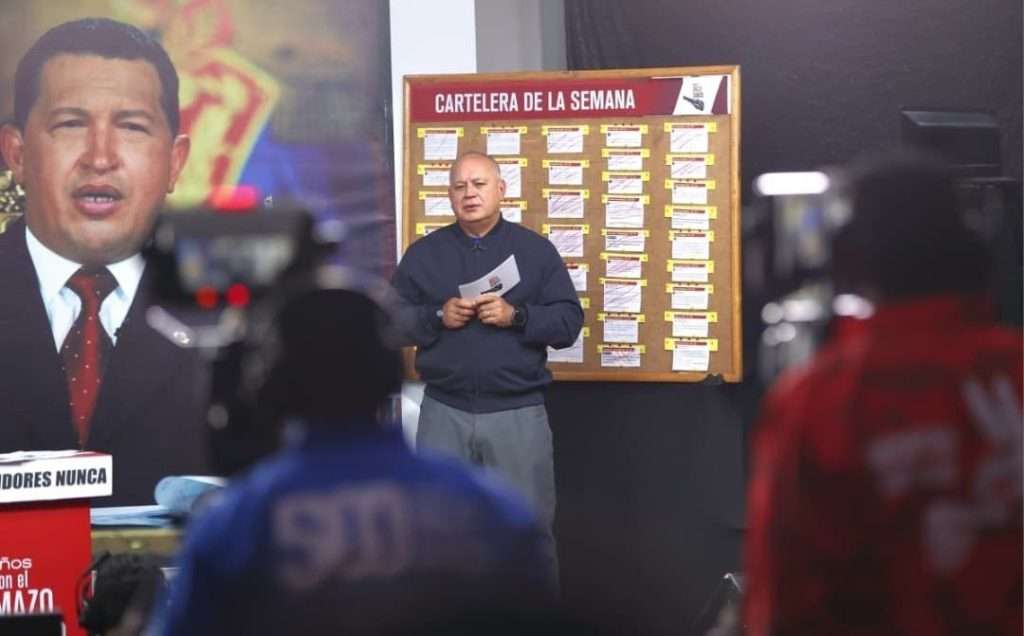
PSUV General Secretary Diosdado Cabello in the 569th edition of his program Con El Mazo Dando, May 6, 2026. Photo: Con El Mazo Dando.
PSUV General Secretary Diosdado Cabello in the 569th edition of his program Con El Mazo Dando, May 6, 2026. Photo: Con El Mazo Dando.
The general secretary of the ruling United Socialist Party of Venezuela (PSUV), Diosdado Cabello, announced the start of the second phase of the national pilgrimage for peace and against sanctions, with the aim of strengthening direct dialogue with the people and consolidating national unity.
During the 569th edition of his program Con el Mazo Dando on Wednesday, May 6, Cabello explained that this new phase will begin with the productive sector and will progressively extend to women, workers, youth, farmers, students, and religious communities.
Assessing the first stage of the pilgrimage, he called the experience “extraordinary” and emphasized that this mobilization does not belong to a political faction, but to all Venezuelans who demand the end of the unilateral sanctions imposed by the US.
“The pilgrimage is for those who want peace, coexistence, and prosperity,” he said. “Chavismo must strengthen itself from within, with awareness, and without trying to please those who have historically hated the Revolution and the Homeland.”
Recovery of assets
Cabello also underscored that the Venezuelan government will not rest until it is able to recover the Venezuelan assets seized abroad.
“No one can steal with impunity; things always come to light. We are going to recover the seized gold [in the UK] and the CITGO company [in the US],” emphasized Cabello.
Thousands Converge in Caracas to Demand End to US Sanctions on Venezuela
In this context, he pointed out that members fof the extreme-right opposition attempted to negotiate a so-called “aid” to release the gold held in the Bank of England, in exchange for hiding the responsibilities for embezzlement and misappropriation revealed by the audits conducted on CITGO in the US.
Cabello further questioned the sectors that are trying to present individuals associated with plans of violence, drug trafficking, and attempts of invasion as “political prisoners.” He also criticized the inconsistency of the opposition regarding the Amnesty Law.
“First, they said the law was useless and incomplete, and now they demand its application,” Cabello said. “The country knows who went to ask for sanctions and blockades around the world. If Venezuela has been able to move forward under siege, without a blockade the path to prosperity would be much broader.”
Translation: Orinoco Tribune
OT/SC/DZ