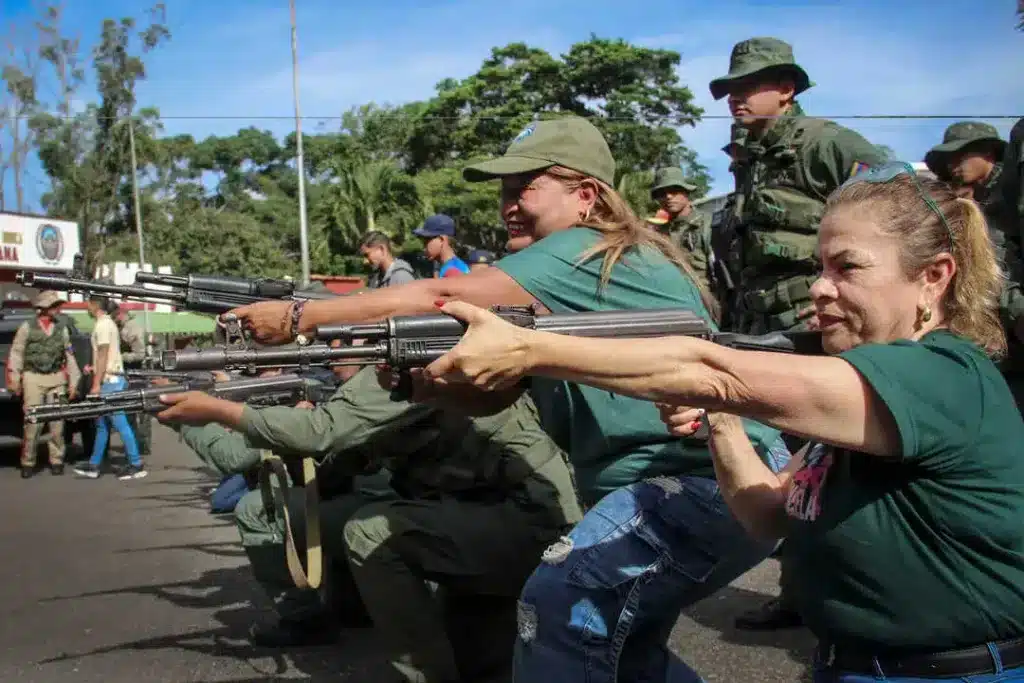
September 13, 2025, San Cristóbal, Venezuela: A group of civilians and military personnel aim assault rifles during training at a military camp. The training for militia members, reservists, and volunteers took place at various barracks and military training centers in Venezuela, organized by the government of Nicolás Maduro as part of what authorities describe as an effort to strengthen national defense through civil-military mobilization. Photo: Jorge Castellanos/Zuma Press/ContactoPhoto.
By Bruno Sgarzini – Sep 28, 2025
Underestimating Chavista strength is one of the recurring mistakes of American presidents.
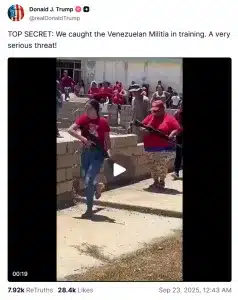
Donald Trump is wrong to laugh at Venezuelan women militia members for their height and weight. They were the same ones who, in 2020, along with fishermen from Chuao, recognized a small boat carrying several former Venezuelan soldiers and two former Green Berets from the US Army Special Forces. The group planned to enter Venezuela by sea, seize a nearby airport, and fly Nicolás Maduro out of the country after a “fantastic” capture, the kind seen in Mission: Impossible, that could only succeed in their imaginations.
Aaron Barry and Luke Denman, the mercenaries in question, were two American operatives who had fought in Libya and Iraq and were recruited for the mission. They held Bronze Star Medals and other insignia awarded by the US Army when they were arrested, thanks to the very militia members Trump now mocks on social media. These are the same women the US president ridicules for their appearance and phenotype, yet he does not hesitate to accuse them of belonging to the mythical “Cartel of the Suns.”
A screenshot of Trump’s social media post mocking Venezuelan militia members. Photo: Truth Social.
Recent Venezuelan history shows a long line of underestimations and miscalculations by opponents, senior foreign officials, and US presidents. Pedro Carmona Estanga, then-president of the business group Fedecámaras, believed that in April 2002 it would be enough to arrest Hugo Chávez to force his resignation, and that Chavista military forces would not counterattack to retake Miraflores Palace, backed by massive mobilizations in Caracas neighborhoods.
Donald Trump believed his national security adviser, John Bolton, in January 2019, when Bolton claimed that if the US recognized Juan Guaidó’s self-proclamation as president, thousands of military personnel would defect and stage a coup against Maduro.
Later, in one of the most ironic episodes in Venezuelan history, Trump again relied on assurances from Leopoldo López and Juan Guaidó, relayed through Bolton, that Maikel Moreno, then-head of the Supreme Court, would issue a ruling recognizing Guaidó as president, with the backing of Defense Minister Vladimir Padrino López and SEBIN chief Christopher Figuera. The saga ended with Guaidó and López recording a video on a dark highway, calling on the military to rise up, while Moreno and Padrino López ignored their calls. For the immortality of Venezuelan memes, rebel troops fired ammunition stored in banana crates from the Francisco Fajardo Highway. The image of that fiasco, which sparked global mockery of US power, contributed to Bolton’s ouster from the Trump administration.
A few years later, the same fanciful, outdated thinking appears to have returned with the White House comeback of the orange-haired creator of The Apprentice. It’s no longer Bolton filling Trump’s ears with empty promises, but Secretary of State Marco Rubio, who also serves as national security adviser, envisioning a revival of gunboat diplomacy, when the United States militarily occupied Latin American nations and orchestrated coups. In Rubio’s “domino” logic, Venezuela’s fall would end Cuba’s revolution and oust Nicaragua’s Daniel Ortega. It would also send a warning to any country that defies Washington or draws close to China or Russia, Monroeism on steroids.
As in past cases, this calculation, made by Cuban American officials who have never lived in Latin America, assumes the “Chávez regime” would collapse overnight and that María Corina Machado would emerge as the undisputed leader of all Venezuelans, leaving everyone else to fend for themselves. But many things could go wrong. If US military pressure, “surgical strikes,” or “targeted assassinations” succeeded, Venezuela could descend into a power vacuum, potentially seized by military factions more radical than Maduro, or fragment into warlord-controlled zones, as in Libya or Syria, with a US-backed rump state in the center. Venezuela has a long history of regional caudillos that could resurface.
Alternatively, as in previous episodes, nothing might happen: military pressure could fail, Trump could lose interest, and he might strike a deal with Venezuela, exchanging Venezuelan migrants for oil, as proposed by MAGA-aligned members of his cabinet. Yet one of the worst outcomes for Trumpism would be a military intervention in Venezuela that achieves nothing. Such a failure would shatter the myth that gunboat diplomacy can be revived in Latin America. It could happen, for instance, that Trump deploys heavily decorated US soldiers, only for them to be detained by the very militia members he mocks online.
That is why Trump is wrong to laugh at Venezuelan militia members.