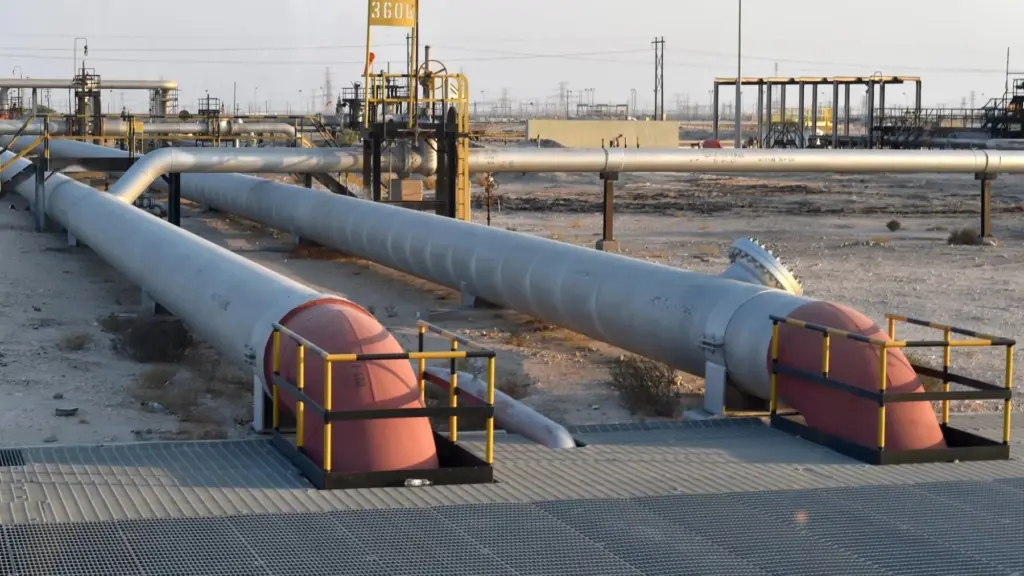
A segment of Saudi Arabia's East-West pipeline. Photo: Fayez Nureldine/AFP.
A segment of Saudi Arabia's East-West pipeline. Photo: Fayez Nureldine/AFP.
The Gulf states seek to build new ports, pipelines, and roads to allow them to export oil via new routes amid Iran’s closure of the strategic waterway
Borrowing from Persian Gulf nations in international debt markets has spiked this year, in a bid to finance the construction of costly infrastructure to bypass oil export routes through the Strait of Hormuz, Bloomberg reported on 24 July.
“With the Iran war entering its sixth month, Saudi Arabia, Kuwait, the United Arab Emirates and Qatar are looking to invest billions of dollars in infrastructure less vulnerable to Iranian attacks than the Hormuz waterway,” the financial news outlet wrote.
The Strait of Hormuz, through which around 20 percent of the world’s oil and gas exports normally pass, was closed following the start of the US-Israeli war on Iran in February, crippling oil exports from the Gulf states.
Iran has regularly attacked tankers and ships attempting to transit Hormuz without taking permission from it.
The Hormuz closure has forced the Gulf states to find alternatives, such as building new ports on the Red Sea or the Gulf of Oman, refurbishing and expanding old pipelines, and improving desert road networks.
🇸🇦🌍 The Hormuz crisis could reshape Saudi Arabia’s role in the Gulf
An EIU analysis argues that Hormuz is no longer a guaranteed commercial gateway, but an increasingly contested passage shaped by attacks, military escorts, political pressure and soaring insurance costs.
That… pic.twitter.com/Qz2HG0Jxor
— Gölge Veri (@golgeveri) July 24, 2026
To finance these alternatives, the Gulf states have borrowed a record $112 billion this year, according to data compiled by Bloomberg. The finance ministries of some of these countries are in talks with bankers and investors to borrow even more to fund the projects, according to people familiar with the matter.
The UAE’s foreign trade minister said this month new pipelines and ports would help his nation achieve “zero Hormuz dependency.”
Dubai-owned port operator DP World is developing two deepwater terminals on the coast of the emirate of Fujairah, which lies outside Hormuz. The new ports will help replace oil exports lost via DP’s flagship Jebel Ali Port, located within the strait.
Saudi Arabia is working to expand its East–West Pipeline, which takes oil from the Persian Gulf coast west toward the port of Yanbu on the Red Sea. The kingdom is also upgrading desert roads to move oil by tanker trunk, in a further effort to bypass Hormuz.
According toBloomberg, there is significant demand for bonds issued by the Gulf states despite the political risk of the ongoing war with Iran, as they all have large foreign-exchange reserves that can be used to make debt payments.
Kuwait saw strong demand for the $6 billion in bonds it sold this week, even though the country’s oil exports have been halted and despite regular Iranian attacks on US bases in the country.
Similarly, investors showed strong interest in bonds sold earlier this year by Saudi Arabia, the UAE, and Qatar.
Amid its control of Hormuz, Iran could seek to target oil infrastructure now being built by the Gulf States to bypass it.
This week, Iran’s ally Yemen began striking oil tankers and commercial vessels seeking transit through the Bab al-Mandab Strait to reach Saudi ports on the Red Sea.
“I expect more sovereign issues and spreads widening, but also anticipate Bab al-Mandab as the next choke point if things escalate,” said Ahmed Nabi, an emerging markets credit trader at Caventor Capital.
The borrowing by the Gulf States will help US and European banks profit from the ongoing war on Iran, just as US and western energy and defense firms have profited from higher oil prices and increased weapons sales.