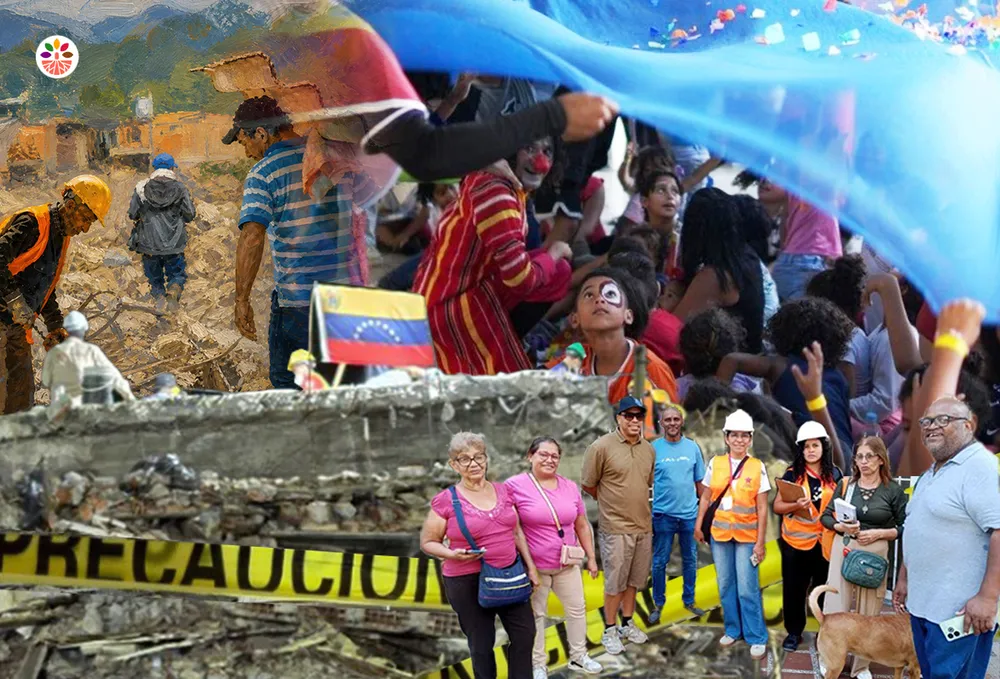
Montage of Venezuelan community amidst the earthquake disaster. Photo: Tamayba Lara/RAÍCES.
Montage of Venezuelan community amidst the earthquake disaster. Photo: Tamayba Lara/RAÍCES.
By Tamayba Lara – Jul 30, 2026
The earth moved—and so did the political and social forces
Venezuelan soil was shaken by the violence of two devastating earthquakes of magnitudes 7.2 and 7.5 and occurring just 39 seconds apart. While the Venezuelan people were commemorating the Battle of Carabobo and celebrating to the beat of drums on the feast of San Juan, the tremors dissolved the ground beneath their feet and abruptly interrupted the country’s daily life. More than half a century had passed since the last earthquake to shake the nation. These years had allowed the uncertainty generated by the aftershocks to fade from memory. Today, more than 1,500 aftershocks have been recorded, continuing to shake the soil and bodies alike and turning every tremor into a latent threat.
On June 24, the collapse of telecommunications across several areas of Caracas left thousands in the dark. The anguish of not knowing whether family members were safe coexisted from the very first moment with the need to sustain and care for others in the community. In those first hours, the cautious assumption that only “a couple of buildings” had fallen gave way as cracks began to appear in walls, asphalt, and everyday routines across the country.
Although the epicenters were located in Yaracuy state, more than 300 kilometers away, the shockwave concentrated its greatest lethality and impact on the capital, Caracas, and on La Guaira state, a strategic territory housing the country’s main port through which a significant portion of the Venezuelan economy flows. Official emergency reports recorded 5,346 deaths and 6,462 people rescued alive from the rubble.
Immediately, 31,745 volunteers registered to take on priority tasks: rescue operations in collapsed structures, technical damage assessments, and operational management of relief camps. In terms of urban infrastructure, the earthquakes caused the total collapse of 190 buildings, eight of them in Caracas, and left more than 856 properties with structural damage across the country.
Three minutes were enough to fracture daily life and lay bare the vulnerability of concrete cities. Yet, in the face of disaster, the Venezuelan social response did not retreat into the individualism of “every man for himself” nor did it degenerate into the speculative chaos driven by market dynamics. The fundamental containment of the tragedy came not only from emergency services but also from the convergence of massive popular solidarity, student and general volunteerism, institutional response, militant internationalism, and the organized action of communal self-government.
Popular abundance: solidarity as an ethic in the face of individualism
Within hours of the disaster, popular and institutional mobilization began. At 9 a.m. on the Thursday following the earthquake, the first bus of brigade members departed from the Ministry of Communes and Social Movements, led by Minister Ángel Prado, heading for the hardest-hit areas of La Guaira state. On the ground, the removal of rubble by hand, bucket by bucket, became both an affective and political necessity: the only tangible way to channel collective helplessness, process grief, and wrest lives from death amid dust and aftershocks.
The popular response made it clear that hunger is not the result of scarcity but of inequality. During the most difficult hours, people put themselves at the service of life. In the night after the earthquake, nobody in Caracas went hungry. The city witnessed overflow in family and community kitchens where volunteers prepared food without pause to sustain brigade members, rescue workers, medical personnel, and public officials. In this way, the crisis exposed the redistributive and logistical potential of organized people when they prioritize the care of life over commodity.
The personal experience and accompanying grief
The personal experience of the first days was lived in the San Bernardino parish of Caracas. From Friday, June 26, and for eight continuous days at the ruins of the Edificio Rita, brigade members and volunteers worked without rest, removing rubble in the hope of finding survivors. Of the 43 people trapped beneath the collapsed structure, six were rescued alive. This figure that reflects both the raw cruelty of the tragedy and the incalculable value of collective effort.
At the Edificio Rita, there was a convergence of the Fire Department, Civil Protection, the Caracas Police, and the Bolivarian National Armed Forces, with notable participation from student volunteers from the Central University of Venezuela (UCV), all working under the persistent risk of aftershocks. Alongside the rescue and extraction work, an emotional support and mental health care station was activated with the support of the “Siempre Juntos” program in coordination with the Caracas Mayor’s Office. This work was led by psychologist and UCV Psychology Institute researcher José Tato Guzmán, who, alongside a multidisciplinary team of professionals, graduates, and student volunteers, carried out specialized interventions.
These consisted of direct family support aimed at mitigating suffering and sustaining the heavy burden of grief for those facing the anguish of having a loved one trapped beneath the rubble. This work proved fundamental in humanizing institutional protocols during the search for victims and during their rescue and identification. Psychosocial and community accompaniment was also provided, focusing on conflict management and mediation in the spaces where family members were camped, as well as attention to residents of surrounding areas. Through support groups and collective coping strategies, the team provided emotional containment during moments of high tension, shielding families from the excessive media intrusion of outlets seeking to commodify the tragedy. Psychological first aid and individual intervention were also provided through a three-step sequential methodology:
See: Observe and critically read the context to identify the person’s needs from an attentive, respectful presence.
Listen: Offer non-interpretive, non-judgmental listening, aimed at validating emotions, facilitating emotional release—whether through tears or spontaneous narration—and applying bodily self-regulation techniques and breathing exercises.
Refer: Channel cases according to their complexity toward specialized services—civil protection, medical care, or the psychological helpline 0800-2JUNTOS—or reconnect the person with their own family unit to rebuild support networks.
This immediate primary care is crucial for processing traumatic experience and managing acute stress symptoms. As Guzmán explains, guided processing of the event prevents dissociative defense mechanisms from becoming entrenched in the body over time, significantly reducing the risk of developing post-traumatic stress disorder in the weeks following the disaster.
Guzmán further explains that beyond the immediate response, subjective, and social recovery from loss requires the collective construction of a narrative about what occurred. Assimilating grief means understanding that mourning, though expressed at the individual level, constitutes a shared trauma encompassing society as a whole. This process requires reconfiguring our identities on the basis of the reality that remains: the memory of the disaster, the pain for those no longer with us, and the inspiration born of solidarity and mutual care profoundly transform who we are and who we want to become. Understanding distress as an organic adaptive response opens the door to community hope, knowing that wounds will, progressively, become new forms of organization and sustainable life.
The institutional response capacity and the magnitude of the tragedy were, and continue to be, experienced differently in La Guaira state, where rescue and recovery operations persist to this day.
The communal response: nodes of sovereignty and popular logistics
Venezuelan society did not react from the position of a passive victim waiting for assistance. On the contrary, various territories activated a network built over decades: communal organization as a living structure of self-government. Communities assumed territorial control, mapped immediate vulnerabilities and transformed grief into logistical and operational response capacity. The question resonating most powerfully in the minds and hearts of the general population, and of commune members in particular, was how can I help?
Various urban and rural communes,such as the Comuna 5 de Marzo “Comandante Eterno” provided support as part of the emergency response. Spokeswoman Anaís Márquez recounts how for 17 straight days her commune sustained the collection and distribution of supplies to critical areas of Caracas (San Bernardino, Pinto Salinas, Macarao, Antímano, El Valle, Santa Rosalía, and El Junquito) and of La Guaira state (the Hugo Chávez Commune, Tanaguarena, and Caraballeda). On the night of the earthquakes, the Somos Karive Communal Enterprise sheltered more than 200 people who feared returning to their homes to sleep. Communes from other states, including Lanceros de Atures, El Maizal, 5 Fortalezas de la Revolución Bolivariana, and Felipe Antonio Acosta, among others, activated a national collection process to send aid to the capital region.
In La Guaira, the communal and internationalist contingent contributed to the formation of a transitional camp at the Universidad Marítima del Caribe (UMC) to shelter more than 3,000 families, organizing security, health, and food commissions. The communal deployment included house-by-house censuses in affected areas, medical care sent from Apure state, and the delivery of food and supplies. Eudy Colmenares recounts how, during 10 days of militant work alongside commune members from El Maizal and the Argentinian Diego Armando Maradona Brigade, they took on logistical and operational support tasks in rescue and victim recovery operations.
Colmenares, a militant of the El Maizal Commune, shares a humble gesture of communal solidarity: offering his commune’s land to provide a housing solution and productive integration for survivors of the La Guaira earthquake. The El Maizal commune members returned to Lara state with seven displaced people, including a newborn. The commune has since launched a self-build housing plan and labor insertion program, incorporating survivors into the Communal Property Enterprises and the Maestra Isabel González Communal School. This gesture illustrates one of the alternatives through which self-government can confront crisis.
Another valuable experience is that shared by Gabriela Márquez, civil engineer and professor at the Central University of Venezuela, who joined the Presidential Commission for the Assessment of Housing and Infrastructure Habitability as a volunteer. She explains that the primary emergency response required addressing the massive goal of more than 20,000 homes through standardized rapid assessment methodologies. She also notes that the technical crews led by engineering professionals and made up of volunteers do not act in isolation but through prior coordination with communal councils and communes, which guide their approaches.
The specialist highlights that the house-by-house deployment, carried out alongside communal spokespersons, combined technical diagnosis with social support, encompassing everything from external physical assessment to detailed inspection of the critical floor to determine the presence of severe and moderate structural damage.
In this way, technical risk categorization was translated into a two-phase planning protocol. Márquez explains that the findings were systematized using a traffic-light habitability code: green for low risk with no restriction; yellow for medium risk with limited access; and red for high risk. The latter requires evacuation of the structures in order to protect the lives of their inhabitants. The initial rapid assessment then gives way to a second phase of detailed inspections by structural pathology and/or structural design specialists, allowing buildings marked yellow or red to be reassessed and appropriate interventions determined, whether repairs, structural reinforcement, or demolition.
One month after the earthquake: the daily work of care and the geopolitical response
One month after the earthquake, as the city’s usual rhythm gradually returns to its apparent normality—amid political tensions and the pressing demands of a population of more than 17,200 displaced—commune members continue their accompaniment of transitional relief camps in coordination with institutions.
This process is sustained by the mobilization of activists from various regions of the country. Rosarys Salazar, spokeseprson of the 5 Fortalezas de la Revolución Bolivariana Commune in Sucre state, describes how she has been called to join the brigades that in the coming days will travel to Caracas and La Guaira to put their organizational experience at the service of the camps’ operations.
Care work has been strengthened through popular internationalism. The sustained on-the-ground participation of the Diego Armando Maradona Brigade from Argentina and the Apolônio de Carvalho Internationalist Brigade of the Landless Rural Workers’ Movement (Brazil/MST) has made it possible to share operational, constructive, and educational tasks side by side with affected communities.
Conclusion: toward where to rebuild in a landscape of dispute?
Reconstruction after the earthquake is traversed by deep national grief, class contradictions, and economic pressures. As initial technical assessments conclude, the imminent risk of real estate speculation and gentrification emerges in the areas where buildings collapsed. The logic of capital seeks to reappropriate urban land, displacing working-class families under the pretext of vulnerability in order to make way for lucrative developments.
This dispute takes on first-order geopolitical significance in La Guaira state—a strategic territory housing the country’s main port and serving as a connecting axis of the national economy. In response to the question of toward where to rebuild, the popular movement’s answer is categorical: toward the commune. Reconstruction cannot be reduced to a purely technical intervention. It is, above all, a process of reorganizing life and a dispute over the nation’s historical horizon.
Experiences such as the relocation and productive integration of displaced families at the El Maizal Commune in Lara state demonstrate that popular self-government possesses both the will and the maturity to plan housing, education, and work in a sovereign manner. In the same direction, the reconstruction of La Guaira state demands recognition of its condition as an ancestral territory inhabited by a people with deep economic, cultural, and social practices who deserve to rebuild their lives sustainably. To rebuild toward the commune means letting the drums sound again, raising buildings that understand the earth as a living being,and that the movement of living things cannot be stopped.
In scenarios of profound pain, complexity, and uncertainty, hope asserts itself as a discipline because it is a practical tool for doing, for rebuilding the community fabric, and for contesting the communal future.
(RAÍCES)
Translation: Orinoco Tribune
OT/CB/SL
Cameron Baillie is an award-winning journalist, editor, and researcher. He won and was shortlisted for awards across Britain and Ireland. He is Editor-in-Chief of New Sociological Perspectives graduate journal and Commissioning Editor at The Student Intifada newsletter. He spent the first half of 2025 living, working, and writing in Ecuador. He does news translation and proofreading work with The Orinoco Tribune.