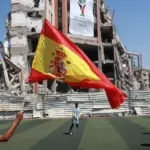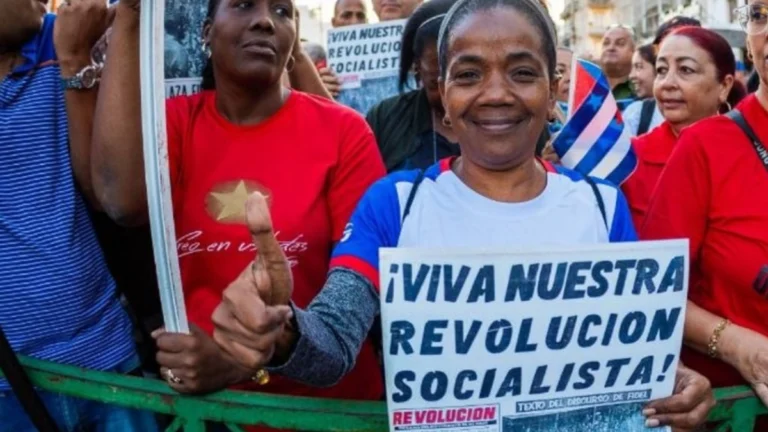
The sign reads, “Long live our Socialist Revolution!. Photo: teleSUR.
The sign reads, “Long live our Socialist Revolution!. Photo: teleSUR.
The U.S. blockade is the main cause of the suffering of the Cuban nation.
On Thursday, Cubans commemorated the 65th anniversary of the proclamation of the socialist character of the Revolution with mass events in several cities across the country.
In Havana, President Miguel Diaz-Canel rejected the hostility of the U.S. government, which has maintained an economic, commercial and financial blockade for more than six decades.
He also rejected growing threats of military aggression that are accompanied by a cynical narrative according to which Cuba is a “Failed State.” Such arguments, he said, have been used by Washington to destabilize and attack other revolutionary processes.
Diaz-Canel affirmed that Cubans will face any external threat and will fight to defend their sovereignty and independence.
“The socialist character of our revolution is not a phrase from the past; it is the shield of the present and the guarantee of the future. Cuba does not surrender. No one surrenders here. As the song goes, here, we will bring fire,” he said.
The Cuban president evoked the epic and unforgettable days of the Playa Giron battle and recalled the words of Commander Fidel Castro:
“Worker and peasant comrades, this is the socialist and democratic revolution of the humble, with the humble, and for the humble. And for this revolution of the humble, for the humble and for the humble, we are prepared to give our lives,” he said.
#Usa continues to attack Cuban medical brigades: teleSUR correspondent in #Cuba Belen de los Santos tells you why.#teleSUREnglish pic.twitter.com/ZNw8NZql3N
— teleSUR English (@telesurenglish) April 14, 2026
During the event in Havana, Diaz-Canel recalled another phrase spoken by Fidel just hours after the attempted U.S. invasion in 1961.
“What the imperialists cannot forgive us for is that we are here. What the imperialists cannot forgive us for is the dignity, the integrity, the courage, the ideological firmness, the spirit of sacrifice and the revolutionary spirit of the Cuban people,” the guerrilla leader said.
“That is what they cannot forgive us for. They cannot forgive us for being right under their noses — and for having made a socialist revolution right under the noses of the United States!” Fidel stressed.
Drawing a parallel between the threats of that time and those Washington generates now, Diaz-Canel highlighted the firmness and heroism of Cubans in defending their revolution.
“Cubans marched from here to combat and from combat to victory,” he said, emphasizing that the Playa Giron battle, “the first great defeat of imperialism in the Americas”, occurred after just 72 hours of fighting.
“The mercenaries were about to throw themselves against the nation that saw them born, convinced that nothing could stand against the protection the empire guaranteed them. But history would be merciless with them,” Diaz-Canel said, referring to Miami-based Cubans who supported the 1961 U.S. invasion.
“They expected fear and found courage. They bet on treason and were faced by a united people. They believed their lies, and the truth awaited them with rifles at the ready and singing the notes of the Bayamo anthem,” he added.
Fidel Castro on the beach at Playa Giron (Bay of Pigs), the site of the unsuccessful invasion by US-backed forces. Cuba, 1961. pic.twitter.com/cATxbL0XH8
— Historyland (@HistorylandHQ) July 17, 2025
During the mobilization in Havana, Cubans repudiated Washington’s economic war against Cuba, which has caused damages estimated at US$171 billion over six decades.
“As long as the U.S. blockade tightens the economy, no one can deny its absolute blame for the pain of Cuban families. The main cause of our problems is the genocidal blockade of the United States government against our people,” Diaz-Canel stressed.
“They have built a lying and very cynical narrative, presenting Cuba as a failed state, to hide the genocidal and multidimensional nature of the six-decade blockade, which suffocates all the people and can only be called an embargo on the papers of those who impose it.”
Using that malicious discourse, U.S. President Donald Trump and Secretary of State Marco Rubio seek to justify a military intervention and present it as a “humanitarian operation.”
“Cuba is not a failed state. Cuba is a besieged state. Cuba is a state facing multidimensional aggression, an economic war, an intensified blockade, an energy blockade,” Diaz-Canel replied.
“Cuba is a threatened state that does not surrender. And despite everything, and thanks to socialism, Cuba is a state that resists, creates and will overcome. Do not doubt it!”
The Cuban president noted that the danger of an invasion exists even though his administration has shown a willingness to dialogue with the United States to resolve differences in the bilateral relationship.
He urged Cubans to be ready to take up arms and fight if U.S. military aggression were to occur.
“We do not want it, but it is our duty to prepare to avoid it and, if it is inevitable, to win it,” Diaz-Canel said, adding that “Fidel is that conviction that a united people can defeat an empire.”
The Cuban president affirmed that his country believes in dialogue and in the extraordinary power of peace.
For that reason, he invited the U.S. citizens to think “about everything that would affect the human lives of our two peoples if they were dragged into a senseless, illogical contest for which there are no pretexts or justifications, when there is so much we can do together.”
He also called for an international solidarity movement to carry Cuba’s truth and the suffering of its people as a result of the U.S. economic war, which has been aggravated by an oil blockade since January, to every corner of the planet.
El 15 de abril del año 1961
Bombardeo a los aeropuertos de San Antonio de los Baños y Ciudad Libertad, en La Habana y; el de Santiago de Cuba, como preludio de la invasión por Playa Girón. pic.twitter.com/z3u4yOOf6t— Elia Oro (@oro_elia5297) April 15, 2026
The text reads, “On April 15, 1961, as a prelude to the Bay of Pigs invasion, the U.S. bombed the airports of San Antonio de los Baños and Ciudad Libertad in Havana, and the airport of Santiago de Cuba.” The image shows Fidel Castro atop a tank.
The proclamation of the socialist character of the Revolution took place on April 16, 1961, during the funeral honors for victims of bombings perpetrated the previous day by the United States against various points of the national territory, resulting in deaths and injuries. Those attacks were the prelude to the invasion of a mercenary brigade at the Bay of Pigs, which was armed and trained by the Central Intelligence Agency.
Before thousands of people who gathered near Colon Cemetery in Havana, Commander Fidel Castro Ruz called on workers, peasants and students to advance the “socialist and democratic revolution of the humble, with the humble and for the humble.”
In response, thousands of militiamen raised their rifles in the air and expressed their determination to defend the homeland. That date went down in national history as Day of the Militiaman. This occurred before the attempted U.S. invasion that began in the early morning of April 17 at the Bay of Pigs, south of Matanzas province.
On April 16, 1961, the July 26 Movement, the Revolutionary Directorate and the Popular Socialist Party — the three political-military organizations that fought the U.S.-backed dictatorship of Fulgencio Batista — took a first step toward their union.
On Oct. 3, 1965, those historic organizations formally constituted the Communist Party of Cuba and elected members of the Central Committee, among whom was Fidel Castro.
(teleSUR)