
By Marco Teruggi – Mar 14, 2021
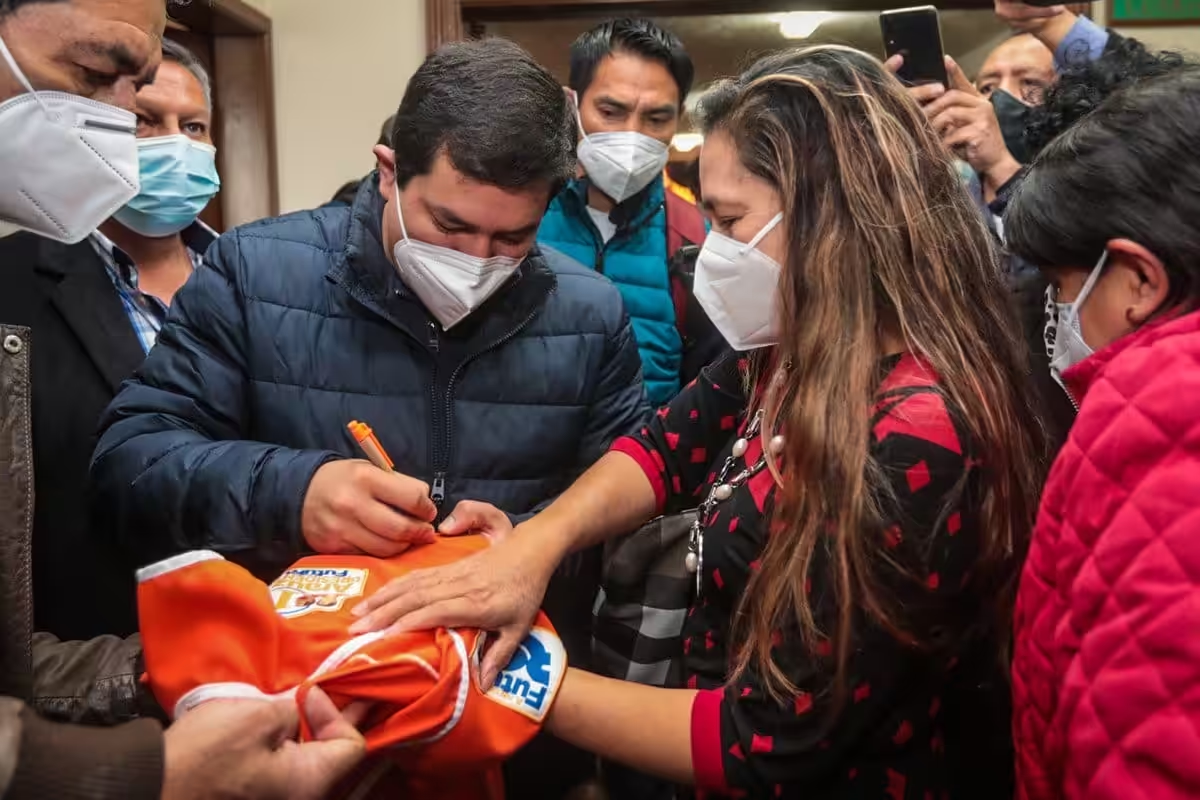
The second round of the presidential elections in Ecuador will take place on April 11. Andrés Arauz, who came in first at the polls on February 7, and Guillermo Lasso, are touring the country with different social, economic and political actors. The campaign will officially begin next Tuesday, but just before this decisive election is to take place there are still threats.
One of them was the call for the intervention of the Armed Forces in the electoral process made by Yaku Pérez, who came in third in the race, and maintains that there has been a fraud. The candidate for the Pachakutik party publicly called for a constitutional pronouncement to replace all members of the National Electoral Council (CNE), to declare the first round of elections null and void, and for the intervention of the Comptroller’s Office and the Attorney General’s Office in the electoral authorities’ computer systems.
Pérez also requested that the Attorney General’s Office issue a ruling on the complaint filed by the Colombian Attorney General’s Office about alleged campaign financing by the National Liberation Army (ELN) of Colombia for Arauz’s campaign, so that the winner of the first round be criminalized in the framework of an international operation denounced as false by numerous international voices, particularly from Colombia. The Colombian government, in the hands of Álvaro Uribe’s party—who campaigned for Donald Trump in the last US elections—has numerous interests in torpedoing a possible victory for Arauz.
The Pachakutik candidate’s words were denounced as a call for a coup d’état by numerous political actors inside and outside the country. Pérez, later sought to deny this, and affirmed: “I am not asking for military intervention to affect democracy in Ecuador, my request is for the public forces to guarantee that the ballot boxes remain intact, until they open [the boxes] and demonstrate transparency.”
His call to the Armed Forces shed light on the movement of underground plots that seek to alter the election on April 11 in different ways. Along with this alarm, there was a statement by the president of the CNE, Diana Atamaint, who said on Friday that she was “seriously concerned about the fulfillment of the electoral calendar.” The situation, she explained, is due to the fact that they are “waiting for what the Electoral Disputes Tribunal (TCE) will do in these days, which are crucial for the country.”
Atamaint affirmed that it was “in the hands of the TCE,” a situation that is due to the fact that last Monday the Tribunal accepted the appeal presented by Pérez requesting the recount of more than 20,000 polling station tallies, so it will have to decide whether or not the recount should be carried out. The EDT’s decision was preceded by the dissemination of photographs of a late-night meeting in a private building between Pérez and one of the Tribunal’s members, Ángel Torres.
The TCE had already carried out a recount of 31 of the total number of votes requested by the Pachakutik candidate, which had not changed the result of the first round. However, the EDT’s acceptance, with 15 days to rule once the request had been accepted, left the electoral contest with an element of suspense.
Meanwhile, Arauz and Lasso continue their activities around the country and through social networks, and the other political forces have taken a stance on the ballot. Xavier Hervas, of the Izquierda Democrática party, fourth in the elections, stated that he would not form an alliance with either candidate, modifying his initial position, which was to call for a front with Pérez and Lasso against Arauz.
On the other hand, the Confederation of Indigenous Nationalities of Ecuador (CONAI), whose political instrument is the Pachakutik party, resolved to promote the “ideological null vote” for the second round, and to demand that the TCE “give way to the recounting of votes.” The decision was taken at the movement’s Enlarged Council, which was marked by numerous debates, such as the relationship between CONAIE and Pachakutik, as well as internal tensions between sectors seeking alliances with the right, such as Pérez himself, and those who defend a left-wing position, such as the leader Leonidas Iza.
With the decisions announced by Hervas and CONAIE-Pachakutik, the possibility of forming an electoral alliance against Arauz is excluded, at least publicly. This had been raised by different actors, including Lasso himself in his initial rapprochement with Pérez, appealing to the correismo/anti-correismo divide, constructed as a device by the right to divide national politics, and used as a reason by sectors of the indigenous movement to defend rapprochements with those who, even if they are right-wing, oppose a candidacy of the Citizen Revolution.
The second round will be a contest between Arauz and Lasso, each representing different political, economic, social and geopolitical models. The former, with a progressive and Latin American proposal, backed by presidents such as Alberto Fernández and leaders such as Pepe Mujica, the latter, with a neoliberal project aligned with US foreign policy, a position that is clear from his background in private banking and politics, although his current campaign is trying to present him in a different light.
The uncertainty over possible decisions by the country’s institutions, particularly the Attorney General’s Office and the TCE, in the context of four years marked by political persecution against the leadership of the Citizen’s Revolution, casts a level of concern over the race that has been constant since the very registration of Arauz’s candidacy.
Featured image: Arauz campaigning for the second round.
(Resumen Latinoamericano-English)