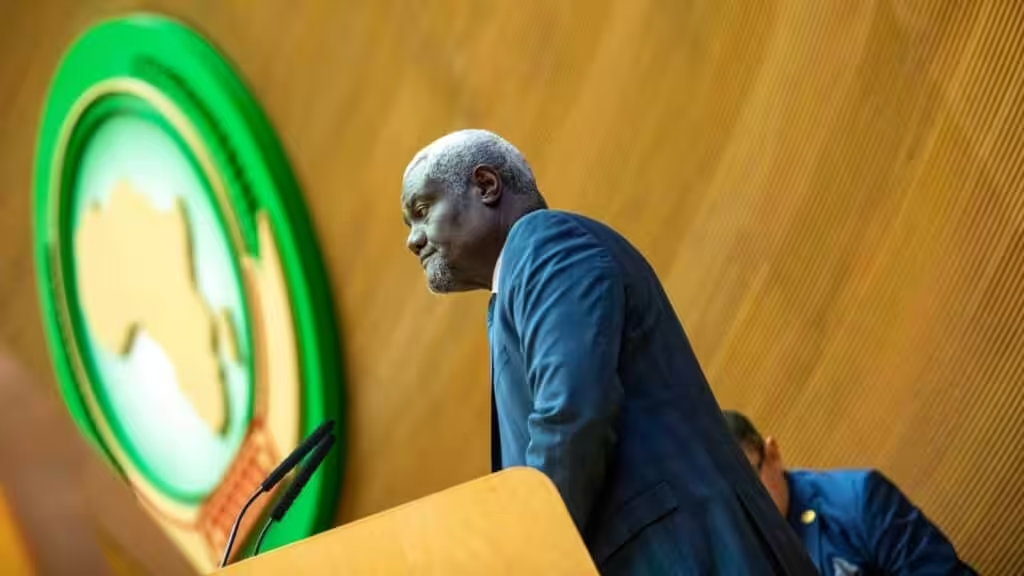
Address by the outgoing Chairperson of the African Union Commission, Moussa Faki Mahamat. Photo: @_AfricanUnion/X.
Address by the outgoing Chairperson of the African Union Commission, Moussa Faki Mahamat. Photo: @_AfricanUnion/X.
By Nicholas Mwangi – Feb 20, 2025
Kenya’s bid for the African Union Chairperson position ends in disappointment as Raila Odinga’s campaign fails despite strong backing.
The African Union (AU) elections concluded last Saturday with the election of H.E. Mahmoud Ali Youssouf from Djibouti as the new Chairperson of the African Union Commission (AUC).
Youssouf, a seasoned diplomat, emerged victorious after a highly competitive and politically charged election process. He will be deputized by H.E. Selma Malika Haddadi from Algeria, who represents the Northern Region. The 60-year-old Youssouf takes over from the outgoing Chairperson, H.E. Moussa Faki Mahamat of Chad (Central Region), who has served two consecutive terms since 2017.
Youssouf has previously chaired the Council of Ministers of the Arab League and the Organization of Islamic Cooperation (OIC).
His victory came after a closely watched contest in which he secured the required two-thirds majority in the seventh round of voting, with 49 countries participating in the election.
Raila Odinga’s surprising loss
Kenya’s candidate, former Prime Minister Raila Odinga, was widely considered the frontrunner, with strong backing from the East African Community (EAC) in a campaign spearheaded by President William Ruto in Nairobi last year. The Kenyan government heavily endorsed Odinga’s bid, with MPs and state officials gathering in Addis Ababa ahead of the election in anticipation of his victory.
However, despite being the favorite, Odinga was eliminated after six rounds of voting. His exit allowed Youssouf to consolidate support and secure the two-thirds majority needed for victory.
This outcome dealt a big blow to Kenya’s long-standing aspiration to hold the top AU leadership position.
This is not the first time Kenya has faced disappointment in AU elections; in 2017, Kenya’s candidate Amina Mohamed lost despite a well-publicized and resource-backed campaign. Analysts point to Kenya’s complex relationships with its neighbors and the strategic unity of the Francophone and Muslim bloc as key factors that have historically hindered the country’s AU ambitions.
Regional politics and SADC’s intervention
The Southern African Development Community (SADC), comprising 16 member states, played a crucial role in the elections by urging its members to back Madagascar’s candidate, H.E. Richard Randriamandrato, in the final stages of voting. This move split the vote, impacting Raila Odinga’s chances. Additionally, the alliance between Djibouti and key Francophone countries, coupled with diplomatic maneuvering, helped Youssouf secure crucial votes in the final rounds.
Kenya’s loss sparks criticism
Kenya’s loss has reignited debates about its foreign policy strategies and effectiveness in securing continental leadership roles. Kenya has historically positioned itself as a regional diplomatic powerhouse, but inconsistencies in its foreign policy and shifting geopolitical dynamics have contributed to setbacks.
A key criticism of Kenya’s AU leadership bid was the overconfidence displayed before the election. Some analysts argue that Kenya’s diplomatic push was perceived as arrogant, alienating potential allies within the AU. While high-profile endorsements and aggressive lobbying have worked in some cases, this approach failed to secure the necessary support this time.
Geopolitical challenges facing Kenya
Kenya’s geopolitical positioning, particularly its stance on key international conflicts, may have contributed to its loss. The country’s balancing of alliances has drawn criticism for failing to align with the prevailing mood across the continent.
Palestine
One contentious issue has been Kenya’s position on the Israeli war on Gaza. While the country has largely aligned itself with Western nations, South Africa has taken a firm pro-Palestinian stance, even taking Israel to the International Court of Justice (ICJ) for war crimes committed in Gaza. Kenya’s perceived ambivalence or tacit alignment with Israel could have strained its relations with South Africa and other African nations supporting Palestinian statehood, potentially costing Kenya crucial support in the AU elections.
Russia
Similarly, Kenya’s stance on the Russia-Ukraine conflict has shaped its diplomatic standing. In 2022, Kenya condemned Russia’s actions at the United Nations, a move applauded by Western allies but which created tensions with AU members maintaining close ties with Russia, such as South Africa and Ethiopia. Many African countries remember the Soviet Union’s historical support for their anti-colonial struggles, influencing their diplomatic decisions. Kenya’s swift alignment with the West may have carried diplomatic consequences in this context.
Democratic Republic of Congo (DRC)
Another issue is Kenya’s relationship with Rwanda, particularly regarding the M23 conflict in the Democratic Republic of Congo (DRC). Rwanda’s support for the M23 rebel group has fueled instability in eastern DRC. Kenya’s perceived alignment with Rwanda has strained relations with the DRC. President Ruto’s decision to engage French President Emmanuel Macron on the matter further angered the DRC and regional players, including South Africa.
Haiti
Beyond the DRC, Kenya is involved in multiple diplomatic and military engagements across various conflict zones, including Haiti. These involvements, whether through peacekeeping missions or strategic alliances, have raised concerns that Kenya is advancing Western interests beyond its immediate region.
Sudan
Adding to these complexities, recently a controversial meeting involving sanctioned members of Sudan’s Rapid Support Forces (RSF) was hosted at the Kenyatta International Convention Centre (KICC) in Nairobi. The gathering, intended to establish a parallel civilian government in Sudan, was later postponed but attracted regional and international scrutiny.
By supporting US and UAE interests in Sudan, Kenya risks further destabilizing the region at a time when the majority of Sudanese are rallying behind the national military to end the war, defeat the RSF, and return to civilian rule.
Kenya on the wrong side of history
On multiple fronts, Sudan, the DRC, Israel, Haiti, Kenya’s government appears to be on the wrong side of history.
Meanwhile, across Africa, from the Sahel to Senegal, Ghana, Sudan, the DRC, and even Kenya’s own youth, a new wave of resistance is demanding sovereignty, independence and development.
Against this backdrop, Odinga’s loss in the AU elections is not surprising.
At home, reactions were mixed. Some Kenyans felt betrayed when Odinga, who was expected to be a key opposition figure against the ruling government, joined the government at the height of last year’s youth protests. This raised skepticism about his intentions and especially concerning his leadership aspirations with the AU. Ultimately, Kenya’s failure to secure the AUC position reveals the broader challenges the country faces in navigating the shifting geopolitical and regional realities of a changing continent.