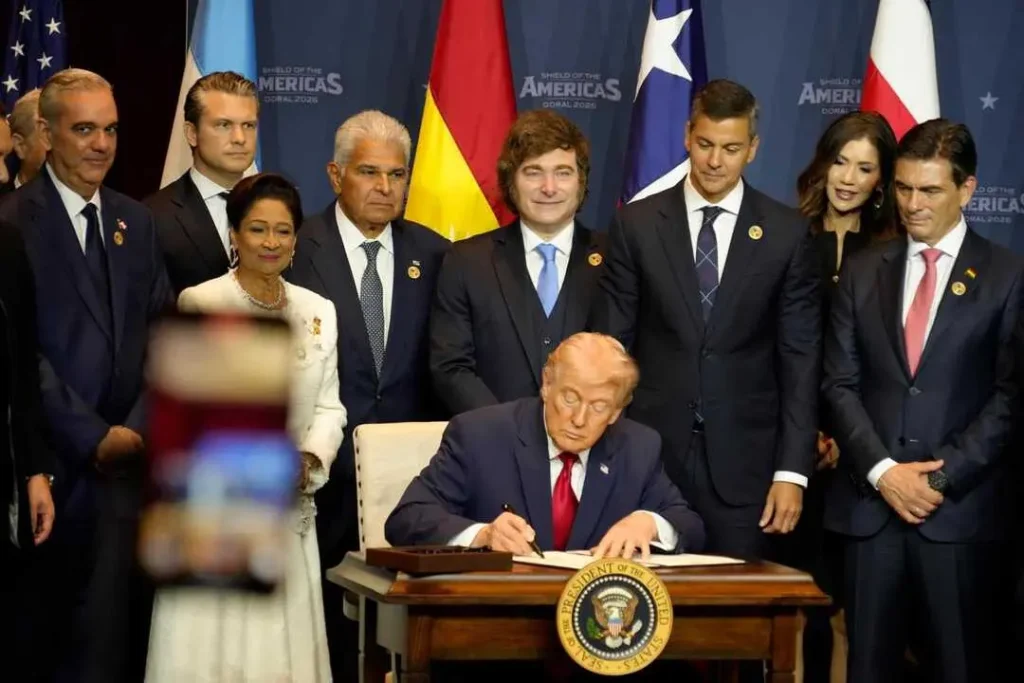
Argentinian President Javier Milei standing behind US President Donald Trump who signs the declaration of the Shield of the Americas summit in Miami. Photo: X/@JMilei.
Argentinian President Javier Milei standing behind US President Donald Trump who signs the declaration of the Shield of the Americas summit in Miami. Photo: X/@JMilei.
In a lecture at Yeshiva University in New York, the president of Argentina, Javier Milei, declared himself proud of being “the most Zionist president in the world.”
In his speech, the Argentinian president spoke about the attack on the Israeli embassy in Argentina in 1992, which killed 22 people and injured 242, and the bombing of the Argentinian-Israelite Mutual Association (AMIA) that occurred in 1994 in Buenos Aires, resulting in 85 deaths and 300 injuries. “Iran planted two bombs on us, one at the AMIA and another at the Israeli embassy. Therefore, we say, they are our enemies. But I also have a strategic alliance with the United States and Israel,” he said.
Argentina is the only country in Latin America that has openly supported the US-Zionist war against Iran. While the rest of the countries in the region took a stance against the war or adopted a position of caution, the Argentinian Foreign Ministry declared in a statement that it “values and supports the joint actions of the United States and Israel aimed at neutralizing the threat that Iran represents to international stability.”
Milei was in the United States earlier this month, where he attended the Shield of the Americas summit held by US President Donald Trump with his Latin American allies in Miami. In his speech in New York, Milei went even further and declared, “We are going to win” in reference to the war on Iran. At the event, Milei was accompanied by his sister, Karina Milei, his chief of staff, Manuel Adorni, and the minister of Foreign Affairs, Pablo Quirno.
In an interview with Radio Now, Milei claimed that the rise in international oil prices caused by the war could have positive effects on the Argentinian economy. “There will be an improvement in the terms of trade,” he said, as Argentina is a net exporter in the energy sector.
Bolsonaro requests Supreme Court authorization to receive visit from a Trump advisor
The former president of Brazil, Jair Bolsonaro, requested authorization from the Federal Supreme Court to receive a prison visit from Darren Beattie, a senior advisor to US President Donald Trump on policies related to Brazil.
According to Brazilian media reports, Bolsonaro's defense also requested the presence of a translator during Beattie's official visit to Brazil this month.
Bolsonaro is serving a prison sentence of 27 years and three months for a coup attempt against the current president, Lula da Silva. Since Supreme Court Justice Alexandre de Moraes was the rapporteur of the case that led to Bolsonaro's sentence, it is he who will decide whether the request would be approved.
How the US war on Iran affect fuel prices in Latin America
The war initiated by the United States and Israel against Iran on February 28 is having a direct impact on oil prices. For Latin America, the impact of this increase in oil prices, especially in how it affects fuel prices, is not uniform, as the region has two realities, having net importing countries and producer-exporters, according to an analysis by RT.
Chile, which is a net importer of oil, is experiencing an increase in fuel prices. Since March 5, gasoline prices have increased by about 20 pesos ($0.022) per liter on average and further increases could occur if crude oil prices remain high, reports the media outlet Ex-Ante. For now, the Fuel Price Stabilization Mechanism (MEPCO) has prevented drastic increases all at once.
The countries of Central America are also net oil importers. In Honduras, the Honduran Association of Petroleum Product Distributors (AHDIPPE) warned of further increases in fuel prices due to the war in the Middle East. It also warned of possible increases in prices of electricity and basic basket products in the coming weeks.
In Guatemala, during March 1-7, regular gasoline rose from $28.57 quetzals ($3.72 dollars) per gallon to 31.59 ($4.11), an increase of 10.6%, while diesel rose by 11%, reports Prensa Libre.
In Panama, the authorities announced an increase in fuel prices, slightly higher than the one made in February. “In the price calculation for this period, the impact of the recent conflict in the Middle East is still limited,” they noted.
The case of Mexico is different. Despite being a major oil producer, it imports most of the gasoline it consumes. However, President Claudia Sheinbaum has already declared that the cost of fuel will not increase in the country.
“If the price of gasoline, the production of gasoline, or the importation increases, there is a mechanism through the reduction of the IEPS (Special Tax on Production and Services) so that gasoline price does not increase in our country,” said President Sheinbaum at her daily press conference, referring to the tax applied to fuels, which authorities have used in recent years as a stabilization mechanism, reducing or subsidizing it when international prices soar. The mechanism was established by former President Andrés Manuel López Obrador.
In an analysis titled “Latin America: Limited Spillovers from the Middle East Conflict for Now,” published by The Economist, experts from Oxford Economics say that Colombia, like Mexico, is likely to fully subsidize the impact of the increase in fuel prices.
As for Brazil, despite being a net exporter, its pricing policy is more linked to international prices. However, the impact of the war on the prices that Brazilian consumers pay for petroleum-derived fuels, such as gasoline and diesel, may take time to become notable, according to the president of the Brazilian Institute of Oil, Gas, and Biofuels (IBP), Roberto Ardenghy, as cited by Agência Brasil.
“It is a long process, which can take up to six months. There will be no changes in the price level in the short term, not even for the Brazilian consumer,” said Ardenghy.
In Argentina, the president of the state-owned oil corporation YPF, Horacio Marín, posted a message on X to try to reassure the population, “I understand the uncertainty caused by the volatility of international oil prices; therefore, I believe that it is important to reaffirm our position. YPF will not create shocks in fuel prices, we are prudent and we are honoring our honest commitment to consumers.”
Translation: Orinoco Tribune
OT/SC/DZ