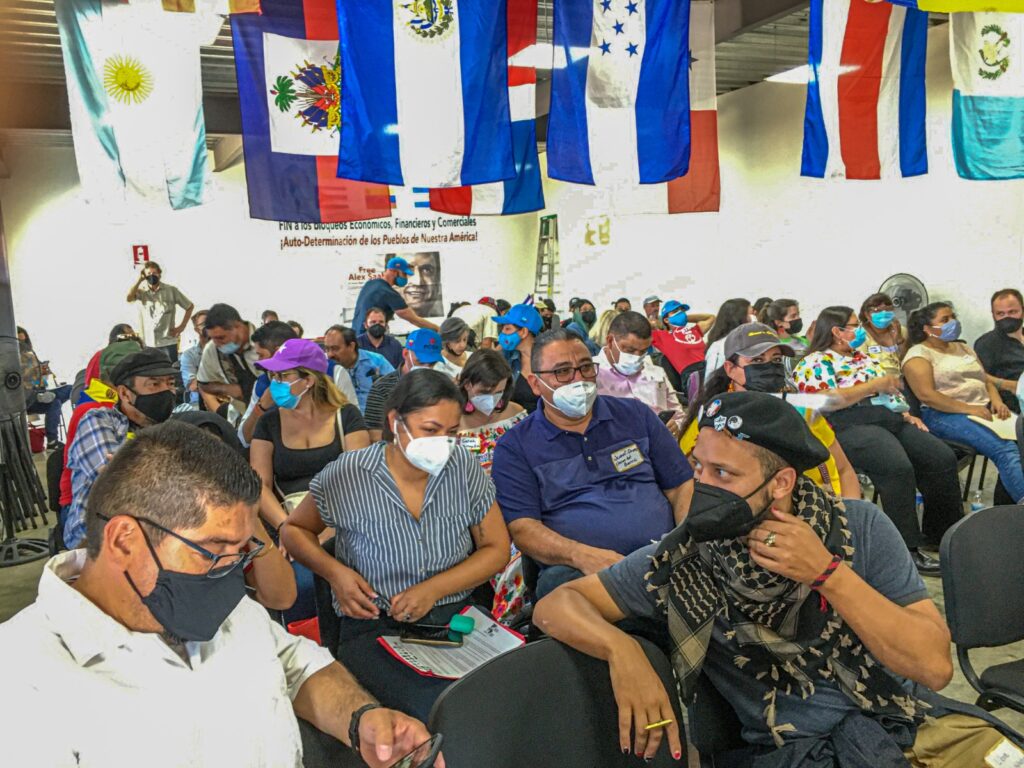
Partial view of the attendance to one of the Worker’s Summit panels. Photo: Roger D. Harris.
Partial view of the attendance to one of the Worker’s Summit panels. Photo: Roger D. Harris.
By Roger D. Harris – Jun 15, 2022
Valentín, the man next to us in line as we made our way across the international border, asked what we had been doing in Tijuana. We had been at the Workers Summit of the Americas, organized as an alternative to Biden’s Summit of the Americas in Los Angeles. Our summit was as a place where countries besieged by and barred from the US could participate and was held in cooperation with a kindred counter-summit in Los Angeles.
Valentín, who had been born in Mexico and spent most of his working life in the United States, had seen the border from both perspectives. He commented about Biden’s summit that although the US is rich in resources, industry, and agriculture, “it wants it all,” which pretty much sums up what imperialism is about.
Historical debt to Mexico
That border had not always been at Tijuana. As the immigrant rights movement reminds us, “we did not cross the border, the border crossed us.”
Texas seceded from Mexico and was annexed to the US in 1845. The following year, the Mexican-American War was provoked by the US in a campaign of conquest. Two years later, Mexico was forced to sign the Treaty of Guadalupe Hidalgo ceding nearly half its national territory. The US gained what would become parts or all of California, Arizona, Nevada, Utah, New Mexico, Wyoming, and Colorado. The Gadsden Purchase of 1853 added southern Arizona and New Mexico to the spoils of war.
In all, 55% of Mexico, over half of her sovereign territory, was taken by the Colossus of the North. Consequently, the US owes Mexico an historical debt for the theft of its sovereign territory. This debt should be included with other major US historical debts such as those incurred by the exploitation of African slave labor and the genocide of its original peoples.
RELATED CONTENT: Regional Leaders Snub Summit of the Americas as Activists Hold People’s Summit
Mexican Revolution
Besides acknowledging the theft of Mexican lands, those of us on the left should also recognize Mexico’s considerable political contributions. The Mexican Revolution stands in the pantheon of great 20th century revolutions. Before the Russian, Chinese, Cuban, Vietnamese, and other revolutions, before the many Third World liberation struggles of the last century, came the Mexican Revolution, which began in 1910.
As the first of the major 20th century revolutions, the Mexican Revolution guaranteed labor rights, nationalized subsoil rights, secularized the state and curbed the power of the Roman Catholic Church, and granted inalienable land rights to indigenous communities. Women’s rights were advanced, and women fought as soldiers and even commanders in General Emilio Zapata’s revolutionary army.
There was no established path for the Mexicans when they made their revolution. That path was made by walking; they led the way.
Cracks in the imperial façade
For the first time since its 1994 launch in Miami, the US was hosting the Summit of the Americas, convened by the Washington-based Organization of American States (OAS). However, as AP News described, Biden’s maneuverings in the leadup to his summit was a “scramble” to “avoid a flop.”
That was in part because, today, Mexico again led the way challenging imperial hubris. Its president, Andrés Manuel López Obrador (AMLO), stood up to Biden’s imperial summons to come to the summit. AMLO would only dignify the event with his presence if all the countries of Our Americas were invited. Even after the US dispatched a team to Mexico City to cajole him to attend – but still refusing to invite the heads of Cuba, Nicaragua, and Venezuela – AMLO stood by his original principled stand.
Joe Biden surely found it lonely with the presidents of Bolivia, Honduras, Guatemala, and St. Vincent and the Grenadines similarly boycotting his summit. The presidents of El Salvador and Uruguay also purposely missed the party, albeit for different reasons.
Biden’s summit took place, but the buzz both inside the meeting and outside was the hypocrisy of the US attempt to try to appear to be promoting a “Summit for Democracy” while its actions have proven the opposite. The US-imposed illegal sanctions and blockades – unilateral coercive measures – on countries whose people fail to elect leaders sufficiently obedient to Washington are, in fact, a denial of democracy.
And speaking of unelected leaders, the Trump-anointed and Biden-supported so-called “interim president of Venezuela,” Juan Guaidó, wasn’t on the guest list for the Los Angeles summit either. Even though the US and a handful of sycophantic allies still embarrassingly recognize the puppet as the Venezuelan head of state, he was closeted.
Inside Biden’s summit, Argentinian President Alberto Fernández delivered what the press called a “damning speech” condemning the US president to his face for excluding other states. Belize, Chile, and a number of Caribbean countries also criticized the exclusions, calling for a realignment of regional institutions.
Outside Biden’s summit, the official Cuban government statement commented: “Arrogance, fear of inconvenient truths being voiced, determination to prevent the meeting from discussing the most pressing and complex issues in the hemisphere, and the contradictions of its own feeble and polarized political system are behind the US government’s decision to once again resort to exclusion in order to hold a meeting with no concrete contributions yet beneficial for imperialism’s image.”
As Ajamu Baraka of the Black Alliance for Peace commented: “For the peoples of our region, the failure of Biden’s Summit of the Americas would be a welcome event.”
Even a corporate press report admitted: “President Joe Biden sought to put on a show of hemispheric unity at a Los Angeles summit this week, but boycotts, bluster and lackluster pledges instead exposed the shaky state of US influence in Latin America.”
Workers’ Summit of the Americas
In contrast, the Workers’ Summit of the Americas in Tijuana called for the unity of grassroots working class, peasant, political, and social movements to create a permanent forum for solidarity and linking of progressive struggles.
Organizers from workers, peace, human rights, and solidarity organizations from north of the Rio Grande included Alliance for Global Justice, All-African People’s Revolutionary Party, Fire This Time, Unión del Barrio, Troika Kollective, Black Lives Matter – OKC, the Latino Community Service Organization (CSO), Freedom Road Socialist Organization, and the Task Force on the Americas.
Mexican participation included Movimiento Social Por la Tierra, Sindicato Mexicano Electricista, and Frente Popular Revolucionario. Venezuelans included militants with the Plataforma de la Clase Obrera Antiimperialista (PCOA). Among the other participating organizations were Central de Trabajadores de Cuba, Asociación de Trabajadores del Campo de Nicaragua (ATC), and the Haitian MOLEGHAF.
Host Jesús Ruiz Barraza, rector of CUT-University of Tijuana, opened the encuentro on June 10. US political prisoner Mumia Abu Jamal, via recording, welcomed “the delegates of the excluded” in Tijuana. Former president of Ecuador, Rafael Correa, addressed the encuentro, also via recording.
Nelson Herrera of the Venezuelan PCOA, Rosario Rodríguez Remos of the Workers’ Central Union of Cuba, and Fausto Torres Arauz of the ATC of Nicaragua spoke. Revered Venezuelan campesino leader Braulio Alvarez, who had twice survived assassination attempts and is now a deputy in the National Assembly, addressed the meeting along with Venezuelan union leader Jacobo Torres de Leon.
RELATED CONTENT: Laila Tajeldine: Summit of the Americas Is Proof that US Has Lost Hegemony
The second day was devoted to movement building and featured workshops on solidarity with the countries excluded from the Biden summit along with workshops on regional integration.
With flags and banners flapping in the sea breeze, the last day convened on the international border. Speakers from both sides of the border and from throughout Our Americas addressed the crowd.
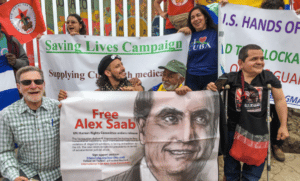
Standing in front of the border wall, Venezuelan-American activist with the FreeAlexSaab campaign William Camacaro called for the immediate release of the Venezuelan diplomat from a Miami prison. That day, June 12, marked the second year of Alex Saab’s imprisonment for the “crime” of engaging in legal international trade to buy needed food, fuel, and medicine for the Venezuelan people, but in contravention of the illegal US sanctions designed to asphyxiate that independent nation.
The final declaration of the Workers Summit called for a robust internationalism to promote solidarity with the sovereign nations and peoples suffering from sanctions imposed by the US and its allies. Latin America and the Caribbean were proclaimed a zone of peace.
RDH/OT
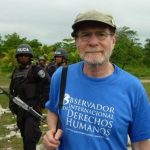
Roger D. Harris lives in California and is with the anti-imperialist human rights organization Task Force on the Americas, the Venezuela Solidarity Network, the US Peace Council, and the Marxist Forum. He writes regularly on Latin American and the Caribbean with a special emphasis on Venezuela, Cuba, and Nicaragua.