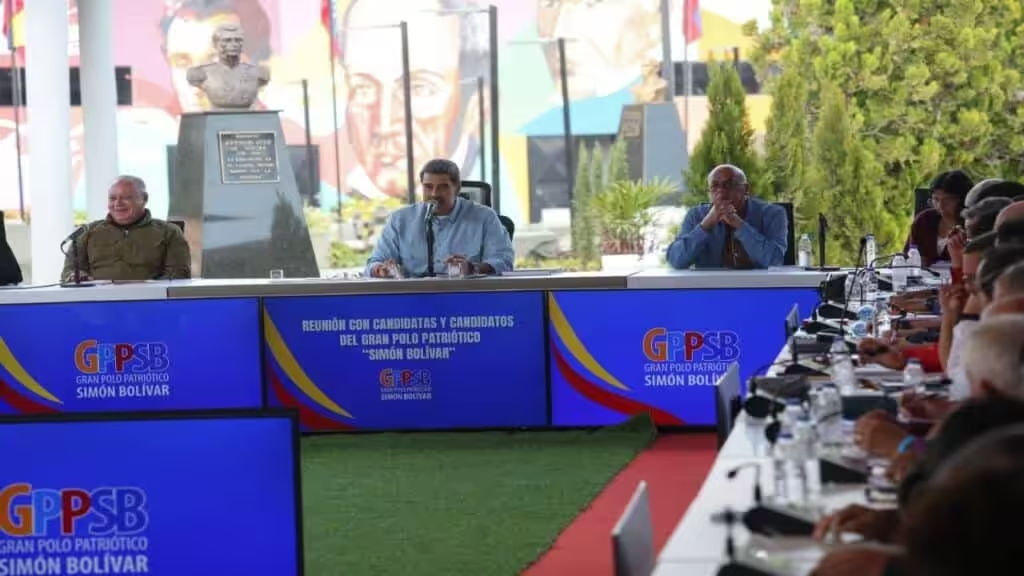
Venezuelan President Nicolás Maduro alongside PSUV Secretary General Diosdado Cabello and National Assembly President Jorge Rodríguez during the announcement of the PSUV candidates for governor for the upcoming May 25 elections. Photo: Venezuela Presidential Press.
In the presence of President Nicolás Maduro, the secretary general of the United Socialist Party of Venezuela (PSUV), Diosdado Cabello, announced the 24 governor candidates for the upcoming May 25 elections, after reading the declaration of the Simón Bolívar Great Patriotic Pole in recognition, support, and commitment to the candidates.
Cabello added that the organizations that make up the Simón Bolívar Great Patriotic Pole (GPPSS)—a revolutionary alliance created by Hugo Chávez and continued by President Nicolás Maduro—are based on the principle of “unity through diversity” and include the United Socialist Party of Venezuela (PSUV), Homeland for All (PPT), We Are Venezuela, People’s Electoral Movement (MEP), Tupamaros, PODEMOS, Fall in Love with Venezuela, Venezuelan Popular Unity (UPV), Green Party of Venezuela, Authentic Renewal Organization (ORA), Alliance for Change (APC), Future Movement, and the Communist Party of Venezuela (PCV).
He then read the candidates by state:
• Amazonas: Miguel Rodriguez
• Anzoátegui: Luis Jose Marcano
• Apure: Wilmer Rodriguez
• Aragua: Joana Sanchez
• Barinas: Adán Coromoto Chavez
• Bolívar: Yulisbeth Garcia (La nana)
• Carabobo: Rafael Lacava
• Cojedes: John Moreno
• Delta Amacuro: Loa Tamaronis
• Falcon: Victor Clark
• Guárico: Donald Donaire
• La Guaira: Jose Alejandro Teran
• Lara: Luis Ramon Reyes Reyes
• Mérida: Arnaldo Sanchez
• Miranda: Elio Serrano
• Monagas: Ernesto Luna
• Nueva Esparta: Marisel Velasquez
• Portuguesa: Primitivo Cedeno
• Sucre: Joana Carrillo
• Táchira: Freddy Bernal
• Trujillo: Gerardo Marquez
• Yaracuy: Leonardo Intoci
• Zulia: Luis Caldera
• Guayana Esequiba: Neil Jesus Villamizar Sanchez
Cabello highlighted the “unitary formula” used to select candidates, calling it a strength of the Bolivarian Revolution initiated in 1999 with the election of Chávez to the presidency. The selection process included assemblies in the 47,263 communities across the country, where 163,015 applications were submitted, and 131,102 leaders were identified.
“Thanks to consultations with the rank and file of the United Socialist Party of Venezuela, we have a clear and consensual proposal from the candidates of the Great Patriotic Pole for the elections of governors, legislators to the Legislative Councils of each state, and deputies to the National Assembly, on May 25, 2025,” noted Cabello.
On March 25, the PSUV secretary general said: “The names of our candidates for the gubernatorial, National Assembly, and Legislative Council elections must be announced. These are the men and women who are ready—the result of a grassroots consultation process, utilizing measurement mechanisms, and an agreement with the Great Patriotic Pole, which also has its own mechanisms.”
Despite PSUV attempts to reach gender parity in the postulation process, the final outcome only granted women representation in 21% of the available governor candidate posts.