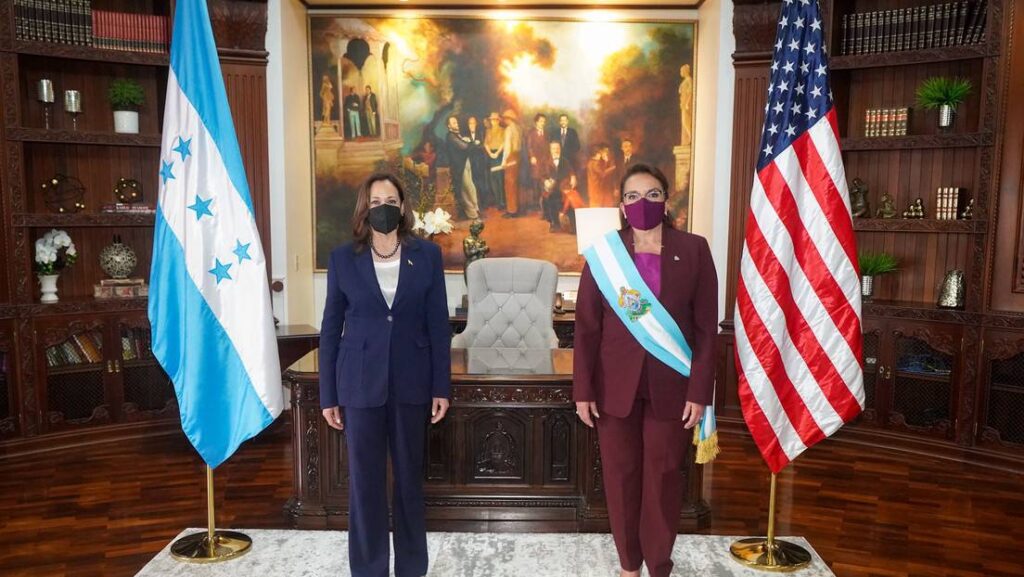
The Vice President of the United States, Kamala Harris, together with the President of Honduras, Xiomara Castro. Photo: Twitter @VP.
The Vice President of the United States, Kamala Harris, together with the President of Honduras, Xiomara Castro. Photo: Twitter @VP.
By Brett Heinz and Beth Geglia – Oct 06, 2022
Xiomara Castro, the president of Honduras, won a major victory for democracy earlier this year when Congress repealed the country’s Zonas de Empleo y Desarrollo Económico law (ZEDE, or “Economic Development and Employment Zones” in English). The legislation enabled the creation of special governance zones, which have “functional and administrative autonomy” from the national government. The zones allowed investors to create their own governance systems, regulations, and courts, providing room for experimentation with privatized government to create a “legal environment adequate … to be competitive at the international level.”
This policy was highly controversial, earning the opposition of Honduran labor unions, campesinos, Indigenous organizations, and even the nation’s largest business groups. As described by the US State Department, the zones “were broadly unpopular, including with much of the private sector, and viewed as a vector for corruption.” When President Castro proposed abolishing the policy, the Honduran legislature repealed it unanimously.
The Biden administration has argued that corruption is one of the largest barriers to development in Central America. The Biden administration’s “U.S. Strategy for Addressing the Root Causes of Migration in Central America” promises to “[p]rioritize an anticorruption agenda .…” But when this goal conflicts with others, like promoting US investment, which is more important? A recent report from the State Department criticizing President Castro for eliminating the ZEDE law suggests that private interests take priority over public transparency and accountability.
“Commitment to Commercial Rule of Law”
The Biden administration’s agenda for Central America is ostensibly meant to address the “root causes” that lead to migration to the US. But the plan’s heavy reliance on attracting private investment from multinational corporations undermines many of its most laudable goals. By ignoring corporate exploitation of land and workers as a root cause of migration in itself, the White House’s plans will support some of the very businesses creating the problems that they hope to solve.
Each year, the US State Department releases “Investment Climate Statements” for countries around the world, identifying foreign policies which are viewed as beneficial or harmful to the interests of US companies. The reports serve as a signal to investors, but they also help to shape the government’s priorities when interacting with other countries and with US diplomats “working with partner countries to address these barriers .…”
The 2022 Investment Climate Statement for Honduras is the US government’s first time issuing such a report for the government of President Castro, who won a landslide victory in last year’s elections. One of the keys to her coalition’s success was their pledge to address the rampant corruption in Honduran politics embodied by the prior president, Juan Orlando Hernández (“JOH”), who is now under indictment in the United States on drug trafficking charges.
When Castro won last year’s presidential election, the State Department congratulated her and said it would assist in “fighting corruption.” Yet when it chose to comment on the repeal of the ZEDE law, the State Department condemned the move in harsh terms: “the [Honduran] government has exposed itself to potentially significant liability and fueled concerns about the government’s commitment to commercial rule of law.”
The report criticizes Castro for eliminating the unpopular policy rather than “pursuing reforms or seeking dialogue with the ZEDE investors.” The move, they claim, “contributed to uncertainty over the government’s commitment to investment protections required by international treaties.”
The US government’s condemnation contradicts their public anti-corruption commitments directly. Even though ZEDE promoters claim that the autonomy of the zones will provide alternatives for Hondurans and foreign investors to the “corrupt” Honduran legal system, the model actually combines a lack of public accountability and embedded conflicts of interest with secretive financing to create a perfect environment for corruption.
The zones are allowed to create “their own police, as well as agencies tasked with criminal investigation, intelligence, prosecution, and … a penitentiary system.” However, these private agencies are under no obligation to share information with local citizens and can even unilaterally decide to limit their cooperation with Honduran government authorities. One zone, Ciudad Morazán, has declared that Honduran police are not allowed inside “without an invitation and supervision.”
The zones themselves are approved and constituted in secret. The body formed in the 2013 law to oversee ZEDE development, the Committee for the Adoption of Best Practices (CAMP), has been scrutinized for its lack of transparency and its antidemocratic nature. While the original members of the international committee had to be ratified by Congress, the committee can replace its own members with no oversight. No one knows who is currently on it, despite multiple requests for disclosure filed by scholars and civil society organizations under access to information laws. A list of members from 2013 includes former members of Ronald Reagan’s Outreach Group on Central America and problematic actors such as Ebal Díaz, a former JOH advisor who may have recently fled the country to avoid a corruption investigation.
The unelected CAMP has a disproportionate amount of power in Honduras. The CAMP approved three known zones behind closed doors, and the committee has yet to publish information about other zones under consideration. In areas of low population density on the northern and southern coasts of Honduras, the CAMP has exclusive authority to approve new zones; no congressional approval is needed. The CAMP can even intervene in a zone’s internal policy-making and influence the selection of its leader, the “Technical Secretariat.” Meanwhile, there is nothing barring CAMP members from holding positions of power within ZEDE governments.
Indeed, corruption is one of the only reasons the ZEDE policy came into place. After the 2009 coup d’etat against Xiomara Castro’s husband, then president Manuel Zelaya, the coup government of Honduras launched their first attempt at creating special jurisdictions, much to the pleasure of wealthy libertarian investors from the US. Paul Romer, a Nobel Prize-winning economist who helped inspire the policy, quickly distanced himself from it, citing concerns about a lack of transparency.
The policy, then known as the “Regiones Especiales de Desarrollo” (RED) law, was quickly challenged by Indigenous, Afro-Indigenous, and land rights groups throughout the country. It was soon deemed unconstitutional by the Honduran Supreme Court. In 2012, the Honduran legislature responded by replacing four of the five Supreme Court judges. The only judge who voted in favor of the RED zones, Oscar Chinchilla, was subsequently made attorney general of Honduras. With all judicial opposition eliminated, the modified ZEDE law was reintroduced and formally added to the national constitution. Thus, the law’s very passage was made possible by Honduran elites bending the law to the benefit of investors.
Who Benefits?
The first zone to open in Honduras, “Próspera,” quickly became a magnet for controversy. It provoked resistance from the nearby village of Crawfish Rock, where the project interfered in local affairs and water access. More recently, the zone has joined the neighboring country of El Salvador in accepting Bitcoin as currency. While Próspera claims to adhere to anti-money-laundering standards, organizations from Fitch Ratings to the International Monetary Fund have cautioned that such a policy could increase opportunities for money laundering.
Who are the investors backing these zone projects? No one knows for sure. “Honduras Próspera, LLC” is a trademarked subsidiary of NeWay Capital, an investment firm based in Washington, DC. NeWay Capital’s CEO Erick Brimen refers to himself as “Founder and CEO of Próspera” and serves on the Council of Trustees that governs the zone. He has also suggested to the Financial Times that the Próspera project had the backing of the US Embassy.
Many of Próspera’s board members and known investors are associated with the libertarian “free cities” movement and conservative politics generally. One investor is Pronomos Capital, a fund led by Milton Friedman’s grandson and supported by far-right billionaire Peter Thiel. Another is Free Private Cities Inc., whose CEO remarked in an interview that Próspera may be selective about whom it allows into the zone: the private government “reserve[s] the right not to accept serious criminals, communists and Islamists.”
Despite the law’s repeal which authorized their existence, ZEDEs are still in operation today. The Honduran government is insisting they reorganize to follow the legal standards used by other special economic zones, but Próspera has suggested that it will ignore them. The company seized upon the State Department’s report to claim that it does not have to change, arguing that “[t]he repeal of the ZEDEs cannot be legally interpreted as the elimination of the existing ZEDEs.” Even in defeat, these private territories are refusing to acknowledge the higher authority of the Honduran government.
Honduras: Xiomara Castro’s Government, Advancing Along a Mined Road
Accountability and Democracy Must Come First
In condemning the repeal of the ZEDE law, the State Department continues to place the interests of the US business sector above its own stated intentions in Central America. In fact, such a stance reveals a loyalty to “commercial rule of law” at the expense of democratic rule of law. By prioritizing US-based investment firms like NeWay Capital over basic transparency, accountability, and participatory democratic governance, the US government is contributing to the issues plaguing the region.
In a nation where corruption is already entrenched, private governmental zones with opaque cash flows and little oversight can serve as a breeding ground for foul play. If the Biden administration is serious about tackling the root causes of forced migration in Central America and genuinely wants to support constitutional democracy in the region, then it should recognize the end of the ZEDEs as a positive step forward.
Brett Heinz is the Program Assistant for CEPR’s International Team.
Beth Geglia is a Ph.D. candidate in Anthropology at American University
(CEPR)