By John Parker and Greg Butterfield
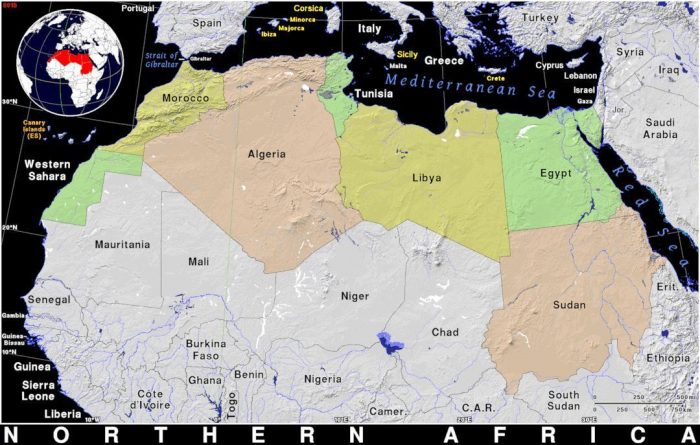
In early April, longstanding governments were toppled by protest movements and military coups in the North African countries of Algeria and Sudan.
The contradictions of these governments are real. That must be acknowledged. What must also be acknowledged is that, even if it seems apparent in the corporate media that the protests are a genuine reflection of anger and frustration by the people, it doesn’t answer important questions like: Which class forces are the primary engines of these events? How much influence is coming from the United States and other Western imperialist powers?
Even many progressive media outlets and left organizations reported uncritically on these events, despite the fact that both countries have been frequent targets of Western aggression and “regime change” threats.
Which begs other questions like: What is Washington’s role? Do these changes benefit the oppressed workers of the region, or shift the balance of power further in favor of the U.S. and other imperialist countries? Is there an increased danger of Western intervention, military or otherwise?
Asking these questions does not deny a people’s right to self-determination, but it must be determined if these protests are a reflection of that pursuit or an attempt by bourgeois forces at denying self-determination in favor of imperialism.
RELATED CONTENT: The Arab League Summit was Business as Usual
A second Arab Spring?
Corporate media, including the Washington Post, have asked if the protests in Sudan and Algeria herald the beginning of a second “Arab Spring.” But the events commonly grouped under that term were very contradictory.
In Egypt and Tunisia, the Arab Spring described genuine popular uprisings against repressive regimes aligned with global imperialism and the Israeli settler state.
But in Syria and Libya, the same slogan served as a cover for counterrevolutionary, pro-imperialist movements, in which Washington and its allies intervened to overthrow governments resistant to U.S. domination.
It should be clear that when the Post, the New York Times, the Guardian, CNN and their like wish for a new Arab Spring, it is the latter version they’re banking on.
Even as events unfold in Sudan and Algeria, a war between rival armies to dominate Libya’s capital, Tripoli, is intensifying — nearly eight years since NATO’s destruction of the country’s central government. The U.S. now has three military bases in Libya.
RELATED CONTENT: Trump Vetoes Congressional Resolution to End US Support of Saudi-led Yemen War
There are many examples of so-called “color revolutions” — from Yugoslavia in 2000 to Ukraine in 2014 to the ongoing counterrevolutionary attempts in Venezuela today — in which anti-people forces, aided by the U.S., promote an image of popular rebellion to lay the groundwork for an imperialist takeover of a country’s wealth, labor and resources.
These movements rely on misdirecting popular anger over the suffering caused by Western economic warfare into destroying governments that, to one degree or another, have resisted U.S. domination.
It’s important for revolutionary Marxists to look at these movements critically in their historical development. It would be wrong to assume without investigation that a seemingly popular uprising against oppression and injustice is false. But it’s equally wrong to assume without investigation that it is completely progressive — especially when it is praised by the same politicians and media who never fail to denounce fightback movements of workers and oppressed people here at home.
Algeria
The protest movement in Algeria began on Feb. 22, when ailing President Abdelaziz Boutefilka announced plans to run for a fifth term. Underlying the current unrest is high unemployment for college-educated young people, forcing many professionals to emigrate in search of work.
Algeria is one of the world’s major oil producers and is third in the world among natural gas producers. It ranks number 16 in the world in proven oil reserves. State-owned oil company Sonatrach is the largest company in Africa. Algeria’s oil and gas were nationalized after the country’s hard-won independence from France, led by the National Liberation Front (FLN).
Control of its oil wealth allowed Algeria to maintain a degree of independence in its relationship to world imperialism. For example, the FLN-led government, along with Syria, voted against the Arab League’s endorsement of NATO’s “no-fly zone” over Libya in March 2011.
As Reuters noted on April 3, “[Algeria] has almost no foreign debt burden but its hard currency reserves have halved to $70 billion since 2014 due to a slide in volatile oil and gas prices.” Falling oil prices have increased the vulnerability of several countries targeted by the U.S., including Venezuela, Iran and Russia.
President Boutefilka resigned on April 2 after the FLN and Algerian military withdrew support for his administration under pressure from the protest movement. A caretaker government headed by Interim President Abdelkader Bensalah has called new elections for July 4.
Reuters reported that on April 12, following Boutefilka’s resignation, Chevron said it had bought Anadarko Petroleum Corp, which is the biggest foreign firm in terms of oil output in Algeria. This was followed by an announcement by the Algerian state oil firm Sonatrach that it has opened partnership talks with Chevron.
Protests have continued, with some forces demanding the removal of FLN loyalists from government and military posts.
Sudan
In 1989, a coup led by Omar al-Bashir deposed a military dictatorship subordinate to Washington and formed an alliance with Iran. Sudan has been in the gun sights of U.S. imperialism ever since.
By some estimates, before the country’s division in 2011, Sudan may have oil reserves equal to Saudi Arabia — the country with the second-largest proven oil reserves. Sudan also has large deposits of natural gas, high-purity uranium and copper. China has long been Sudan’s top trading partner, helping the country develop its oil and gas infrastructure even while the country was under attack by the West.
President Bill Clinton bombed the Al-Shifa pharmaceutical plant in Khartoum in 1998. The George W. Bush administration, aided by U.S.-based fundamentalist Christian groups, inflamed a civil war between the predominantly Christian south and the Muslim north. This policy continued under Barack Obama.
Washington gave weapons and money to rebel groups in southern Sudan while carrying out a sophisticated campaign to demonize President al-Bashir’s government, using charges of genocide in the country’s Darfur region. Hollywood stars and pro-imperialist “human rights” groups collaborated to build public opinion for Western-led intervention.
As a result, the imperialist-controlled International Criminal Court in The Hague indicted al-Bashir for crimes against humanity, war crimes and genocide. The ICC has outstanding “arrest warrants” for al-Bashir.
In 2005, Washington succeeded in dispatching a 10,000-strong United Nations “peacekeeping” force to Sudan. This occupation provided the basis for South Sudan to declare independence in 2011. South Sudan took with it the bulk of Sudan’s oil reserves, precipitating an economic crisis that helped spark today’s protest movement.
It was in this context that al-Bashir’s government attempted to make an accommodation with the U.S., most notably by breaking off its longtime relations with Iran and sending troops to participate in the U.S.-Saudi war against Yemen. “Sudan has at least 3,000 ground troops and several fighter jets fighting in Yemen as part of the Saudi-led alliance,” reported Reuters in 2018. “Dozens of Sudanese soldiers have been killed on key coastal battlefronts.”
Al-Bashir’s attempt to reach an accommodation with the West wasn’t unique. For the sake of survival, both Muammar Gaddafi in Libya and Bashar al-Assad in Syria made similar efforts in the early 2000s. That didn’t save either country or its leaders from attack, since the U.S. “has no permanent friends, only permanent interests.”
Protesters and military
A Jan. 24 New York Times article, “On Sudan’s Streets, Young Professionals Protest Against an Autocrat,” drew an interesting connection between the current protest movement and imperialist efforts to break up and dominate the country:
“Demonstrations that started on Dec. 19 as a howl against soaring bread prices in the city of Atbara have snowballed into a nationwide movement, driven by daily protests calling for the president’s ouster. They hope to succeed where international efforts failed; Mr. Bashir’s autocratic rule has endured despite American missile attacks, war crimes indictments, international condemnation, economic sanctions, and a momentous 2011 split that led to the creation of South Sudan.
“‘Just fall, that is all!’ cry protesters who mass in the streets of Khartoum nearly every day, often in an effort to reach the National Assembly building on the banks of the Nile. The security forces beat them back with tear gas and live gunfire. …
“The revolt, which has spread from Khartoum to 35 cities in 15 of Sudan’s 18 provinces, is led by disgruntled young professionals from the classes that were long tolerant of Mr. Bashir’s iron-fisted rule. Speaking by phone, a dozen protesters, weary of economic decay and international isolation, said they hoped the government’s panicky reaction signaled that Mr. Bashir’s rule was grinding toward its end.”
Mint Press News reports that the National Endowment for Democracy and the U.S. Agency for International Development began major funding for “democracy promotion” in Sudan starting in 2011 — a strategy used in many U.S.-backed “color revolutions.” Also of note, given recent events in Venezuela, is that Sudan suffered a complete electricity outage just days before the military coup.
A military junta deposed President al-Bashir on April 11, placing him under house arrest at an undisclosed location. Defense Minister Lt. Gen. Awad Mohamed Ahmed Ibn Auf announced the formation of a transitional military council to rule the country during a two-year transition to civilian rule. The next day he resigned, appointing Lt. Gen. Abdel Fattah al-Burhan as his successor.
Leaders of the protest movement reportedly thought Ibn Auf was too close to al-Bashir’s inner circle, but that al-Burhan was someone they could work with. He had previously made overtures to the protesters.
Al-Akhbar, a Lebanese Marxist publication, reported on April 15 that al-Burhan and his deputy have close ties to Saudi Arabia, the United Arab Emirates, Morocco and other regional monarchies strongly opposed to Iran.
“It appeared striking that the first to meet with [al-Burhan] was the U.S. charge d’affaires in Khartoum, Stephen Kotsis,” Al-Akhbar said. “This increasing ‘identity’ raises many questions about what dialogue between the military junta and representatives of the protesters can lead to.” Al-Burhan was quick to reassure Saudi Arabia that Sudan would continue to participate in the anti-Yemen military coalition.
At this writing, the Sudan Professionals Association and its Alliance for Freedom and Change continue their sit-in surrounding the military headquarters in Khartoum, calling for an immediate handover of government control to civilian forces.
The demands advanced by the SPA and AFC do not touch on class and social questions that address the economic crisis of the Sudanese workers and peasants, such as demanding a moratorium on debt service to Western banks or reparations for imperialism’s long war against Sudan. Instead they are based on generalities like civilian rule, ending corruption, dismantling al-Bashir’s National Congress Party and seizing its assets.
“The ongoing demonstration comes as the transitional military council continues to arrest former regime officials,” CNN reported on April 15. “Among them are Bashir, his former interior minister Abdelrahim Mohamed Hussein, and former head of the ruling party Ahmed Haroun, who will be charged with corruption and the death of protesters.” So far the military has rejected calls to turn over al-Bashir to the ICC.
Straddle fence between basic classes
The contradictory nature of governments like those in Algeria, Sudan and Syria is not well understood, even in the communist and socialist movement. These governments emerged from anti-imperialist struggles of the 1960s, 1970s and 1980s, when there was tremendous mass pressure to find a path to independence from imperialism, but a workers’ party fighting for socialist revolution was either absent or repressed.
Discussing this phenomenon in relation to the Saddam Hussein government of Iraq in 1991, Marxist leader Sam Marcy explained: “The problem in the Middle East from the viewpoint of socialism is that in all the political overturns, all the struggles to rid the region of imperialism, none went beyond the level of the February Revolution in Russia. The most profound revolution, that in Egypt led by Nasser, shows the limits of what can be achieved if the revolution stops at the bourgeois-democratic level. …
“These progressive, anti-imperialist revolutions were unable to achieve a transition to a socialist revolution, one that overturns the basic relations of property between the working class and peasants on the one side, and the bourgeoisie on the other, between oppressors and oppressed. …
“Mere nationalization of industry, even of oil, does not in itself lay the basis for socialism. The nationalization retains within itself the growth of the bourgeoisie. While the level of economic well being can be on a much higher level than in a non-oil-producing country, the retention of the bourgeoisie leads to gross social inequality. …
“A characteristic feature of such a regime is that it straddles the fence between the working class and peasants on the one hand, and the bourgeoisie. The severe pressure of imperialism has produced the phenomenon of military rule and a number of coups d’etat.
“In the struggle against imperialism, it leans heavily on the workers and peasants as its fundamental social support. At the same time, the pressure of bourgeois social forces continually pushes it in an adverse direction.”
It’s important to understand the dual character of these governments — a phenomenon known to Marxists as “bonapartism” — because it helps to answer a crucial question. Absent a working-class upsurge with a revolutionary socialist perspective, what does the destruction of these anti-imperialist regimes lead to: liberation — or unbridled imperialist domination?
As events in North Africa continue to rapidly unfold, it is crucial for anti-war and anti-imperialist activists in the U.S. and Europe to expose the past and current crimes of the imperialists, and be vigilant to oppose any moves by the ruling classes here to further intervene through military force, sanctions, seizure of resources and other means that deepen the oppression of the region’s peoples.
Source URL: Struggle – La Lucha