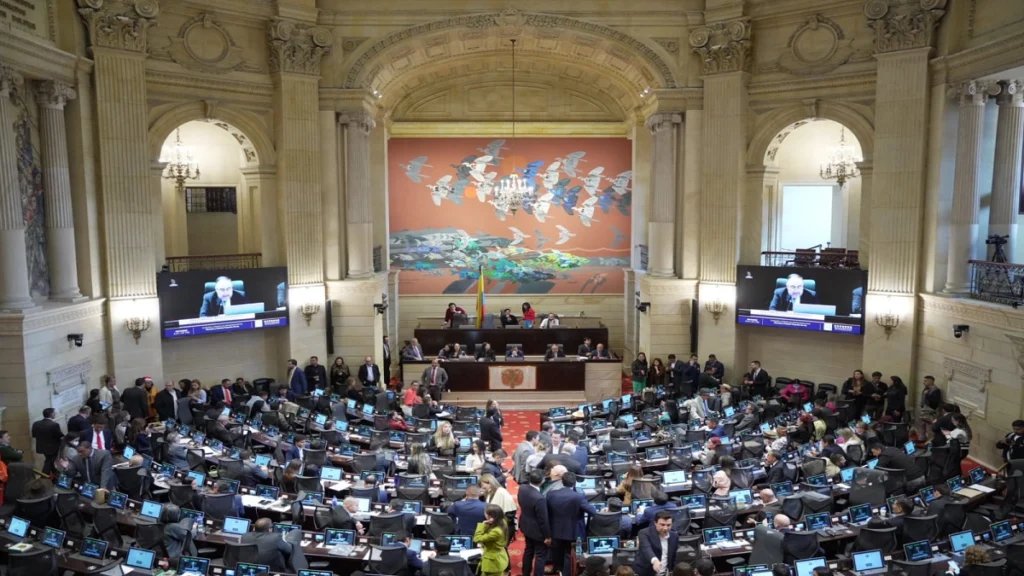
A session in the Colombian Congress. Photo: X/@CamaraColombia.
A session in the Colombian Congress. Photo: X/@CamaraColombia.
On Sunday, March 8, Colombians will go to the polls to elect members of the Senate and the House of Representatives for the 2026-2030 term. These are the first elections of this year’s electoral calendar, which will culminate with the election of President Gustavo Petro’s successor in May, or in June if there is a second round.
On March 8, more than 41 million Colombians in the electoral roll will also be able to participate in the inter-party consultations, which will define the presidential candidates of various parties or coalitions for the presidential elections of May.
These legislative elections will be crucial for the governance of the next president, who will take office on August 7, 2026. The Colombian Congress is composed of two chambers: the Senate (with 102 seats elected by popular vote plus an additional seat given to the second most voted presidential candidate) and the House of Representatives (183 seats).
The parliament not only legislates but also exercises essential political control over the government, approves or rejects structural reforms, and distributes public resources through the national budget.
Voters will elect the parliamentarians through a proportional system (D’Hondt method), with the option of open lists—where the voter marks a specific candidate and the order of the list is defined by individual preference, or closed lists—where the vote is for the party and the order is established by the party or the coalition.
Senate and House of Representatives elections
In the Senate, 102 members will be elected by popular vote: 100 in the national constituency (the entire country votes for the same list) and two in the special indigenous constituency. An extra seat is added for the presidential candidate who comes in second place in the first or second round, according to the Opposition Statute.
In the House of Representatives, there will be elections for 183 seats, with a more diverse and regional distribution: 161 by territorial constituencies (each department and Bogotá elect a number proportional to their population) and 16 Special Transitional Peace Constituencies (CITREP), reserved for victims of the armed conflict.
Moreover, there will be special seats for Afro-descendant communities, indigenous peoples, communities of the San Andrés and Providencia archipelago, Colombians residing abroad, and for the Opposition Statute for the vice-presidential candidate in second place.
Both in the Senate and the House of Representatives, the temporary seats for the Comunes block (signatories of the Peace Accords) will cease to exist in the new term.
The presidential race
Three interparty consultations (on separate ballots) will be held to elect single candidates for each coalition for the presidential race. The voter can only participate in one interparty consultation; marking more invalidates the vote.
For the center-right coalition La Gran Consulta por Colombia, there are nine pre-candidates; for the left, but without the endorsement of President Gustavo Petro, there is the Frente por la Vida coalition with five pre-candidates; and from the center, there is the coalition Consulta de las Soluciones with two pre-candidates but with a clear advantage for Claudia López, former mayor of Bogota.
Two of the candidates with the highest voter intention in the polls: Senator Iván Cepeda, candidate of the ruling party, and Sergio Fajardo, former mayor of Medellín, the second-largest city in the country, will not participate in these consultations and will compete directly in the May 31 presidential elections.
Cepeda, who won the internal consultation of the Historical Pact, Petro’s party, by a wide margin in October 2025 (with over 1.5 million votes), was barred from the Frente por la Vida consultation in a controversial decision by the National Electoral Council.
Left-Wing Candidate Iván Cepeda Leads Polls Ahead of Presidential Elections in Colombia
Historical Pact and Colombia Humana merge as a single party
The National Electoral Council, however, approved the merger of Historical Pact and Colombia Humana, closing weeks of legal uncertainty about the viability of their alliance and generating direct effects on the electoral scene.
With this decision, the two forces cease to operate as a coalition and instead consolidate legally as a single party.
In practical terms, the merger strengthens the Historical Pact on three fronts: legal, organizational, and symbolic. First, it reduces legal uncertainty amid the campaign. Second, it presents a cohesive political structure to the electorate, not a temporary alliance. And third, it consolidates the bloc as the main left-wing party in the country, which could influence the perception of stability and governability among its supporters.
Voting intention figures
A few days before the inter-party consultations, which is the major filter before the first round of the presidential elections, Cepeda continues to lead with a weighted polling of 33.9%, six points more than in January, showing that the voter intentions for him has not yet stagnated.
The far-right pre-candidate Abelardo de la Espriella is polling in second place, with 20.9%. However, the weekend’s marathon of opinion polls showed a halt in his momentum: voting intention for him dropped by 3.8 points.
(Telesur)
Translation: Orinoco Tribune
OT/SC/DZ