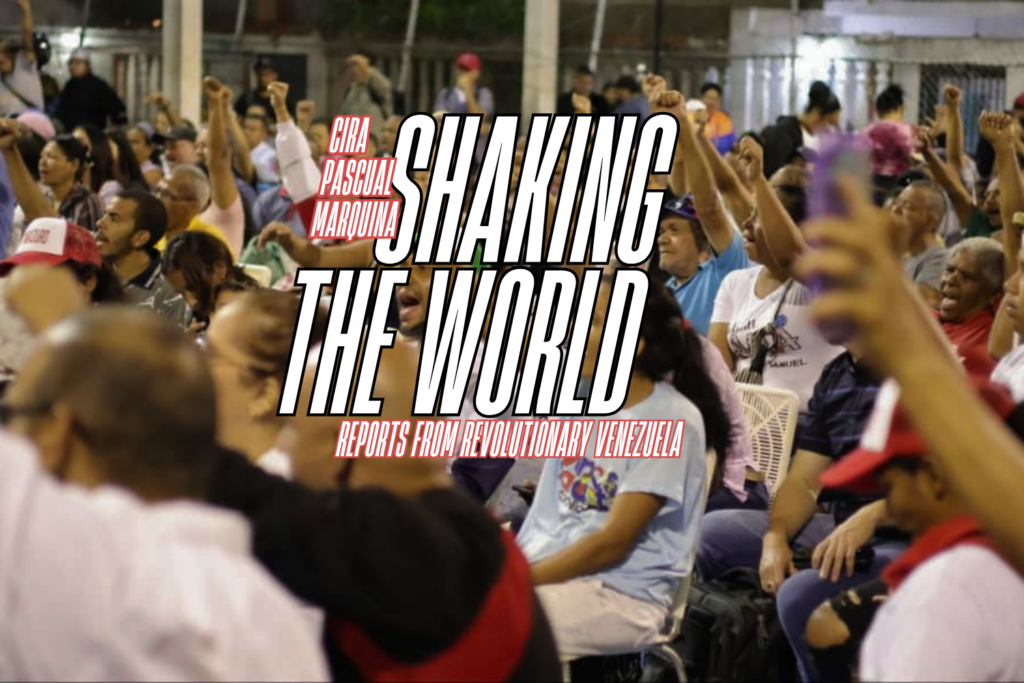
Venezuelan commune members with their arms raised at a meeting. Photo: Monthly Review.
Venezuelan commune members with their arms raised at a meeting. Photo: Monthly Review.
By Cira Pascual Marquina – Mar 27, 2026
I write these lines at a particularly difficult moment for Venezuelan sovereignty. The imperialist attack of January 3 and the kidnapping of President Nicolás Maduro and Congresswoman Cilia Flores marked a new escalation in an aggression that now spans more than twenty-six years against the Bolivarian Revolution. This is not an isolated episode. It is a new chapter in a broad and multifaceted strategy aimed at taking away the Venezuelan people and government’s power of decision and, ultimately, reversing the political path inaugurated in 1999.
In this context, the leadership of the revolution has been forced to make difficult decisions. There has been no shortage of tedious and often legalistic debates about the reform of the Hydrocarbons Law. However, that reform had in fact already been under discussion prior to the attack. By contrast, what does constitute a tactical concession affecting our national sovereignty is how the United States now oversees and controls our oil sales.
No one who has historically defended energy sovereignty can ignore the weight of this blow. Nevertheless, the immediate alternative to this concession was not maintaining sovereignty—an idea often invoked by “leftists” in the global North as they hastily declare the end of our revolution—but rather an all-out bloody war under extremely unfavorable conditions, accompanied by a naval blockade. Under imperialist siege, even revolutionary processes may be forced to maneuver to preserve life and ensure their continuity.
It was a hard blow. But it was also the result of a prolonged economic war whose objective has been precisely to close off all avenues for the country’s material reproduction.
Lenin knew these situations well. In the most difficult years of the Soviet Revolution, he defended the New Economic Policy as a necessary tactical retreat to preserve what was fundamental. Revolutionary politics, he insisted, requires distinguishing between what can be defended at a given moment and what constitutes the strategic core of a historical process.
Today, that distinction becomes crucial once again. National sovereignty is not reducible to control over a strategic resource, however important it may be. In Venezuela, there exists another equally important dimension: organized popular sovereignty.
This is the terrain of the commune.
When Karl Marx analyzed the experience of the Paris Commune of 1871, he wrote a phrase that retains all its force: “The Commune was the direct antithesis of the Empire.” What was revolutionary about that experience was not a change in government, but the emergence of a new political form: a structure in which the working people began to govern themselves.
The commune thus represented more than a local institution or a mechanism to address specific territorial problems. It was a political form capable of embodying collective emancipation.
This idea takes on particular relevance in the contemporary world, and it is precisely for this reason that Chávez conceived the commune as a superior organizational form aimed at undermining the foundations of the bourgeois state, overcoming the metabolism of capital, and transforming the social relations of production.
Capitalism, whose tendency toward concentration and expansion Marx had already anticipated, now takes the form Lenin conceptualized as imperialism: a global system of domination and dispossession in the service of big capital, sustained by financial, military, and—increasingly—communicational power.
In this context, the communal question takes on strategic significance.
As Chris Gilbert argues in his essay “Socialist Communes and Anti-Imperialism: A Marxist Perspective,” for communes to have real anti-imperialist potential, they cannot be conceived as spaces of local autonomy disconnected from the national political process. When this happens, the communal project risks being neutralized or reduced to a marginal experience.
The Marxist—and Chavista—perspective points in another direction. The commune is not a local refuge from the system, but a fundamental component of a broader strategy of power and social transformation.
As Gilbert further explains, when Hugo Chávez proposed communes as the “basic cells” of Venezuelan socialism, he did so within an explicitly anti-imperialist horizon. The goal was not to build isolated communities, but to reorganize the country as a whole and open the path toward a social metabolism different from that of capital.
Chávez made this clear in 2009. “An isolated commune is counterrevolutionary,” he said.
Communes must be articulated into communal cities, federations, and ultimately into a confederation capable of progressively displacing the old state. This was not a localist project. It was a national one.
Today, this wager takes on even greater significance!
Under conditions of imperialist siege, a society’s ability to reproduce life with dignity depends to a large extent on the organization of the working class. Communal production, collective management of services, and collective decision-making become concrete mechanisms both of resistance and of building new social relations that point toward emancipation.
The recent National Popular Consultation, held on March 8, International Working Women’s Day, expresses precisely this dynamic.
Thousands of communes across the country debated and prioritized projects aimed at addressing concrete needs: water systems, productive initiatives, community infrastructure, educational, sports, and cultural spaces. The consultations might appear to be simple administrative measures within the state apparatus, but their significance runs much deeper.
Every time a community collectively decides how to organize its material life, it exercises a concrete form of sovereignty. And we are not speaking here of an abstract sovereignty proclaimed in speeches, but a sovereignty that is practiced.
This popular sovereignty acquires strategic value when a country faces unilateral coercive measures and military aggression. The objective of such attacks is not only to pressure a government: it is to disorganize social life and fracture the collective fabric that allows a society to reproduce itself with dignity.
In the face of this strategy, communal organization operates as a form of social resilience.
Communities that produce food, organize economic circuits, manage services, or collectively prioritize their resources, build a capacity for resistance that no blockade can fully destroy.
This is why the commune is not only a democratic experiment. It is also a form of national defense.
In this sense, it is politically significant that, just two months after the January 3 attack, the national government—with Acting President Delcy Rodríguez at the helm—chose to center these popular consultations. At a moment when imperialism presses for the dismantling of popular power, the decision has been the opposite: to maintain communal democracy as the backbone of the revolutionary process. This reflects a strategic understanding: in the midst of siege, the principal strength of the Bolivarian Revolution does not lie solely in state institutions, but in the territorial organization of the working class. In times of imperialist aggression, strengthening popular power is not a political luxury—it is a historical necessity.
As Gilbert reminds us, Marx argued that communal relations constitute the fundamental antithesis of a system based on commodity exchange. Whereas capitalism transforms social relations into relations between things—relations that are mediated by money, the markets and capital—communal production implies collective control over productive activity.
That collective control is, ultimately, a form of sovereignty.
In Venezuela, sovereignty is being built in thousands of communes—some more robust and consolidated, others still incipient—where politics ceases to be a distant affair and becomes a daily practice.
Of course, commune-building is full of contradictions. The construction of the communal state coexists with inherited bureaucratic structures, enormous economic difficulties, and the tensions inherent to any process of historical transformation.
Yet even amid these tensions, the commune remains the strategic horizon. In a world where power is increasingly concentrated in corporations and financial centers, the idea that communities can directly govern key aspects of their collective life carries a profoundly subversive potential.
Defending Venezuela against imperialism does not mean only denouncing external aggression. It also means defending and deepening the forms of popular organization that can sustain daily life with dignity.
If, at times, national sovereignty must maneuver or concede ground in specific areas in order to withstand the siege, there is one sphere in Venezuela where there can be no retreat: that of popular sovereignty in the territory.
It is there that the deepest root of our historical process is found.
Oil may be subject to tactical negotiations. Geopolitical correlations may shift. Economic conditions may force difficult decisions. But as long as there exists an organized pueblo capable of governing its territories, the possibility of building a different society remains alive.
In Venezuela, that possibility has a name: the commune.
Industrial Integration and the Impact of the US Blockade: Vida Café Economic Circuit (Part 3)
And in times of imperialist siege, defending the commune as a national project means defending the deepest form of sovereignty: the sovereignty of an organized people that produces and shares collectively. But this defense cannot be reduced to resistance. The commune is also a strategic wager for popular offensive action: rebellious yet disciplined, creative yet organized—capable of transforming the defense of life into the conscious construction of a new society.
But such an offensive requires acting without naivety or false hopes. As Ramón Grosfoguel recently argued, the moment demands combining tactical flexibility with strategic firmness; constantly assessing the balance of forces with realism; working to recover lost ground; and preparing for future attacks. If the history of imperialism teaches us anything, it is that its ultimate objective is not merely to pressure or discipline processes of change, but to defeat and bury them.
In the Venezuelan case, defeating the Bolivarian Revolution would mean doing so in all its dimensions, including erasing or blurring the historical horizon embodied in communal construction, with its transformative potential. For this reason, defending the commune cannot be limited to the local management of daily life or territorial resistance to siege. It must be conceived as part of a national project of collective emancipation, capable of sustaining, deepening, and projecting organized popular power toward a socialist future.
Ultimately, what is at stake is not only the survival of the government—though that must be secured—but the historical possibility of the working class governing itself.
That is where popular sovereignty resides.
And that possibility—as Marx reminded us—has a concrete political form: the commune.

Cira Pascual Marquina is a Political Science professor at the Universidad Bolivariana de Venezuela in Caracas. She is also co‐producer and co‐host (with Chris Gilbert) of the Marxist education program Escuela de Cuadros. She is actively engaged with grassroots organizations in Venezuela and abroad, and is dedicated, both as a militant and as an investigator, to communal initiatives.
Pascual Marquina is co-author of Venezuela, the Present as Struggle: Voices from the Bolivarian Revolution (Monthly Review Press) and co‐compiler of two books: Para qué sirve El Capital: un balance contemporáneo de la obra principal de Karl Marx and ¿Por qué socialismo? Reactivando un debate (both Editorial Trinchera).