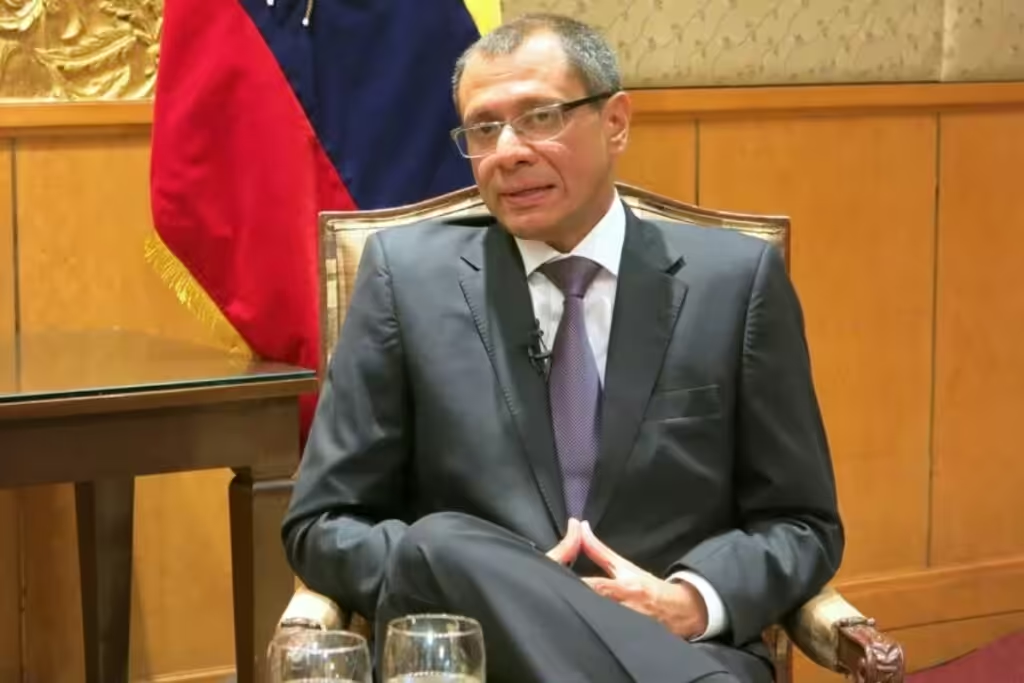
Former Ecuadorian Vice President Jorge Glas in court for one of the lawfare cases against him, May 2023. File photo.
Former Ecuadorian Vice President Jorge Glas in court for one of the lawfare cases against him, May 2023. File photo.
Lawyer Sonia Vera, a member of the international defense team for the former vice president of Ecuador, Jorge Glas, expressed her concerns about Glas’s serious condition, highlighting that he is at risk of dying from malnutrition in the El Encuentro maximum-security prison.
In a social media post, Vera revealed that Ecuadorian security agents reported Glas’s condition in the Health Care Registration Platform of the Ministry of Public Health. “I am watching him die,” the lawyer wrote, emphasizing that her client’s health is constantly deteriorating.
Publico este vídeo con autorización de @JorgeGlas.
Lo que he visto en las últimas semanas no puede seguir siendo ocultado ni distorsionado.
Frente a la desinformación que circula, es necesario decirlo con claridad: el nuevo hábeas corpus correctivo no busca privilegios.
Busca… pic.twitter.com/pQf9RiIi0A— Sonia Gabriela Vera García (@sonicorver) April 1, 2026
According to the reports presented by the defense, a nutritionist reported on February 10 that Glas lost nine kilos in just three months. Despite a specific dietary regimen being ordered, it has not been followed. Vera pointed out that the Ecuadorian State prevents a complete medical evaluation of Glas by prohibiting the entry of basic instruments into the prison facility.
The former vice president is suffering from a severe psychiatric condition resulting from his experiences in several prison massacres. He currently requires 45 daily doses of more than 22 medications; however, the supply of medications is inconsistent.
The defense claims that Jorge Glas is suffering psychological torture and total isolation, as visits from his family members have been prohibited since December 2024. His condition is getting worse due to constant surveillance that prevents him from communicating freely and privately.
Sonia Vera decried the violation of the right to defense due to the lack of confidentiality in legal meetings. Glas remains without access to his Ecuadorian lawyers since his transfer to the El Encuentro prison, limiting his legal assistance.
On April 2, a corrective habeas corpus hearing, originally filed on February 9, was held. The petition seeks to ensure that the State guarantees to Glas minimum living conditions, access to food supplements, and adherence to the medical diet.
“We are not asking for a privilege or impunity, we are asking that they not let him die of hunger,” Vera stated.
Political Figures & Social Movements Demand Release of Ecuadorian Former VP Jorge Glas
History of persecution
Sonia Vera emphasized that the situation of Jorge Glas, imprisoned for the first time in 2017, is a case of lawfare, a prolonged political persecution characterized by the arbitrary use of the penal system.
According to the lawyer, Glas is the only Ecuadorian citizen with 10 pronouncements from international organizations in his favor, all of which highlight the violation of his fundamental rights.
The defense pointed out that, due to legal insecurity, Glas had requested diplomatic asylum at the Mexican Embassy in Quito in December 2023, which was formally granted on April 4, 2024. However, on April 5, Ecuadorian police forces stormed the diplomatic mission and abducted Glas.
Vera reiterated that her client remains in the custody of a “persecuting State” that even ignores the nullity of evidence issued by the Supreme Court of Brazil in the Odebrecht case and Interpol’s refusal to issue red alerts against him.
Despite meeting the legal requirements, the Ecuadorian justice system has systematically denied the prison benefits requested by Glas. In this scenario, the international defense has formally requested the extension of provisional measures requested by the Inter-American Court of Human Rights, urging the international community not to ignore the case.
According to Vera, the April 2 habeas corpus represents a crucial opportunity for the Ecuadorian State to prevent an imminent risk of custodial death.
(Telesur)
Translation: Orinoco Tribune
OT/SC/DZ