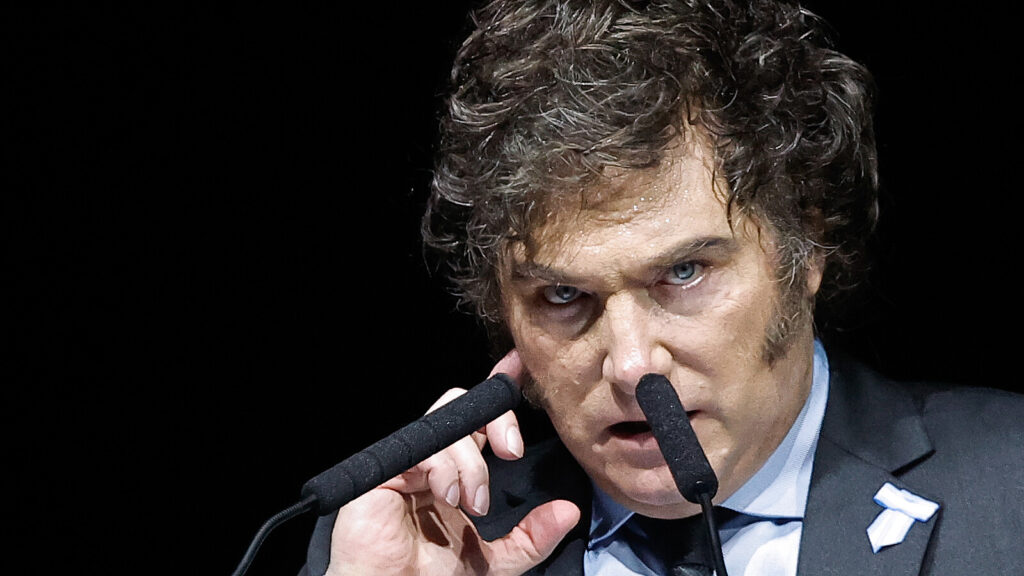
The president of Argentina, Javier Milei, involved in the $Libra crypto scandal. Photo: EFE/Juan Ignacio Roncoroni
The president of Argentina, Javier Milei, involved in the $Libra crypto scandal. Photo: EFE/Juan Ignacio Roncoroni
A group of Argentinian opposition parliamentarians filed a criminal complaint against federal prosecutor Eduardo Taiano, in charge of the $Libra crypto scam investigation, for misconduct and violation of public duties. The accusation is based on “unjustified delays in the production of evidence” and the “retention and concealment” of the same from the plaintiff.
On Thursday, April 2, the complaint was filed by legislators Mónica Frade and Maximiliano Ferraro from Civic Coalition; Sabrina Selva, Juan Marino, Itai Hagman, Julia Strada, and Rodolfo Tailhade from Union for the Homeland; and Esteban Paulón from United Provinces. These parliamentarians, who last year led the investigative committee on the $Libra case, argued that the prosecutor’s actions affect the progress of the judicial process related to the massive fraud of citizens’ assets through a cryptocurrency promoted by President Javier Milei.
#Libra: El fiscal Taiano obstruye el avance de la causa, y recordemos que hizo lo imposible para que la comisión investigadora no pudiera reunir pruebas. Nos enterarnos que durante cinco meses, desde que la comisión investigadora elevó su tarea, Taiano durmió la causa. Por eso… pic.twitter.com/DcVU2th0wj
— Pablo Juliano (@PabloJulianoLP) March 16, 2026
Chronology of the events in the complaint
In the document, the signatories detail a sequence of events that clearly show unjustified delays. The judicial scandal of the $Libra case started on February 14, 2025, with a promotional tweet from the Argentinian president about a cryptocurrency whose value plummeted just hours later. However, the seizure of electronic devices belonging to Mauricio Novelli and Sergio Morales—the original orchestrators of the plot—only took place on March 6, 2025.
“Between the months of March and May 2025, the material was received by the prosecutor’s office, making potentially decisive elements available to them for the advancement of the process from that moment on,” the complaint mentions. “Nevertheless, it was not until September 9, 2025, that the analysis of said material was ordered, which implied a significant initial delay in the handling of essential evidence.”
On October 15, 2025, the parliamentarians had requested a meeting with Prosecutor Taiano to access the case file and expedite the work of the investigative committee. The prosecutor’s refusal, according to the complainants, “broke the entire legislative tradition regarding cooperation between the legislative and judicial branches of the state.”
On November 17, 2025, the prosecution received a preliminary report on Novelli’s phone analysis, which was finally completed on January 7, 2026, “without this translating into an effective boost to the investigation.” It was not until March 13, 2026, that the parties to the case were granted full access to the evidence collected from the mobile phone of Novelli, who acted as the local link in the multimillion-dollar scam orchestrated with the US entrepreneur Hayden Davis.
“Thus, a sequence of delays exist which, due to their extent and lack of justification, are incompatible with the diligent performance of the prosecutor’s function,” the parliamentarians noted. “During that entire period, despite the existence of elements indicating the possible presence of significant economic agreements, communications among those involved, and signs of prior and later coordination regarding the investigated events, no substantial measures were adopted to advance the determination of responsibilities. Not only were no summons for questioning issued, but no charges were formalized either.”
Route of the investigation and summons to communicator Natalia Volosín
The legislators questioned the prosecutor’s diligence in other aspects. Taiano summoned a testimonial statement from journalist and lawyer Natalia Volosín after she made public the retention and concealment of evidence. The journalist revealed the signing of a confidential contract between Davis and Milei, two weeks before the launch of the cryptocurrency.
“Immediately Taiano issued summons to Volosín, with a haste that we had not noticed in the investigation of the facts subject to the complaint. After the public scandal, Prosecutor Taiano nullified the summons, a reaffirmation of an action—at the very least—errant and slow,” the signatories noted. Moreover, the prosecutor directed the investigation toward the people behind the media “leak” of audios and messages from Novelli’s phone. “For the second time, he directed the focus of his activity not toward the scandalous events that occurred on February 14, 2025 and the months before and after, but toward everything ancillary,” they criticized.
Possible crimes attributed to the prosecutor
The complaint identifies a “pattern of behavior” characterized by unjustified delays, which affects due process, cooperation between branches of the State, and criminal action. “Journalism is moving faster than the judiciary itself,” the legislators reproached. Among the possible crimes of the prosecutor, they highlight “improper retention of relevant evidence” and its “potential concealment from the plaintiffs,” incompatible with the principle of objectivity of Article 9 of Law 27.148, which requires acting in the pursuit of truth without selective criteria.
They also point out the absence of substantial measures—such as charges or inquiries—despite incriminating evidence, in violation of article 25, sections (a) and (b) of Law 24.946, which mandates judicial action in defense of legality.
The redirection of the investigation toward ancillary issues, such as the inquiry into the leak and the summons Volosín, constitutes a “diversion from the object of the investigation,” once again violating the duty of objectivity. The restrictions on access to the case by interested third parties generate a lack of transparency and a refusal to inter-institutional collaboration.
The legislators concluded that “all of this constitutes a case of functional misconduct, as it involves the serious breach of the duties mandated by Article 120 of the National Constitution, Law 27.148, and Law 24.946, directly impacting the proper functioning of the justice system.”
(Telesur)
Translation: Orinoco Tribune
OT/SC/DZ