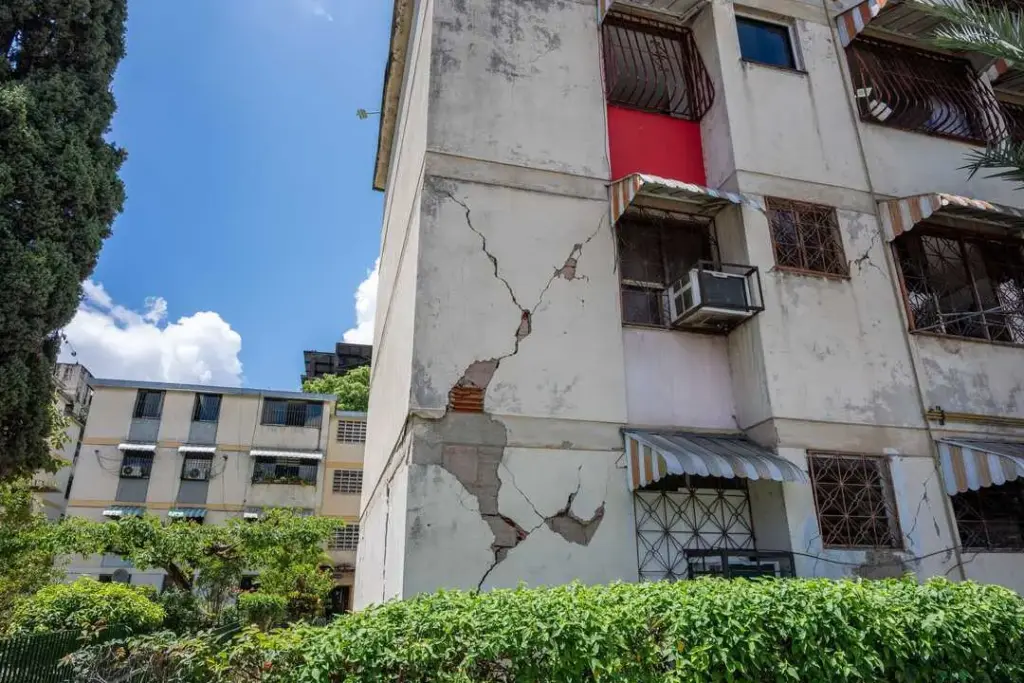
Cracks observed on a building in Caracas impacted by the June 24 double earthquake. Photo: Jimmy Villalta/JNA Press.
Cracks observed on a building in Caracas impacted by the June 24 double earthquake. Photo: Jimmy Villalta/JNA Press.
By Bruno Sgarzini – Jul 7, 2026
The earthquakes in Venezuela have left a tragic, painful toll on the body of the Bolivarian nation. National and international solidarity has been the only oasis of certainty amid so much commotion and an unprecedented situation for the society of Venezuela, a country, located between two tectonic plates, that experiences an event of this magnitude only once every two generations.
Due to this incredibly difficult situation, and amid so much pain, many Venezuelans are looking for culprits beyond nature. Because the mind and the heart, will always dig until they find what could have been done better to save the thousands of people who died under the rubble.
Despite the event being catastrophic, that there have only been six double earthquakes in the world since the 1970s, or that the ten years of sanctions have weakened the Venezuelan State’s capabilities, for a large part of Venezuelan society, Venezuelan institutions should have done more to prevent and respond to the catastrophe.
Therefore, everything is under scrutiny: the response time of State agencies, the presence of military personnel and high-ranking officials at the disaster site, the administration of humanitarian aid, the arrival of international rescuers, and even the relationship with the United States.
The Venezuelan government is dealing with the emotional effects of an unexpected catastrophe that overlaps with a decade of conflicts, sanctions, economic exoduses, public service failures, and economic crises.
The void left by those who died in the earthquakes is compounded by the migrants missing from family tables at the end of the year, as well as those who lost their lives in hospitals due to the shortage of medications and lack of medical care. The pain in the body of the Venezuelan society accumulates, like the effect of the sanctions on the State.
The math is simple for the Venezuelan opposition: because Chavismo has been in power for more than two decades, the responsibility lies with Chavismo. It does not matter that several leaders of the opposition had called for sanctions, nor that this has affected the country’s economic health.
For María Corina Machado, she wishes to return to the country to engage in “grotesque political opportunism,” according to US officials, in order to take center stage in Venezuela and effectively replace the Venezuelan authorities.
Against Amnesia: The Venezuelan Earthquake, the Historical Moment, and the Continental Question
Her desperation to take advantage of the political context is mainly related to turning the “national pain” into political dividends for her project. She is trying to fish in troubled waters even at the cost of being criticized by some of the officials surrounding Trump. This would be a new chapter of necropolitics in Venezuela, where it is more important to instrumentalize the tragedy than to understand the role of the leaders in this context.
In this new political climate after President Maduro’s kidnapping by the US, this catastrophe is also a litmus test. The government of Delcy Rodríguez will have to translate the rapprochement with the United States into concrete benefits, beyond the investment announcements and the change of positions on key issues of Chavismo in domestic and foreign policy.
The government of Delcy Rodríguez will have to deal with the pain and anger of the Venezuelan society while, around it, the umpteenth political conspiracy is being plotted to remove Chavismo from power. It will have to chart a course towards a new horizon that would be shared by the majority of Venezuelans, and rescue the country from the painful present and the perception of a perpetual crisis that burdens millions of people.
Translation: Orinoco Tribune
OT/SC/DZ

Bruno Sgarzini is an Argentinian analyst, writer and researcher part of the Mision Verdad team