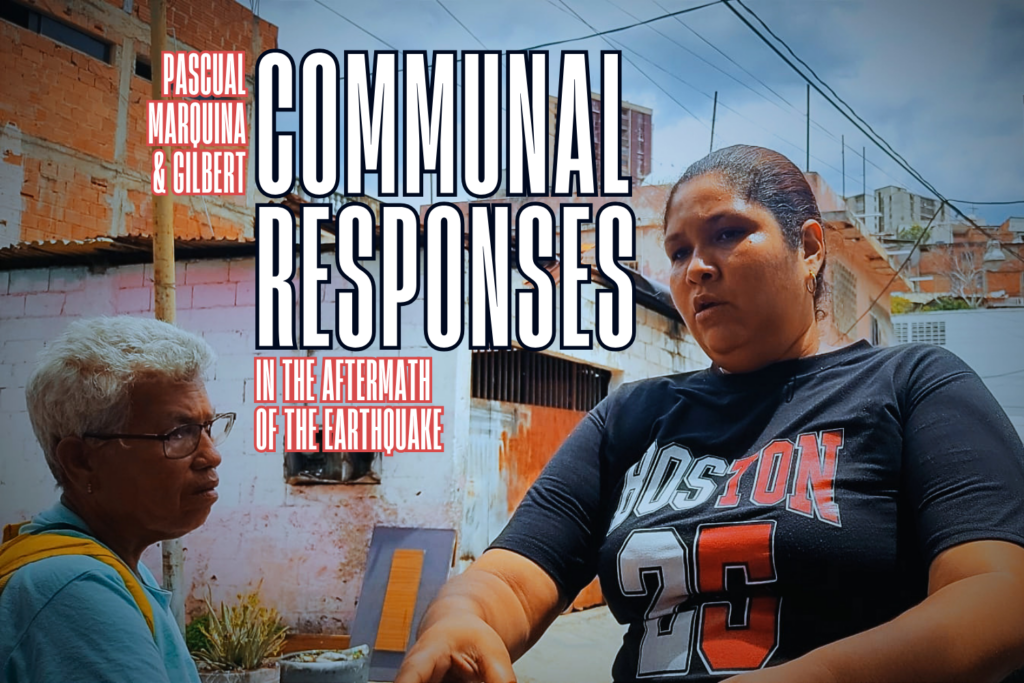
Communal response in the post-earthquake recovery in Venezuela. Photo: Monthly Review.
Communal response in the post-earthquake recovery in Venezuela. Photo: Monthly Review.
By Cira Pascual Marquina and Chris Gilbert – Jul 27, 2026
The flatbed truck left Caracas in the early morning, carrying personal care items, diapers, and children’s supplies toward La Guaira, the region hardest hit by the June 24 earthquakes. Riding behind it was an old bus carrying a twenty-person brigade from the Venezuelan chapter of ALBA Movimientos, a network of grassroots organizations across Latin America and the Caribbean. The destination was the Rómulo Gallegos Communal Circuit in Catia La Mar.[1]
Unlike conventional relief operations, the brigade aimed to strengthen a process already underway—one rooted in years of communal organizing and shaped by two successive emergencies.
Just days after the earthquake, ALBA Movimientos and the Simón Bolívar Institute had launched the Venezuela por la Vida campaign and brigade to accompany the recovery effort. The idea was straightforward: skip the ready-made solutions and work in a community that was already organized, strengthening its collective response by working with local leaders and respecting the priorities established by the people themselves. In Venezuela, this means working hand in hand with communes and other expressions of popular self-government, which are the foundation of the country’s anti-imperialist and socialist project. In contrast to the dominant model of humanitarian assistance, which is often indifferent or even hostile to popular power, the goal was to strengthen the communal fabric while fostering political consciousness.
Catia La Mar is a historic working-class township on Venezuela’s Caribbean coast. Named after the cacique Catia, of the Tarma people, who joined legendary cacique Guaicaipuro in an alliance of Indigenous peoples who resisted Spanish colonialism in the 16th century, the area has long been shaped by traditions of collective struggle. Later, as the nearby deepwater port expanded, generations of dockworkers, migrants, and Afro-Venezuelan communities made the territory their own, building a culture marked by solidarity, barrio-level organization, and a deep devotion to San Juan Bautista, whose feast day, June 24, would become the day the earthquake struck.
When we arrived, there was little sign of panic. Instead, what immediately stood out was the spirit of a community already hard at work.
The communal circuit wasn’t just recovering from the recent quake. Six months earlier, on January 3, a fragment from a U.S. missile had landed in the barrio, killing one woman immediately and then another weeks later from her injuries. The community, already mourning its dead and with a strong sense of righteous indignation because of the imperialist attack, now found itself facing another catastrophe.
Damage from the quake in this zone is less visible than in other areas of La Guaira, but still severe. Here, there are visible tears that run through the pavement and cracks in the walls of many homes. Though only a few have completely fallen, many will have to be partially or fully destroyed. Then there is the square, where some of the two hundred families who either lost their homes or are waiting for engineers to inspect them are living in tents. Yet what struck us most was the remarkable level of organization: people were carrying supplies, neighbors were arriving with news from different sectors, young people on motorcycles were zipping in from local communal councils, while children drifted into the square where volunteers were setting up recreational activities.
As we unloaded the flatbed on the first day, we were met by communal leader Raimelis Navarro. A person who seems to have the gift of omnipresence: she greeted the brigade, coordinated the unloading of supplies, answered questions from neighbors—all the while checking messages on her phone, and keeping track of displaced families. That fatal number had recently climbed from ninety-three to nearly two hundred, as structural inspections declared more houses unsafe.
Faced with a new batch of supplies, the community’s distribution system seamlessly kicked into gear. Volunteers carried boxes into a communal space and began sorting them into kits destined for each of the communal councils in the circuit. Meanwhile, the recreation activity leaders in the brigade left for a nearby square where dozens of children, many of them still sleeping in tents with their families, were waiting for activities intended to interrupt, if only briefly, the trauma and the limbo of the previous weeks.
Only after all this was underway did Raimelis have a moment to explain what we were seeing. “We’ve had six difficult months,” she said, almost apologetically, as though the evidence were not already visible all around us. She wasn’t referring to the earthquake alone.
The Rómulo Gallegos Communal Circuit brings together fourteen communal councils across Catia La Mar and is home to some 5,500 families. Like many working-class communities in Venezuela, its people have spent years building institutions of popular self-government, but the process was uneven and essentially a work in progress. It was only after the January 3 attack, Raimelis explained, that the communal circuit began consolidating a truly robust system of coordination. Faced with an emergency, the communal councils learned to work together in new ways. Those hard-won lessons would prove indispensable when the earthquake struck less than six months later.
Reimelis said, “The bombing changed us.” What she meant was something very profound. The January 3 attack killed two people and displaced several families, forcing the communal circuit to confront a crisis few could have imagined. While the Venezuelan government set about rebuilding the blown-up social-housing block, the community worked to arrange temporary housing, coordinate food distribution, and hold assemblies to process the political and human impact of the strike.
The January 3 attack became a turning point: it exposed some shortcomings in the country’s capacity to respond, but in the Romulo Gallegos Communal Circuit, it also accelerated a process of organization that might otherwise have taken years. Communal councils that had often worked independently found themselves coordinating daily, sharing information, and developing common mechanisms for decision-making.
“When the earthquake came,” Raimelis recalled, “we already knew how to work together.”
Within hours of the June 24 quake, neighbors were checking in on one another, identifying buildings in danger, and sending reports to the Sala de Autogobierno, the communal circuit’s coordinating body. Information flowed from each communal council to the circuit’s coordinators, allowing priorities to be established almost immediately.
Venezuela’s Social Movements Reclaim Simón Bolívar’s Legacy Amid National Challenges
Watching Raimelis in action, it is clear that her role is less about giving orders than about connecting people. Someone arrives asking about the location of the temporary shelter. Another wants to know whether a grandmother with limited mobility had been included in the latest assessment. A volunteer interrupts to ask where the children’s supplies should be placed. Before answering, Raimelis glances at her phone, where new messages from different sectors of the communal circuit keep pouring in.
Nothing in her demeanor suggests exhaustion. She has a quick smile, greets nearly everyone by name, and seems to know not only what needs to be done but also who needs a reassuring word. Several people later confided in us that this is simply who Raimelis is: someone whose warmth and capacity to organize made her a natural point of reference in the community long before either catastrophe occurred.
Yet her composure conceals months of strain. Raimelis admits that she, like the rest of the community, was terrified on January 3, when the missile fragment struck the barrio. Since the earthquake, she has slept very little. The urgent tasks leave little time for rest. Every aftershock revives memories of the first tremor, and each spell of heavy rain brings renewed worry that damaged hillsides or weakened homes might give way.
“This isn’t something one person can do alone; we do it together,” she says, speaking from experience. “Each communal council already knows its territory. They know which families have children, which older adults live alone, who lost their homes, and who needs medicine. That’s why we can respond quickly.”
Raimelis is describing far more than an efficient emergency response. She is explaining a form of collective know-how produced through years of organizing, governing, and confronting problems together. The response was not improvised after the earthquake; it had been learned long before —and, like all knowledge forged in practice, it cannot easily be unlearned. This is the material expression of lessons accumulated through years of collective practice.
The earthquake did not create the community’s capacity to respond; it revealed capacities built over time and deepened in the wake of the January 3 attack. If history can leave behind ruins, it can also leave behind institutions, stronger social relations, and enduring forms of knowledge that become indispensable when disaster strikes.
Note
[1] A communal circuit is a grouping of neighboring communal councils (direct democracy spaces in the territory) that coordinate planning, decision-making, and collective projects, often as a step toward becoming a formally constituted commune.

Cira Pascual Marquina is a Political Science professor at the Universidad Bolivariana de Venezuela in Caracas. She is also co‐producer and co‐host (with Chris Gilbert) of the Marxist education program Escuela de Cuadros. She is actively engaged with grassroots organizations in Venezuela and abroad, and is dedicated, both as a militant and as an investigator, to communal initiatives.
Pascual Marquina is co-author of Venezuela, the Present as Struggle: Voices from the Bolivarian Revolution (Monthly Review Press) and co‐compiler of two books: Para qué sirve El Capital: un balance contemporáneo de la obra principal de Karl Marx and ¿Por qué socialismo? Reactivando un debate (both Editorial Trinchera).