By William Camacaro and Frederick Mills
“The reality is that we need not only a new system of human rights, but a new Inter-American system. We must understand that the Americas to the north and south of the Río Grande are different, and we must speak as blocs.”
Rafael Correa, April 12, 2015.
Summary
The concept of Pan-Americanism has been a contested space since the early nineteenth century between the Bolivarian project of uniting the newly independent states of Latin America against foreign interference, on the one hand, and Monroeism, which has sought to establish the Americas as a protectorate of the U.S., on the other.[1] The idea that the U.S. has the historic mission of leading a process of Pan-American unity against any European incursion contains the contradiction of introducing a new process of colonization, with all its multiple hierarchies of domination (race, class, gender, culture), but this time by Washington, in the name of regional autonomy and mutual assistance. Today we are witnessing a growing aversion to the Monroeist vision of Pan-Americanism as manifest in the deteriorating legitimacy of the Organization of American States (OAS) as an impartial association of the hemisphere’s countries. This deterioration is precisely due to Washington’s relentless opposition to Latin American independence and integration and its failure to adopt a policy based on recognition of the sovereign equality of nations.
Biden follows Trump’s path
The Joe Biden administration, by moving quickly to the right of Donald Trump on hemispheric policy, has overplayed its hand and evoked indignation and heightened Bolivarian sentiments throughout the hemisphere. The State Department has not only refused to resume Barack Obama’s policy of normalizing relations with Cuba; it has launched a fresh offensive against the island-nation during the COVID-19 pandemic and on the heels of another overwhelming United Nations (UN) vote in favor of ending the 62-year embargo. While the U.S. seeks to ratchet up the pressure in Cuba’s time of need, Mexico,[2] Nicaragua,[3] Bolivia,[4] and Russia[5] are sending urgently needed food and medical supplies to the besieged nation.
The political fallout is just beginning. Although there have been earlier indications that the days of the OAS were numbered, with growing criticism of Secretary General Luis Almagro’s extreme partisanship on behalf of right wing governments and against progressive ones, it was President Biden’s adoption of Trump’s hard line on Venezuela, Cuba, and Nicaragua, that have dashed any hope that the OAS could act as an impartial regional organization.
The Demise of Monroeist Pan-Americanism
The gap between Monroeist Pan-Americanism and the Bolivarian cause cannot be closed because the U.S. and its Canadian and European allies have sought to dominate the Latin American political, economic, and cultural landscapes. Addressing the 21st Summit of Foreign Ministers from the Community of Latin American and the Caribbean States (CELAC) on July 24, Mexico’s President Andrés Manuel López Obrador (AMLO) delivered a historic speech, eloquently suggesting that it was time to replace the OAS with a truly autonomous regional organization that will be free of “lackeys” and advance the interests of the Americas based on cooperation, peaceful resolution of conflict, and sovereign equality. What made the occasion even more momentous was that the Summit took place in commemoration of the 238th anniversary of Simon Bolívar’s birthday.
“Throughout almost the entire 19th century, we suffered from countless invasions, annexations… Mexico suffered the loss of half of its territory in 1848,” observed AMLO. “Since that time, the U.S. has not ceased to carry out overt or covert operations against the independent countries located south of the Río Grande.” AMLO also clearly denounced the blockade of Cuba declaring, “To have resisted 62 years without subjugation is quite a feat… In my opinion, the Cuban people deserve a Dignity Award for their struggle in defense of their country’s sovereignty.” President López Obrador also called for what amounts to an end of the Monroeist version of Pan-Americanism:
“The policy of the last two centuries, characterized by invasions to install and remove rulers at the whim of a superpower is unacceptable. Let’s say goodbye to impositions, interference, sanctions, exclusions, blockades.”[6] The next day, President Luis Arce of Bolivia, whose nation just two years ago suffered an OAS-orchestrated coup,[7] endorsed AMLO’s suggestion.[8] On July 28, a special session of the organization to discuss the “situation” in Cuba was reportedly cancelled after push back from enough member states made such a meeting unfeasible.[9]And on July 29, Argentinian President Alberto Fernández said that the OAS “has ceased being an organism that works for and serves Latin America” making it necessary “to create a new body that is a better expression” of the region.
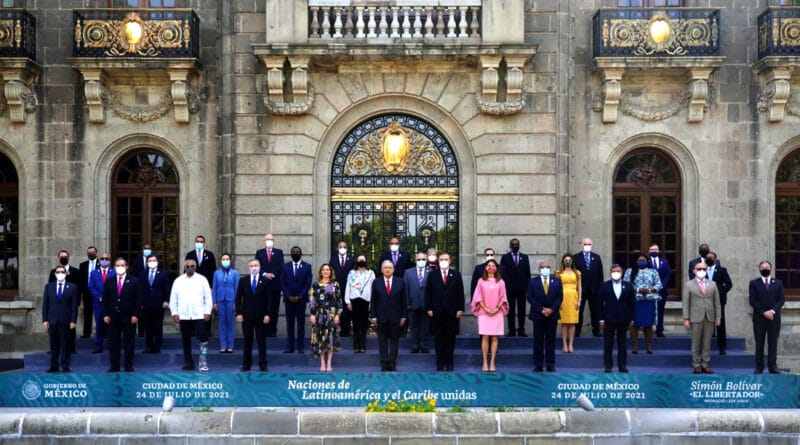
21st Summit of Foreign Ministers from the Community of Latin American and the Caribbean States (CELAC), July 24, 2021. Commemorating the 238th anniversary of the birth of the Liberator Simón Bolívar (Credit photo: Government of Mexico)Historical Reflection
The OAS Charter was signed by delegates at the Ninth International Conference of American States in Bogotá, Colombia on April 30, 1948. The conference met from March 30 to May 2, and the events of those days did not constitute a propitious beginning to an organization ostensibly aimed at promoting democracy and freedom in the region. On April 9, 1948, Jorge Eliécer Gaitán, a popular left leaning member of the Liberal party with a promising trajectory for becoming president of Colombia, was shot and killed in Bogotá, provoking an uprising known as the Bogotazo. The uprising was brutally repressed by Colombian Security forces and sharpshooters, leaving hundreds dead. Gabriel García Márquez describes the scene as delegates of the conference made their way through the streets in the aftermath of the bloodshed:[10]
“Shortly before nine o’clock at night the rain had subsided and the first delegates made their way as best they could through streets strewn with rubble from the popular revolt and corpses riddled with bullets from snipers positioned on balconies and rooftops.”
Márquez remarked that “any dream of profound social change for which Gaitán had died disappeared in the smoking rubble of the city. The dead in the streets of Bogotá that day, and from official repression in the ensuing years, must have added up to more than a million, in addition to the misery and exile of so many.”
In an interview with William Camacaro, the daughter of Gaitán insisted that this was not merely a Bogotazo but a Colombianazo.[11] Today, 73 years later, there are at least seven US military bases in Colombia, and the country remains one of the most dangerous places for social activism and the largest exporter of narcotics in the hemisphere.
We cannot recount the entire history here, but the OAS has served Washington well as an instrument for imposing U.S. hegemony in the region through numerous U.S.-backed military coups, invasions, and support for client governments regardless of their human rights records. Despite the original express intent of Monroeism to limit European inroads in the Americas and build bonds of cooperation, the U.S. declared neutrality during the 1982 war between the UK and Argentina over political control of the Malvinas. Today, the UK’s recognition of Juan Guaidó as President of Venezuela,[12] and the EU’s cooperation with the U.S. in imposing economic sanctions, further demonstrates the organic links between the U.S. and its European partners in the project of recolonizing the Americas. The racism and brutality of the European conquest of Amerindia starting in 1492 continues to inform the heart of U.S. Monroeism.
The Alternative Bolivarian Agenda
The most important challenge to the U.S. vision of Pan-Americanism came at the turn of the twenty-first century with the Alternative Bolivarian Agenda (1996) advanced by Hugo Chávez as the platform for his 1998 run for president.[13] It included three pillars of Bolivarian Chavismo: the need for regional independence in order to build alternatives to the neoliberal economic model; Latin American and Caribbean integration, in order to guarantee regional independence; and the promotion of a multipolar world, so that Latin America could freely develop trade relationships based on complementarity with a diverse array of nations. Chávez saw associations of regional integration that excluded the United States and Canada as a precondition for avoiding subordination and achieving equal standing with the global North.
In the years following the election of Chávez, great progress was made in the establishment of regional organizations such as ALBA, UNASUR,CELAC, and PETRO-CARIBE. Although these associations have experienced some setbacks with conservative electoral gains during the last five years, with the recent elections of Alberto Fernández in Argentina (2020), Luis Arce in Bolivia (2020), AMLO in Mexico (2018), and Pedro Castillo in Peru (2021), and the continued resistance of Venezuela to relentless attacks by the U.S., there is already movement toward the recuperation and expansion of these bodies.
It was the success of the Bolivarian agenda that posed the greatest threat to Monroeist Pan-Americanism. Not only have progressive governments been taking control over their own natural resources and doing business on their own terms, but trade relations with China, Russia, Iran and other countries have increased throughout the region. If Cuba could not be forgiven for its insistence on national independence and socialism, Venezuela could not be forgiven for advancing the Bolivarian cause and calling into question U.S. hegemony in the region.
Obama, Trump, and Biden: Towards the Demise of the OAS
At a November 2014 meeting of the OAS, Secretary of State John Kerry declared “The era of the Monroe Doctrine is over,”[14] to what appeared to be hesitant incredulous applause. Well, it was not exactly over. Under President Barack Obama, Washington opted for a carrot and stick approach to Monroeism. First, it railed against Chinese and Russian influence in the region, under the traditional idea of the U.S. as protector of the Americas. In Cuba it began a process of normalizing relations, in what would appear to be an attempt to influence the country with U.S. companies, NGOs, and social media platforms. Meanwhile in Venezuela, it pursued an overt policy of regime change.
On March 9, 2015 President Obama issued an executive order “declaring a national emergency with respect to the unusual and extraordinary threat to the national security and foreign policy of the United States posed by the situation in Venezuela.”[15] This order led to intensifying economic warfare aimed at bringing down the government of President Nicolás Maduro. Meanwhile, in July 2015, Obama restored diplomatic relations with Cuba.[16] For Cuba, Obama’s version of Monroeism would bring a short-lived sigh of relief and the expectation of the imminent lifting of the embargo. But for Venezuela, the arm twisting would get much more intense.
Whereas the Obama administration tried a carrot and stick approach, the carrot for Cuba and the stick for Venezuela, the Trump administration took off the gloves and declared itself explicitly in favor of Monroeism. In justifying Washington’s hard line against Venezuela, Trump’s national security advisor John Bolton said, “In this administration, we’re not afraid to use the phrase ‘Monroe Doctrine,’” adding “This is a country in our hemisphere; it’s been the objective of presidents going back to Ronald Reagan to have a completely democratic hemisphere.”[17]
During the Trump administration, Obama’s normalization process with Cuba was brought to an abrupt halt and numerous punishing measures were added to the embargo.[18] Sanctions against Venezuela were intensified. In August 2018, there was an attempted assassination of President Nicolás Maduro. In January of 2019 the U.S. went so far as to recognize a self-proclaimed president of the country (Juan Guaidó); and in May of 2020, a mercenary invasion into Venezuela from Colombia was stopped by local residents and military forces. The OAS toed the U.S. line throughout these incidents. The effort to reimpose Monroeist Pan-Americanism, but now without a benevolent mask, was in full swing, and the OAS, with Washington’s loyal servant, Luis Almagro as Secretary General, would place itself at the disposal of regime change operations against Nicaragua, Cuba, Bolivia, and Venezuela.
With the new Biden administration, there was an expectation that Washington would resume Obama’s more soft-power style of Monroeism, but instead, Biden has pivoted to the right of Trump and is ramping up calls for regime change in Cuba. The White House also continues to recognize the notoriously corrupt “self proclaimed” Juan Guaidó as president of Venezuela, despite calls for dialogue by both Maduro and the moderate opposition in Caracas.[19] Biden is also expected to back the RENACER act aimed at Nicaragua and introduced by the U.S. Senate Committee on Foreign Relations on June 22, which “requires the United States government to increase sanctions on key actors in the Ortega ‘regime’ and expand coordination with Canada and the European Union.”[20] Sanctions against those “key actors” will punish Nicaraguans with economic warfare not seen there since the contra war brought hardship and death to thousands of Nicaraguans. With regard to the newly elected president of Peru, leftist Pedro Castillo, Secretary of State Blinken was quick to solicit Castillo’s support for U.S. policy objectives. In a call to congratulate Castillo, Blinken thanked him “for his support in facing the crisis in Venezuela.” Also, “he expressed his hope that Peru will continue to play a constructive role in addressing the deteriorating situations in Cuba and Nicaragua,” and reminded him of the U.S. donations of COVID 19 vaccines to Peru.[21] It is unlikely, however, that Castillo will fall in line.
RELATED CONTENT: Arreaza: Mexico Ensures that CELAC Does Not Meet the Same Fate as UNASUR
An Association of the South
Addressing the 21st Summit of Foreign Ministers from the Community of Latin American and Caribbean States (CELAC) on July 24, Mexican Foreign Minister Marcelo Ebrard asked for a minute of silence for the death of President of Haiti, Jovenel Moïse.[22] This moment drew attention to the first Latin American republic to achieve independence from colonialism yet still struggling to consolidate its sovereignty in the face of UN, OAS, and U.S. intervention. It also marks the failure of Monroeist Pan-Americanism to address the aspirations of Haiti for democracy and independence.
Monroeist Pan-Americanism is an ideologically exhausted project and cannot deter the inexorable Bolivarian movement towards regional independence and cooperation, nor can it suppress the protagonism of Indigenous peoples in the fight for self governance and against white supremacy. The hybrid warfare (propaganda, economic sanctions, political meddling using NGO’s, and other non-military tactics) being waged against non-compliant nations by Washington has evoked the indignation of millions of its victims and their allies.
With the demise of Monroeism as an ideology, there is a danger that the U.S. will resort to increasingly coercive measures in an attempt to impose its hegemony on the region. Such a bellicose approach to hemispheric policy would likely meet with fierce resistance. For there is a new consensus emerging in Latin America and the Caribbean, one that is Bolivarian and humanistic, one that recognizes the seat of sovereignty is ultimately constituent power, and one that respects the protagonism of the diversity of Indigenous cultures engaged in the struggle for liberation.
Indigenous Peoples Conquer Spaces of Power
This last dimension of twenty-first century Bolivarianism has had a remarkable impact on the development of new social contracts in the region. The 1999 constitution (Chapter VIII) of the Bolivarian Republic of Venezuela which guarantees extensive rights to Indigenous peoples; the 2009 constitution of the Plurinational State of Bolivia which guarantees Indigenous peoples the right “to autonomy, self-government, their culture, recognition of their institutions, and the consolidation of their territorial entities” (article 2);[23] the selection by the Constitutional assembly of Chile of Mapuche Elisa Loncon (an Indigenous woman) to lead the body drafting a new document to replace the Pinochet-era constitution; the election of Indigenous teacher President Pedro Castillo in Peru who has promised to promote a constituent assembly,[24] are just a few examples of the growing recognition and protagonism of Indigenous peoples in the cause of democratic self governance. There is no turning back from the process of decolonizing Latin America and the Caribbean (Abya Yala). And an integral part of this process is the disintegration of the OAS in favor of a specifically regional organization.
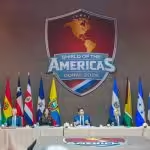
In a historic speech at the Seventh Summit of the Americas, Panama City, on April 12, 2015, Rafael Correa made the case for a new inter-American system:
“The reality is that we need not only a new system of human rights, but a new inter-American system. We must understand that the Americas to the north and south of the Río Grande are different, and we must speak as blocs.”
“The Organization of American States (OAS) has historically been captured by the interests and visions of North America, and their accumulated biases and atavism are inefficient and unreliable for the new times in which we are living in Latin America and the Caribbean.”
“The Community of Latin American and Caribbean States – CELAC – must be the forum for Latin American and Caribbean discussions, and the OAS should become the forum in which, as blocs, CELAC and North America discuss their conflicts.”[25]
It appears that the time for such a proposal has come, as the OAS loses its democratic legitimacy and a new wave of Bolivarian sentiment sweeps the continent.
Sources
[1] Frónesis: Vol. 9, No. 3, 2002: 39-65
[2] Informador.MX. “México envía buque a Cuba con 40 mil litros de petrolíferos”. July 26, 2021.
https://www.informador.mx/mexico/Mexico-envia-buque-a-Cuba-con-40-mil-litros-de-petroliferos-20210726-0074.html
[3] CNN Español. “El Gobierno de Nicaragua dice que enviará un barco con alimentos a Cuba en los ‘próximos días’”. July 28, 2021.
[4] Kawsachun News. “Bolivia will send food and syringes to Cuba.” July 28, 2021. https://kawsachunnews.com/bolivia-will-send-food-and-syringes-to-cuba
[5] Telesur. “Rusia envía 88 toneladas de ayuda humanitaria a Cuba”. July 24, 2021.
https://www.telesurtv.net/news/rusia-cuba-ayuda-humanitaria-toneladas-20210724-0008.html
[6] Telesur, “Let’s keep alive Bolivar’s integration dream”, July 24, 2021. https://www.telesurenglish.net/news/Lets-Keep-Alive-Bolivars-Integration-Dream-AMLO-Says-20210724-0001.html
[7] Council on Hemispheric Affairs. Danny Shaw. “Behind the Racist Coup in Bolivia.” https://www.coha.org/behind-the-racist-coup-in-bolivia/ Nov. 11, 2019.
CEPR. “Data from Bolivia’s Election Add More Evidence That OAS Fabricated Last Year’s Fraud Claims.” October 21, 2020.
https://cepr.net/data-from-bolivias-election-add-more-evidence-that-oas-fabricated-last-years-fraud-claims/
New York Times. “M.I.T. Researchers Cast Doubt on Bolivian Election Fraud.” March 11, 2020.
[8] https://twitter.com/LuchoXBolivia/status/1419426973022052358?s=20
[9] Prensa Latina. “Foreign Minister of Cuba: OAS maneuver against Cuba ‘defeated’.” Havanna, July 28, 2021.
https://www.plenglish.com/index.php?o=rn&id=69958&SEO=foreign-minister-of-cuba-oas-maneuver-against-cuba-defeated
[10] Revista de Frente. “El Bogotazo, contado por Gabriel García Márquez”. April 9, 2020.
[11] Interview at WHCR 90.3 FM NYC -Roots. April 10, 2008
[12] AP News. “UK government backs Guaidó claim in Venezuelan gold fight.” July 19, 2021. https://apnews.com/article/europe-business-health-venezuela-coronavirus-pandemic-cc49bb0740185516fe7dd3db9da33f67
[13] Agenda Alternativa Bolivariana: Una Propuesta Patriótica para Salir del Laberinto. Hugo Chavez. 1996. https://entremusasyalusiones.files.wordpress.com/2017/06/agenda-bolivariana-17-pags.pdf
[14] US Department of State. John Kerry. Secretary of State. Organization of American States. Washington DC. November 18, 2013. https://2009-2017.state.gov/secretary/remarks/2013/11/217680.htm
[15] White House Office of Press Secretary. Fact Sheet: Venezuela Executive Order. March 9, 2015. https://obamawhitehouse.archives.gov/the-press-office/2015/03/09/fact-sheet-venezuela-executive-order
[16] Reuters. “U.S., Cuba restoring diplomatic ties after 54 years.” July 1, 2015.
https://www.reuters.com/article/us-cuba-usa-ties/u-s-cuba-restoring-diplomatic-ties-after-54-years-idUSKCN0PB4G320150701
[17] Washington Post. “What is the Monroe Doctrine? John Bolton’s justification for Trump’s push against Maduro.” March 4, 2019.
https://www.washingtonpost.com/world/2019/03/04/what-is-monroe-doctrine-john-boltons-justification-trumps-push-against-maduro/
[18] Congressional Research Service. Cuba: Trump Administration Expands Sanctions. May 17, 2019. https://crsreports.congress.gov/product/pdf/IN/IN11120/1
[19] Washington Post. “Top Democrat warns Biden he could miss rare diplomatic opening in Venezuela.” May 15, 2021.
https://www.washingtonpost.com/national-security/venezuela-biden-maduro-sanctions/2021/05/14/36433662-b4dd-11eb-a3b5-f994536fe84a_story.html
[20] Senate Foriegn Relations Committee. Committee Approves RENACER Act to Hold Ortega Regime Accountable for Subverting Democracy in Nicaragua. June 22, 2021.
https://www.foreign.senate.gov/press/chair/release/committee-approves-renacer-act-to-hold-ortega-regime-accountable-for-subverting-democracy-in-nicaragua
[21] El Nuevo Herald. “Blinken felicita a Castillo de Perú y le pide un ‘rol constructivo’ en Cuba y Venezuela”. July 27, 2021.
https://www.elnuevoherald.com/noticias/mundo/america-latina/article253053253.html
[22] Youtube. Mexico: Comenzó XXI Reunión de Cancilleres de la CELAC. July 24, 2021.
https://www.youtube.com/watch?v=O90jkcS0kjc&t=36s
[23] Bolivia (Plurinational State of) 2009. Constitution. Oxford University Press.
https://www.constituteproject.org/constitution/Bolivia_2009?lang=en
[24] Los Angeles Times. “Pedro Castillo reitera pedido de nueva Constitución en Perú”. July 16, 2021.
https://www.latimes.com/espanol/internacional/articulo/2021-07-16/pedro-castillo-pedido-nueva-constitucion-peru
[25] Global Learning. http://www.globallearning-cuba.com/speech-at-summit-of-the-americas-2015.html
Featured image: Credit main photo: Government of México. 21st Summit of Foreign Ministers from the Community of Latin American and the Caribbean States (CELAC), July 24, 2021
(Council Hemispheric of Affairs)
Jill Clark-Gollub and Patricio Zamorano contributed as co-editors
William Camacaro
William Camacaro is a Venezuelan-American National Co-Coordinator in the Alliance for Global Justice. He was a co-founder of the Bolivarian Circle of New York “Alberto Lovera” and Senior Analyst for the Council on Hemispheric Affairs (COHA). He holds a Master’s Degree of Fine Arts and a Master’s Degree in Latin American Literature from City University of New York. William has published in the Monthly Review, Counterpunch, COHA, the Afro-America Magazine, Ecology, Orinoco Tribune and other venues. He has organized delegations to Ecuador, Bolivia and Venezuela. He has been a long-time activist for social justice in the United States, such as organizing protests against police brutality in NYC, for the independence of Puerto Rico, and for the freedom of political prisoners. William has also been a leader in defense of progressive governments and social movements in Latin America.
Frederick B. Mills
Frederick B. Mills, Ph.D., is professor of philosophy and a member of the Philosophy of Liberation Association and the American Philosophical Association. He has received awards for excellence in teaching and international outreach from Bowie State University. Mills has published articles on philosophy of mind, ethics and public policy, Descartes, Spinoza, Kant, Sartre, Merleau-Ponty, Mario Bencastro, Enrique Dussel as well as political analysis on contemporary Latin American politics. He has contributed articles to Counterpunch, the Council on Hemispheric Affairs, and other independent media.