Five decades ago on August 22, Hugo Banzer’s seven-year military dictatorship was installed in Bolivia through the civic-military coup of August 21, 1971—with all the attributes and objectives of Bolivia’s 2019 coup. Among the parallels, was Banzer’s vice president during his second period in power, Jorge “Tuto” Quiroga, who emerged as a senior figure in 2019 and was appointed as an international envoy by Jeanine Áñez.
Over 100 people were killed and at least 500 wounded between August 18-21 of 1971, including 24 university students in Santa Cruz who were killed on August 20. The period of dictatorship resulted in the murder of 468 people. In addition, thousands went into exile, at least 150 were forcefully disappeared and thousands were held as political prisoners, most without trial, and many having suffered torture.
To mark the anniversary, a tribute to the victims of the Banzer coup was held in La Paz, organized by the Association of Relatives of Detained, Disappeared and Martyrs for National Liberation (ASOFAMD), with the participation of President Luis Arce, who said that both the 1971 and 2019 coups had a similar objective: to appropriate natural resources and to “fill the regime’s pockets with the hunger of the people.”
Ruth Llanos, a survivor of the Banzer coup, took to the podium and outlined the similarities with the Jeanine Añez regime: In both cases, destabilizing movements began in Santa Cruz and took on a particular religious and racist character. Llanos warned that Bolivia must not allow new destabilizing actions and must fight Plan Cóndor 2.0.
President Arce announced the installation of “Houses of Memory” to be placed around the country in memory of the massacres and serious human rights violations which occurred during both periods.
“In no way must we generate impunity: neither forgiveness nor forgetfulness. Justice,” said the president. The commemoration for the victims of the Banzer dictatorship drew particular attention in light of the newly released human rights report of the GIEI-Bolivia, in which international experts on human rights and law confirmed that the Áñez regime had carried out massacres after the constitutional president Evo Morales was deposed and forced to flee the country. The full report can be read here.
RELATED CONTENT: APDHB: Añez Escape Attempt Underway
Banzer’s dictatorship was the first in the 1970s in the Southern Cone, opening the cycle of counter-revolutionary coups of that decade. Bolivia would be followed in June and September 1973 by coups carried out in Uruguay and Chile, and in 1976 by the coup led by Videla and the military junta in Argentina. Like the Áñez coup of 2019, Banzer’s dictatorship received immediate support from the United States and Brazil. Press was censored and opposition radio/television stations were closed down in both 1971 and 2019.
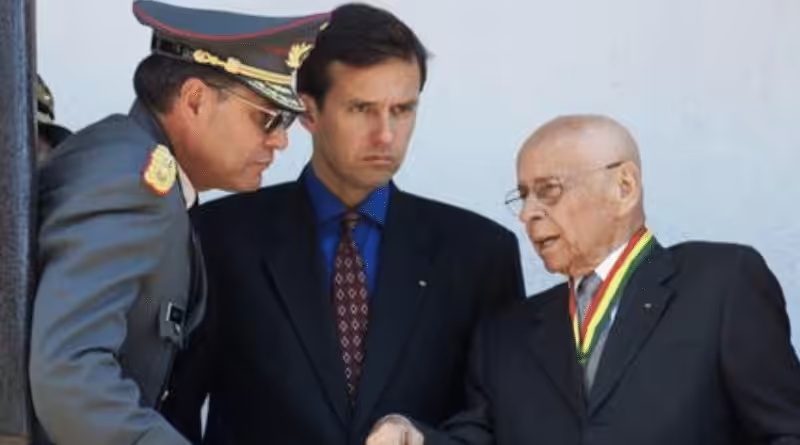
Political heir of the Hugo Banzer regime, Tuto Quiroga, played a leading role in the 2019 coup. Tuto Quiroga with ex-dictator Jeanine Áñez and the principal minister of her de facto government, Arturo Murillo. Tuto Quiroga looks on as Jeanine Áñez greets Jhanisse Vaca Daza, founder of the US State Department-supported NGO Ríos de Pie.Banzer’s economic strategy sought foreign investment by eliminating restrictions and tariffs on the introduction of capital. The elimination of subsidies for popular consumer products and substantial price increases to food affected campesinos whose mobilizations in Cochabamba were met with lethal force in the Masacre del Valle of January 1974, in which the military fired on thousands of campesinos from fighter planes, tanks and armored vehicles.
#UnDíaComoHoy, 1971, el dictador Hugo Banzer, inició la sangrienta dictadura de 7 años con el Plan Cóndor de la #CIA. Hoy, sus herederos políticos buscan impunidad por el último golpe de 2019 que también causó masacres, torturas y persecuciones racistas. Golpismo es imperialismo pic.twitter.com/zIJNW0wV7u
— Evo Morales Ayma (@evoespueblo) August 21, 2021
Former President Evo Morales recalled the date, saying, “In 1971, the dictator Hugo Banzer began the bloody 7-year dictatorship with the CIA’s Operation Cóndor. Today, his political heirs seek impunity for the last coup of 2019 that also caused massacres, torture and racist persecution. Golpismo is imperialism.”
Featured image: Former dictator of Bolivia, Hugo Banzer (right), with Jorge “Tuto” Quiroga and former military commander Alvin Anaya, in Sucre in August 2001. Photo courtesy of Kawsachun News.