Faced with the Left’s lead in the polls, coup-installed president Jeanine Áñez has suspended Bolivia’s election for the third time. The COB trade union federation has responded with a general strike and road blockades around Bolivia — showing that the country’s mighty social movements will not allow an illegitimate regime to continue clinging to power.
By Anton Flaig and Denis Rogatyuk – Aug 10, 2020
Nine months after the military coup that ousted left-wing president Evo Morales, Bolivia’s coup government has suspended elections for the third time. In reaction to acting president Jeanine Áñez’s move to delay the ballot, the Bolivian Workers’ Central (COB) staged marches around the country, with some half a million people turning out for the demonstration in El Alto. Addressing the rally, COB general secretary Juan Carlos Huarachi threatened an indefinite general strike unless the elections went ahead as planned.
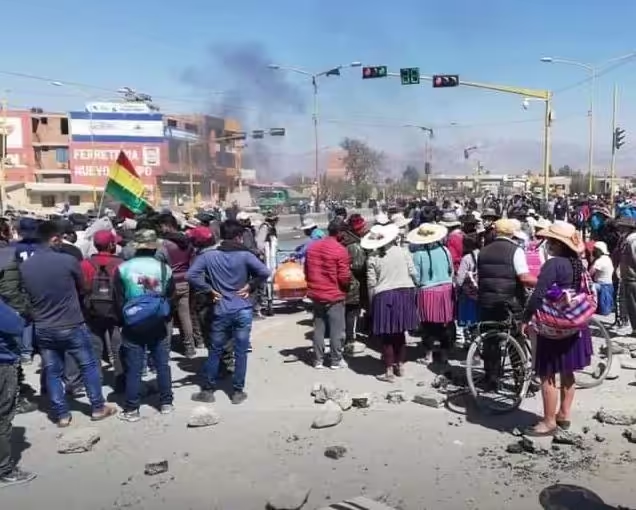
The El Alto demonstration was the biggest since the immediate aftermath of Morales’s overthrow in November, when indigenous people protesting the coup were “shot like animals,” killing at least thirty-seven. Yet the election court president Salvador Romero, appointed by the coup regime, ignored the protests, and on Monday, August 3, the indefinite general strike began in earnest, with protests, marches, and road blockades rapidly spreading across Bolivia. Within twenty-four hours, over seventy-five major roads and highways in the provinces of La Paz, Cochabamba, Santa Cruz, Oruro, and Potosí were completely or partially blockaded by local trade union branches and social movements.
The COB-backed blockades were widely supported by trade unions and social movements. Participants included the Union Federation of Bolivian Mine Workers (FSTMB), the coca growers (the Six Federations of the Trópico of Cochabamba), the Bartolina Sisa women’s federation, the Tupac Katari peasants’ federation, and the trade union Confederation of Intercultural Communities of Bolivia (CSCIB). These forces have a history of mass mobilizations against neoliberal governments, such as the historic 2003 Gas War and the 2000 water wars in Cochabamba. Following the first few days of blockades, on August 6 the Supreme Electoral Court (TSE) was forced to open talks with the social movements regarding the final date of the elections.
After a tense night of negotiations on August 8, which involved the COB, the TSE and both houses of the Plurinational Legislative Assembly, no agreement was reached. The electoral court continues to rebuff any attempts to move the election closer to the original September 6 date. The following day, an attempt by the Áñez regime to convene a national political dialogue ended in a humiliating failure, as not only Morales’s Movement Toward Socialism (MAS), but practically all political forces boycotted the meeting, except for her own “Together” (Juntos) alliance and two minor right-wing parties.
More promisingly, it seems that under Huarachi’s leadership, the COB has now returned to its historic roots of fighting for democracy and against military dictatorship. Indeed, while the COB is now firmly standing against the coup regime’s bid to delay elections, even a few months ago its stand was far less robust. With the coup regime seeking to avoid a test at the polls, the coming developments will test the power of Bolivian social movements — and their willingness to stand shoulder to shoulder with Morales and his allies.
RELATED CONTENT: Perspective on the Recent Protests in Bolivia
How the COB and FEJUVE Failed to Defend Evo
This relationship cannot be taken for granted. When Bolivia headed for presidential elections in October 2019, the alliance of urban mestizo workers and rural indigenous social movements that had long backed Morales’s government had begun to weaken. After fourteen years of governing, there wasn’t much left of the revolutionary spirit that first brought Morales’s MAS party into office. And though Morales was credited as Bolivia’s first indigenous president, this distinction had become age-worn.
When Bolivians did go to the polls on October 20, deciding whether to grant Morales another term, he took some 47 percent of the popular vote. This may seem like a high score in a multicandidate race, but by comparison, in 2014 he had swept to victory with 61.36 percent support. The 2016 constitutional referendum on allowing Morales and vice president Álvaro García Linera to run for a historic fourth term saw the MAS vote drop below 50 percent for the first time since 2005 — a key loss that set off the domino effect that would eventually result in the coup of November 2019.
While Morales did eventually obtain the right to run in the 2019 presidential election, thanks to a ruling from the Plurinational Constitutional Court, the right-wing opposition invested a great deal of time and energy in building a false narrative that Bolivia had turned into a “narcostate” and “dictatorship,” given Morales’s refusal to accept the results of the referendum. This narrative found its expression in the extreme violence perpetrated during last October’s election campaign by far-right groups like the 21F movement, the Cochala youth resistance group, and the Cruzenian Youth Union, followed by a police mutiny at the start of November and the military coup on November 10.
The MAS’s indigenous strongholds endured the brunt of the violence surrounding October’s election. The two key massacres happened in Sacaba, Cochabamba, against the Morales-loyalist coca growers from the Six Federations of the Trópico; and in Senkata, against the self-organized indigenous Aymara residents of El Alto (FEJUVE).
Faced with such intense persecution, neither FEJUVE nor COB robustly defended Morales’s government. With a huge Organization of American States media campaign speaking of supposed “election fraud” and right-wing mass demonstrations, and military and police demanding that Morales resign, COB leader Huarachi became a part of “pacification” moves.
Like many labor leaders, he received serious death threats; and when police and military forced Morales to resign, Huarachi commented that he should do so if it would help “pacify the country.” Many hardcore MAS supporters regarded this as treachery — and Venezuelan president Nicolás Maduro called Huarachi a traitor.
Yet in recent months, these social movements have regained strength — and hardened their line. This has especially owed to the Áñez regime’s relative absence during the coronavirus crisis, and the demand for justice after a period of intense repression. Under the leadership of Basilio Villasante, FEJUVE, which forms part of the MAS-affiliated “Pact of Unity,” is working together with COB groups with which the Áñez government has refused all negotiations.
By announcing the indefinite general strike and mass mobilizations, the COB is reestablishing the unity of rural peasants (campesinos), miners, and urban workers which was lost last November. In recent decades, it was precisely this unity and permanent mass mobilization that made the nationalization of natural resources and fourteen years of MAS government with successful economic development possible. Several weeks before the marches began, Miners leader Orlando Gutiérrez from the FSTMB said: “This is no longer about a political party. This is about the dignity of the people.”
Memory of Struggles
In his speech at the El Alto demonstration, Huarachi invoked the struggles of recent Bolivian history, noting how he himself marched during the Gas War of 2003. “How can we forget these struggles and those who gave their lives in those struggles?” he asked, “After many years, the people are united again and telling the government to respect the election [date] of September 6.”
The day after the march, the coup regime filed a criminal lawsuit against him and other trade unionists for “promoting criminal acts and threatening public health.”
Miners — as represented by Huarachi’s own union, the FSTMB — used to be the major stronghold of Bolivian workers’ organization, leading the National Revolution of the 1950s, and the resistance against military dictatorships and neoliberal policies dictated by the IMF. Their work in the mines, in a country heavily reliant on exporting minerals, made them the strongest — and the only armed — sector of organized workers. This changed with the closure of the state-owned mines under Víctor Paz Estenssoro in 1985, undermining the union.
In more recent years, Morales’s government prevented the closing of state-owned mines and gave subsidies to private mines to protect relatively well-paid jobs. This helped make the FSTMB (and the COB) a close ally in the “process of change.” But even if the FSTMB has lost some of its power, its legacy continues in militant unions involving former miners, like the Six Federations of the Trópico, the coca growers from Yungas, union associations in El Alto, and many indigenous suburbs.
Such organizations are still under the ideological influence of pre-capitalist indigenous culture, but also trade union traditions: COB also has major symbolic value given its historic role in the fight for democracy.
The COB thus has to represent its traditional base among workers and, at the same time, the indigenous middle class that emerged under Morales’s presidency, including large numbers of university students. Under the Áñez regime, parts of this new indigenous middle class are already losing the social rights conquered over the last decade, with shock-neoliberal policies destroying their standard of living.
So, the economic incapacity of Áñez’s government to deal with the terrible economic situation and economic crisis is strengthening social movements and the COB, while the racism of the government is bringing middle-class indigenous people back into the MAS fold.
Echoes of 2003
For many MAS supporters and left-wing intellectuals like Jorge Richter, there are clear parallels with the turbulent neoliberal times in the early 2000s, which prepared Morales’s initial rise to power. There are number of important similarities.
Just like back in 2003, we have long queues to buy gas, a government asking for IMF loans, mass demonstrations, tanks on the streets protecting an unpopular government, and radical Aymara-Indianist Felipe Quispe Huanca announcing his support for COB blockades.
Quispe was probably the most important figure in the fight for indigenous rights throughout the 1990s and early 2000s. His line “I don’t want my daughter to be your housemaid” changed Bolivian politics and he was the intellectual author of the Gas War of 2003.
He was never a MAS member and since 2014 has been one of the toughest Indianist critics of the Morales government. Yet even among such critics, he is hardly alone in taking a stance in favor of the current protests. Dr Félix Patzi, indigenous governor of La Paz and a former MAS politician, said that Jeanine Áñez will end up like Gonzálo Sánchez de Lozada (“Goni”), the president overthrown by the anti-privatization protests of 2003: “Escaping by a helicopter from the palace because of the conflicts that are coming, people are tired of her and are going to stand up.”
Anti-MASism
But there is an important difference between the Áñez government and Goni’s: the latter had, after all, won a democratic election, even if narrowly; after his ouster, he was replaced by his vice president Carlos Mesa. Áñez took office thanks to a military-police coup in the name of democracy and “God,” supported by the old racist middle class.
The vast majority of the Bolivian press framed the COB-led march as a revolt organized by Morales’s own MAS party, feeding the coup government’s narrative that the mass mobilizations are primarily directed at destabilizing the country in the middle of a pandemic This press has routinely attacked protestors as “savages.”
The main viewers and readers of these racist media outlets are in the traditional middle class of big cities and, in the white-separatist stronghold of Santa Cruz, even workers. Together they are building a strong anti-MAS bloc, to elect “anyone” but a renewed MAS government.
Journalist Fernando Molina has developed a good explanation for this phenomenon. The traditional middle class never truly accepted the indigenous president Morales. For them, the emerging indigenous middle class was eroding the “educational capital” of the old, privileged middle class of partly Spanish ancestry.
So, the protests against Morales were not just about any supposed “election fraud.” This was a euphemistic way to express a rejection of indigenous power, to be replaced by a power bloc centered on “military and police forces, the judiciary, the mass media, the universities and the organizations and institutions of the middle and upper classes.”
Yet given its own corruption and internal divisions, as well as the regime’s dramatic mishandling of COVID-19, this movement has largely demobilized in recent months. Morales’s main challenger in the October election, former president Carlos Mesa has thus far failed to unite enough white and mestizo middle-class voters behind his own candidacy.
If democratic elections do ultimately take place, he will try to use the formula of the “useful vote,” presenting himself as the only candidate capable of winning a democratic election against MAS. In the time between the coup in November 2019 and the COVID-19 crisis starting this March, his claim was probably accurate. But with the coronavirus crisis, the social reality in Bolivia has changed.
COVID-19 and Economic Crisis
During more than a hundred days of quarantine, the government failed to buy respirators and inform the indigenous-speaking population about the dangerous pandemic, instead preferring to close down indigenous radio stations. So, it didn’t take long for the health system to collapse. Since then, people have been dying on the streets in the thousands, in a country of just 11 million.
At the same time, the economic situation has worsened drastically. In the thirteen years of MAS rule, Bolivia regularly posted the strongest economic growth in Latin America. This took place under economy minister Luis Arce Catacora, who is now the MAS presidential candidate. In just over a decade, extreme poverty fell by more than half, from 38.2 percent in 2005 to 15.2 percent in 2018; moderate poverty also decreased from 60.6 percent in 2005 to 34.6 percent in 2018. In this sense, under Evo Morales and Luis Arce, Bolivia had a golden decade.
The poor indigenous population working in the informal economy benefited most from all this. Natural gas was nationalized, making possible mass-scale investments. Social benefit payments for elderly people, mothers, parents, and others were created. A huge infrastructure of schools, universities, hospitals, and public transport were built, including modern projects like the urban cable cars connecting La Paz and El Alto.
A new generation of indigenous working-class teenagers entered universities for the first time. In the last year, the MAS government had sufficient financial resources to start creating a universal health care system (SUS) to make health care a human right. They implemented their own “social-communitarian” economic model, making Bolivia a truly independent country.
But more than half of the workforce still depends, directly or indirectly, on day-to-day work in the “informal sector.” After more than a hundred days of quarantine, without any social policies to alleviate their suffering, this sector is now under intense pressure. Parts of the new indigenous middle class are now losing everything they had. And poor people are hungry, despite neighborhood initiatives like “common pots” and “the people will save themselves.” This terrible situation is the base of the coming social conflicts.
Decisive Test
Faced with a fresh provocation by the coup regime, the COB and social movements have now chosen the path of mass mobilization, with the blockades organized all around the country on August 3. It remains to be seen if they are now strong enough to compel the election court to show a basic degree of institutional independence, and force a democratic vote.
If the coup government gets away with suspending the elections, it can get away with anything. This would mean it continuing to nakedly rob from state companies, persecute trade unionists and indigenous activists, and trample on democratic rights. In the coming days and weeks, we can expect more massacres like in November 2019 and the early 2000s.
The Left has to be on its guard, ready to denounce all such abuses. So far, not a single Western human rights group or NGO has seriously denounced the coup regime for its abuses or the massacres it as committed. It will, then, be up to the Bolivian people to save themselves.
Featured image: Protesters in Cochabamba. (Photo courtesy of COB)
Anton Flaig is the organizer of the Wiphala Movement Germany and a student of political science and sociology.
Denis Rogatyuk is a journalist at El Ciudadano, a writer, contributor, and researcher with a number of publications including Jacobin, Tribune, Le Vent Se Leve, Senso Comune, the GrayZone, and others.