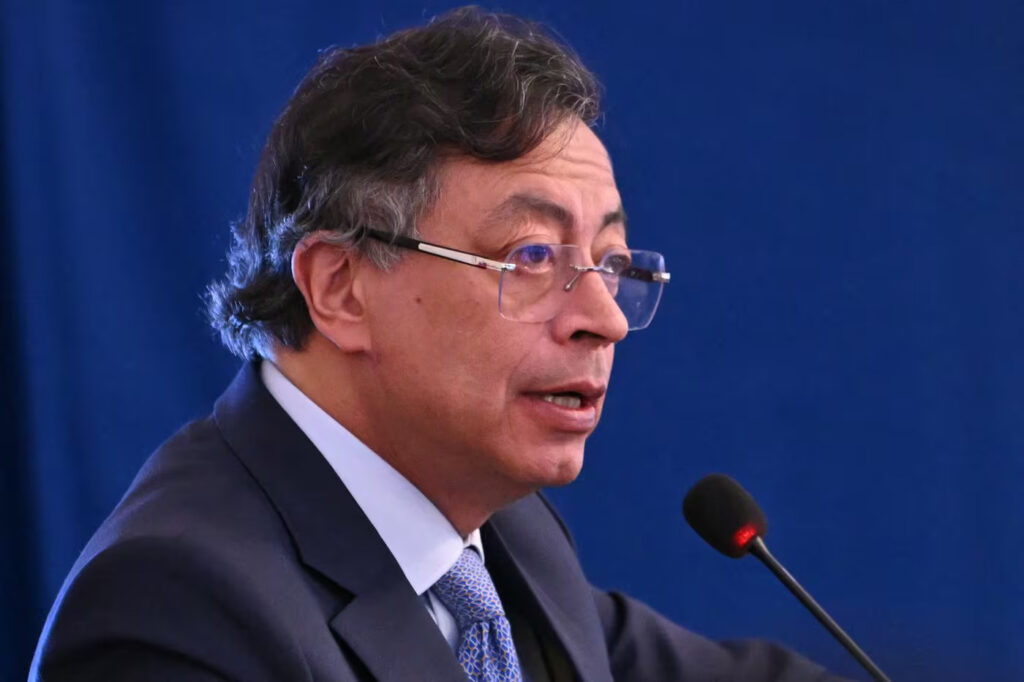
The president of Colombia, Gustavo Petro. Photo: AFP.
The president of Colombia, Gustavo Petro. Photo: AFP.
Colombian President Gustavo Petro announced his country’s exit from the Andean Community in response to Ecuador’s imposition of 100% tariffs on Colombian products, which Petro called a “monstrosity.”
“This means the end of the Andean Pact for Colombia. We have nothing more there,” the Colombian president announced on Thursday, April 9. This marks a breaking point for the regional integration body comprised of Bolivia, Colombia, Ecuador, and Peru.
In this regard, Petro gave instructions for the immediate reorientation of Colombian foreign and trade policy toward Mercosur, the Caribbean, and Central America.
Esto es simplemente una monstruosidad pero significa el fin del Pacto Andino para Colombia. Nada hacemos ya allí.
La canciller debe iniciar el paso en el mercosur a ser socios plenos y dirigirnos hacia el Caribe y centroamérica con más fuerza. https://t.co/DSm9DwQ1Tm
— Gustavo Petro (@petrogustavo) April 9, 2026
Colombian Foreign Minister Rosa Villavicencio supported the decision and confirmed that the process for Colombia’s full membership in Mercosur has already begun. Villavicencio criticized the Ecuadorian government’s stance, describing it as an “anti-progressive ideology” that undermines the necessary Latin American unity to face common challenges.
As part of the diplomatic escalation, the Colombian government called its ambassador in Quito, María Antonia Vélez, for consultations. She will return to Bogotá in the coming hours. Likewise, the suspension of all technical meetings to resolve the economic differences between the two nations was announced.
Analysts and Colombian government sources suggest that Ecuador’s tariff measures are an attempt by President Daniel Noboa to divert attention from the internal security crisis, marked by an increase in violence and drug trafficking.
The Colombian president pointed out that the Noboa administration has neglected surveillance at key ports, facilitating cocaine trafficking. This situation has shifted the focus of bilateral cooperation toward a scenario of political confrontation.
According to experts, Colombia’s exit from the Andean Community will directly impact border populations, and Ecuador will likely suffer the greatest consequences. Ecuador has a high dependence on trade with Colombia in strategic sectors, including electricity supply, hydrocarbons import, and basic manufactured products.
Colombia: President Petro Hints at Possible Ecuadorian Bombing on Shared Border
Daniel Noboa’s government’s increase of tariffs to 100% is part of a trade war that is fracturing regional integration. Quito justifies the measure by alleging a supposed inaction by Bogotá in combating organized crime. However, the diplomatic rift intensified after Gustavo Petro’s criticism of the assault on the Mexican Embassy in Ecuador and the situation of former Vice President Jorge Glas, a victim of lawfare.
The tariff offensive puts a $1.8 billion bilateral trade at risk and exacerbates reciprocal sanctions in the energy sector.
International analysts believe that Noboa’s policy responds to the application of the United States’ Monroe Doctrine in the region. The militarization of the border and the use of anti-terrorism narratives are considered a strategy to divert attention from the internal crisis and to justify actions that violate international law and Colombian sovereignty.
This commercial and diplomatic break jeopardizes the economic stability of the region, leaving Ecuador in a vulnerable position due to the loss of its main energy and essential goods supplier. The breakdown of relations and policies within the Andean Community is reshaping the region’s integration map. Meanwhile, Colombia accelerates its rapprochement with the southern and Caribbean blocs.
(Telesur)
Translation: Orinoco Tribune
OT/SC/SF