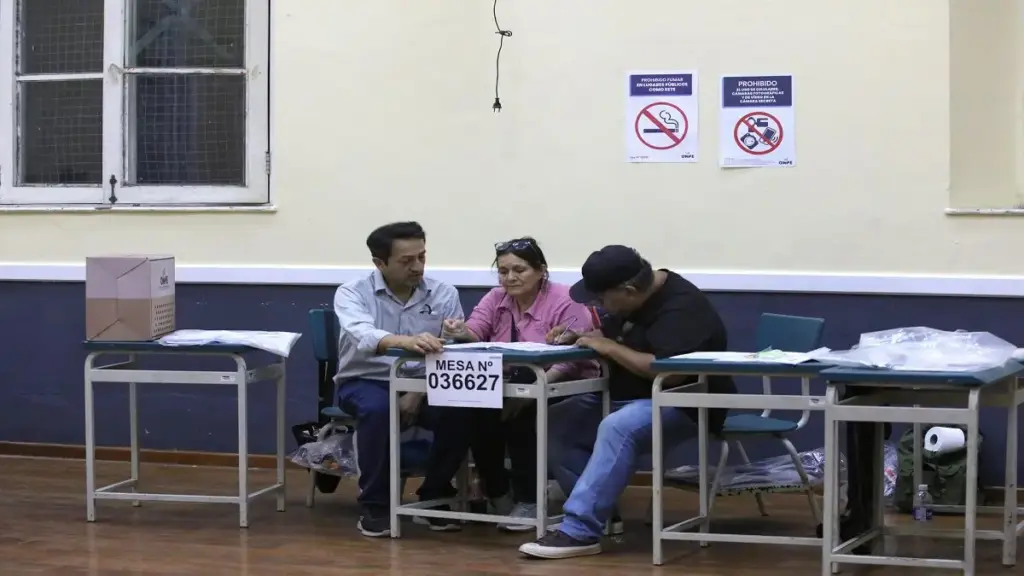
Peruvian ballot counters on election day. Photo: EFE.
Peruvian ballot counters on election day. Photo: EFE.
Initial results from Peru’s 2026 general elections—held to determine the president for the 2026–2031 term—have been released by Peru’s National Office of Electoral Processes (ONPE).
With 46.7% of official results processed, a total of 43,355 tally sheets have been counted out of 92,766, according to the latest update as of April 13, 2026, at 02:47 a.m.
The Special Election Jury (JEE) has so far received 0.07% of the tally sheets, while 53.2%—equivalent to 49,346 records—remain pending as the official vote count continues.
Early standings
With nearly half of the ballots processed, Keiko Fujimori of Fuerza Popular is leading the vote, followed by Rafael López Aliaga of Renovación Popular.
Jorge Nieto, representing the Partido del Buen Gobierno, is currently in third place, followed by Ricardo Belmont of Partido Cívico Obras.
Delays and extended voting—fraud claims pending?
Authorities extended voting hours by one additional hour beyond the scheduled 6:00 p.m. closing time due to delays in the delivery of electoral materials to 211 polling stations. The disruption affected more than 63,000 voters who were initially unable to cast their ballots.
There were reports on the ground in San Juan de Miraflores, Lima, that working-class neighbourhoods suffered disproportionately: 15 polling centres were reportedly closed when citizens turned up to vote.
However, anti-imperialist political analyst Maria-Fe Celi described this as “pro-neoliberal system” and a “far-right” narrative.
Celi wrote on X: the Fujiomi-led party “are trying to create the illusion that they’re winning, so when the rural votes are counted, if they change the initial outcome as it is expected, they will say the election is fraudulent.”
The official count remains ongoing, with more than half of the tally sheets still pending processing.
Keiko Fujimori is the daughter of infamous right-wing Peruvian president/dictator Alberto Fujimori, who ruled Peru from 1990 to 2000. In addition to implementing a neoliberal economic agenda, his presidency was tarnished by extrajudicial killings, forced sterilization of Peru’s Indigenous peoples, and a “self-coup” in 1992 during which Alberto Fujimori dissolved the Congress and Supreme Court, effectively making himself a dictator.
In 2009, Alberto Fujimori was convicted of human rights abuses. Courts found him guilty of ordering the 1991 Barrios Altos massacre and the 1992 La Cantuta massacre and of ordering kidnappings of an opposition journalist and of Samuel Dyer Ampudia. He was sentenced to 25 years in prison.
Later that same year, he was found guilty of embezzling US $15 million of state funds. The assets were handed over to Vladimiro Montesinos, head of Peru’s National Intelligence Service during the Fujimori regime. Again in 2009, Alberto Fujimori was convicted of carrying out illegal phone taps on journalists and opposition politicians and sentenced to six additional years of imprisonment. He died in September 2024.
The US Central Intelligence Agency (CIA) always maintained close ties with the Fujimori regime, particularly with Montesinos, who was provided with at least US $10 million for alleged “counternarcotics and anti-terrorism” programs although the regime’s human rights abuses were well known.
During the 2000 election, in particular, Alberto Fujimori’s campaign was widely condenmned for multiple fraudulent practices, including the use of a “signature factory” whereby voters forged millions of signatures, ballot tampering, and widespread bribery (exposed in the “Vladi-video” scandal). Alberto Fujimori fled to Japan in 2000 as a result.
(Telesur) with contribution from Orinoco Tribune staff
Translation: Orinoco Tribune
OT/CB/SL