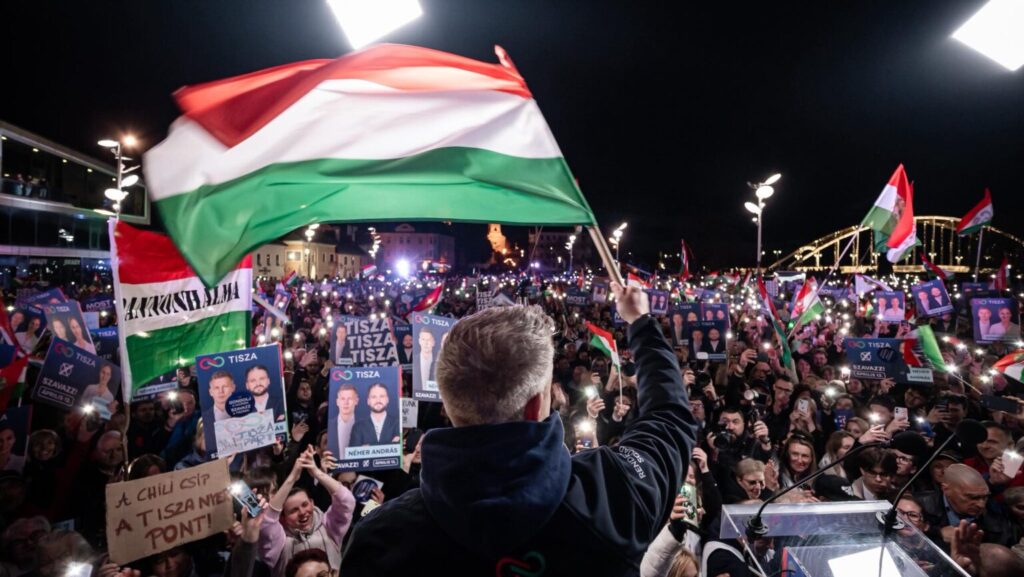
Péter Magyar during a pre-election rally. Photo: Péter Magyar/X.
Péter Magyar during a pre-election rally. Photo: Péter Magyar/X.
By Ana Vračar – Apr 13, 2026
The Tisza party defeated Viktor Orbán’s Fidesz in Hungary’s election, but a likely Magyar administration promises few radical breaks.
After 16 years, Viktor Orbán has been ousted as Prime Minister of Hungary by a landslide victory for Péter Magyar and the Tisza party. On Sunday, April 12, a record number of voters participated in the election, giving Tisza 138 parliamentary seats compared to Fidesz’s 55 – bringing a change of government, but not necessarily a policy or ideological overhaul.
Orbán’s tenure was marked by crackdowns on civil, LGBTQ, and women’s rights, as well as assaults on migrant rights. For European Union officials, it brought headaches as the administration refused to align with the bloc’s position on the Ukraine war and regularly obstructed EU internal processes. Péter Magyar’s election pitch promised to moderate some of these issues, though there is little expectation for radical breaks. After all, Magyar hails from Orbán’s Fidesz party and shares its right-wing positions.
Read more: “A new kind of right-wing extremism is on a roll in Hungary”
Still, local activists describe a sense of relief on the streets Monday, along with surprise that election day passed unexpectedly smoothly. With two-thirds of seats secured in parliament, Magyar will have the necessary majority to implement reforms with relative ease. Orbán himself admitted defeat early during election night, leaving the Patriots for Europe group among the few mentioning potential interference in the electoral process.
“Today, Europe is Hungarian”
European governments celebrated Magyar’s election with a number of statements that far exceeded their reactions to the illegal war the United States and Israel launched against Iran and other recent infringements of international law. Their communications – fueled by the understanding that, with the end of Orbán’s administration, there are now fewer obstacles in implementing a €90 billion joint loan to continue financing the war in Ukraine – applauded Hungary’s return to the so-called European family.
“It’s a return to Europe, sure,” social scientist and activist Tibor Meszmann told Peoples Dispatch. “But which Europe is that?”
The Tisza party is a member of the European People’s Party (EPP), the largest, right-wing bloc in the European Parliament. The EPP has been the proponent of policies that will have a devastating impact on Europe’s working class, as well as migration reforms that virtually erased the right to asylum – policies passed together with the parliament’s far-right groups, to which Fidesz is associated. When contextualized within the overall strengthening of extreme right movements in the region and the rightward shift of other conservatives, it is clear that Tisza’s victory is unlikely to create more space for progressive movements in Hungary.
Similar concerns have been echoed by left movements at the EU level. Manon Aubry of La France Insoumise wrote on Monday: “Péter Magyar is not a clear break from the Orbán era. More mindful – we hope! – of respect for the rule of law, he will lead a policy firmly anchored on the right. He was a member of Orbán’s cabinet and shared some of his positions, particularly on LGBT issues – for example, he refused to oppose Orbán’s ban on Pride in Budapest – or on migration issues.”
How the US-Israeli Aggression Against Iran Is Affecting the War in Ukraine
An election program subservient to foreign capital?
More notable changes might happen in public services and initiatives against corruption, two points that featured prominently in Magyar’s program, based on a combination of pro-market reforms and household support measures introduced by his predecessor.
Overall, local activists say, the election program itself was framed in a conservative populist key while remaining subservient to foreign capital. The few names floated as possible ministers until now additionally point to such a possibility: some potential ministerial candidates and leading party figures having been high-ranking figures in fossil fuel giant Shell and telecommunications multinational Vodafone.
And while the election of a non-Orbán government signals thawing relations with EU and other international institutions – including through the announced return to the International Criminal Court – it should not be assumed that the new government will fully align with the EU path.
This is also because of the economic context, Meszmann points out, marked by growing grievances among the people. The Magyar government is likely to be pragmatic, the social scientist adds, so it is difficult to imagine it will sever ties with Russia, particularly when it comes to energy supply. These forecasts were quickly confirmed, with Magyar announcing Hungary would continue to focus on the cheapest energy sources available – including Russian oil and gas, despite existing EU limitations – during one of his first press conferences after the election.
Continuity is also to be expected in other aspects of international relations, including Hungary’s relationship with Israel. This relationship has continued, strong and steady, throughout the genocide in Gaza, and faces no real threat by Magyar’s coming into office.
Read more: Amid mass protests in the West, Israel’s military footprint expands in Eastern Europe
The thing to watch for in the coming months, Meszmann emphasizes, is how the new government will address the population’s economic needs. Should a Prime Minister Magyar be unable to navigate a likely major economic crisis in the coming year – not improbable if his program prioritizes corporations over the population – it is easy to imagine Viktor Orbán pushing for early elections from the opposition.