A symbolic representation of the North Atlantic Treaty Organization (NATO), positioned between the United States and European Union flags, with a prominent split down the center. Photo: The Cradle.
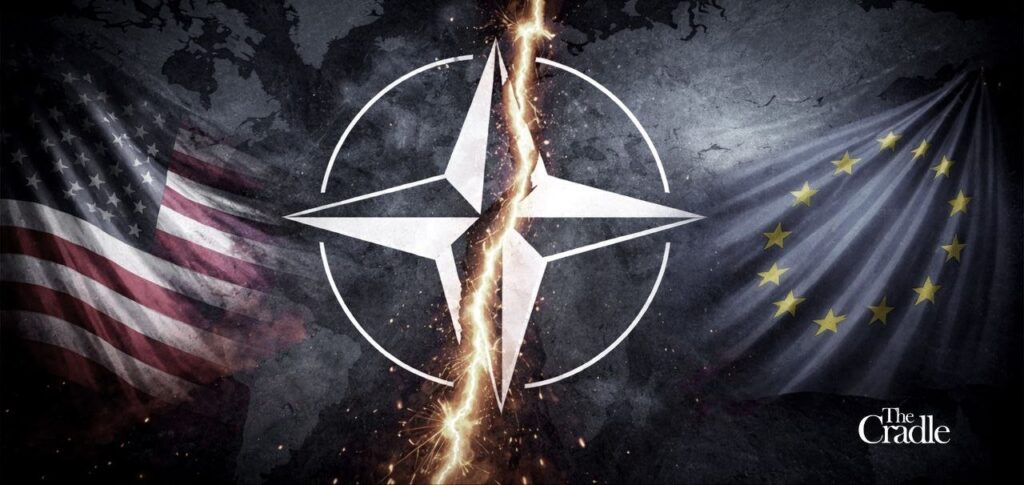
A symbolic representation of the North Atlantic Treaty Organization (NATO), positioned between the United States and European Union flags, with a prominent split down the center. Photo: The Cradle.
By Stasa Salacanin – Apr 13, 2026
Europe is moving, cautiously but decisively, toward a security future that no longer depends on the US.
The war in Iran and US President Donald Trump’s renewed push to annex Greenland have triggered what may be the deepest fracture in the 77-year history of the NATO alliance.
By early April 2026, relations between the US and its European allies appear to have reached a breaking point, with European leaders openly discussing “Plan B” security arrangements that no longer depend on American guarantees.
A fragile two-week ceasefire with Iran, agreed on 8 April, has done little to restore confidence. The following day, NATO Secretary-General Mark Rutte emerged from a high-stakes meeting failing to secure a clear US commitment to the alliance.
Trump, instead, returned to familiar rhetoric, publicly airing grievances and insisting that “NATO wasn’t there when we needed them”—a claim that speaks less to reality than to Washington’s shifting posture toward its own alliance system.
Washington’s failed attempt to assemble an international force to police the Strait of Hormuz further exposed divisions. European allies refused to participate in what they viewed as unlawful US-Israeli aggression against Iran, launched on February 28 under Operation Epic Fury. The situation deteriorated further when Trump revived longstanding threats to annex Greenland, deepening the transatlantic crisis.
An alliance stretched beyond recognition
These tensions did not begin with the war on Iran. Trump and his inner circle have repeatedly criticized the alliance, accusing European members of “free riding,” labeling NATO “obsolete” and “brain dead,” and questioning whether the US would defend Europe in the event of a Russian attack.
These statements, combined with European refusals to support US military initiatives, have created the gravest internal crisis in NATO’s history. While the alliance may endure, this moment could mark the beginning of its long-term decline.
Opinions on NATO’s future vary widely. Rutte – who is often seen as nothing but a Trump lackey, but nevertheless has earned a reputation as a “Trump whisperer” – insisted that the alliance remains “the strongest it has been since the fall of the Berlin Wall,” but many analysts are far less optimistic.
David J. Galbreath, Professor of War and Technology at the University of Bath, argues that NATO has weathered crises before and may survive the current turmoil. However, he warns that the war in Iran could generate long-term instability similar to the aftermath of the 2003 invasion of Iraq, increasing insecurity both in West Asia and globally.
However, Hall Gardner, professor emeritus from the Department of International and Comparative Politics at the American University of Paris, cautions that NATO could eventually fracture under the strain of overlapping geopolitical conflicts – not only between the US, Europe, and Russia over Ukraine, but also between the US–Israel bloc and Iran’s allies including Hamas, Hezbollah, and others in the Axis of Resistance.
According to Davis Ellison, a strategic analyst at The Hague Centre for Strategic Studies (HCSS) specializing in security and defense affairs and chair of the HCSS Initiative on the future of Transatlantic Relations, Washington has already signaled it may retaliate against NATO members that refuse to support its actions against Iran.
This has heightened anxiety among European governments, which now face the prospect of further escalation. At a minimum, Ellison suggests, the crisis will push European states to resolve security issues outside NATO frameworks.
Europe weighs defiance – and its limits
If the conflict persists, European governments may begin restricting US access to military bases, airspace, and ports. Should American ground troops be deployed, domestic political pressure in countries such as Germany, the Netherlands, and Italy could intensify calls to limit US operations, further eroding NATO’s functionality.
However, Gardner remains skeptical that European governments would fully expel US forces, even amid public opposition. Many still rely on American security guarantees. Moreover, Ellison contends that restricting access to US bases would be legally and economically complex, as it could violate existing Status of Forces Agreements (SOFA) and result in the loss of US funding tied to military infrastructure. Nevertheless, as tensions escalate, such costs may become politically acceptable.
Galbreath adds that much of the debate may be obscured by rhetoric. He tells The Cradle: “The Trump administration can do a lot of talking that hides the realities of how these bases are being used, and so far it has been difficult to see how the bases have been used thus far.”
At the same time, both sides are preparing for a more confrontational future. Gardner warns that parallel efforts to expand defense spending in both the US and Europe risk igniting a renewed arms race, one that could prove far more destabilizing than the alliance’s internal disputes.
Carney, NATO, and the War Contractors: How Canada’s ‘Sovereignty’ Pivot Deepens the Military Bloc
Beyond NATO: Fragmentation, not replacement
The deepening rift within NATO has sparked debate across Europe about alternative security arrangements. Many policymakers favor a more “Europeanized” defense structure – either a NATO with reduced US involvement or a more autonomous system built around the EU.
Galbreath agrees that the growing distance between the US and Europe will eventually force Europeans to develop a more self-sustaining security framework. However, he considers such a transformation unlikely in the near term.
Nonetheless, gradual “Europeanization” is already underway, with projections suggesting that by 2027 the US may provide only about half of NATO’s military combat power.
Yet a more European NATO could also expose internal divisions within Europe itself. In a post-NATO scenario, foreign policy might become increasingly “re-nationalized,” with states pursuing their own strategic interests rather than a unified approach.
Some countries might even seek closer ties with Eurasian powers out of economic necessity and geographic proximity, though such a shift would be deeply contentious.
While most European states would avoid alignment with Moscow, some could diversify their partnerships – strengthening economic ties with China or engaging more actively with Central Asia to secure trade routes such as the Middle Corridor.
Still, any “Eurasian turn” would likely be a reluctant and fragmented strategy rather than a coherent alternative to NATO. Therefore, the “Eurasian” shift is a theoretical alternative to a collapsed NATO and would be seen as a desperate move to secure resources and stability rather than as a preferred geopolitical alignment for most European countries.
Ellison points instead to the emergence of smaller, overlapping alliances. Regional blocs – such as Franco–German–Polish coordination or Baltic–Polish security frameworks – may gain prominence, while major European powers expand ties with external partners including Japan, Canada, South Korea, and Australia.
Rather than a single replacement for NATO, the most plausible outcome is a fragmented European security order in which multiple overlapping frameworks coexist. This could lead to significant disagreements over defense spending, integration, and relations with both Russia and the US.
Andrew Gawthorpe, lecturer at Leiden University and senior fellow at the Foreign Policy Centre, warns that in a worst-case scenario, military competition within Europe could re-emerge, particularly in historically volatile regions such as the Balkans or along fault lines like Greece and Turkiye.
Galbreath counters that such outcomes depend heavily on broader global dynamics. If external pressure from major powers intensifies, intra-European rivalries may remain contained. If not, old tensions could resurface with new urgency.
Ellison adds that the resurgence of far-right politics could increase the risk of confrontation over the long term. Still, the deep economic and institutional integration of European societies – especially within the Eurozone – would make outright conflict extremely costly, acting as a powerful constraint against escalation.
The illusion of dependence
The breakdown of NATO would almost certainly drive a sharp increase in European defense spending, with significant domestic consequences. Social discontent could follow, particularly if economic pressures deepen.
Yet the assumption that Europe cannot defend itself without the US is increasingly difficult to sustain.
Despite persistent alarm over Russian intentions toward Eastern Europe, Moscow remains heavily engaged in Donbas and Zaporizhzhia, with limited capacity for direct confrontation with NATO as a whole. While the war in Ukraine has reshaped Europe’s security environment, it has not translated into territorial claims against the EU.
The war in Ukraine has undoubtedly heightened security tensions, yet Russia has not laid claim to any EU territory. By contrast, the US has, at times, made controversial geopolitical proposals, including renewed interest in Greenland – an autonomous territory of Denmark.
NATO’s future will not hinge on a single crisis, but on the accumulation of decisions now unfolding on both sides of the Atlantic. Trust, once assumed, has become conditional. Cooperation, once automatic, must now be negotiated.
What emerges in its place will not resemble the alliance that defined the post-Cold War order.