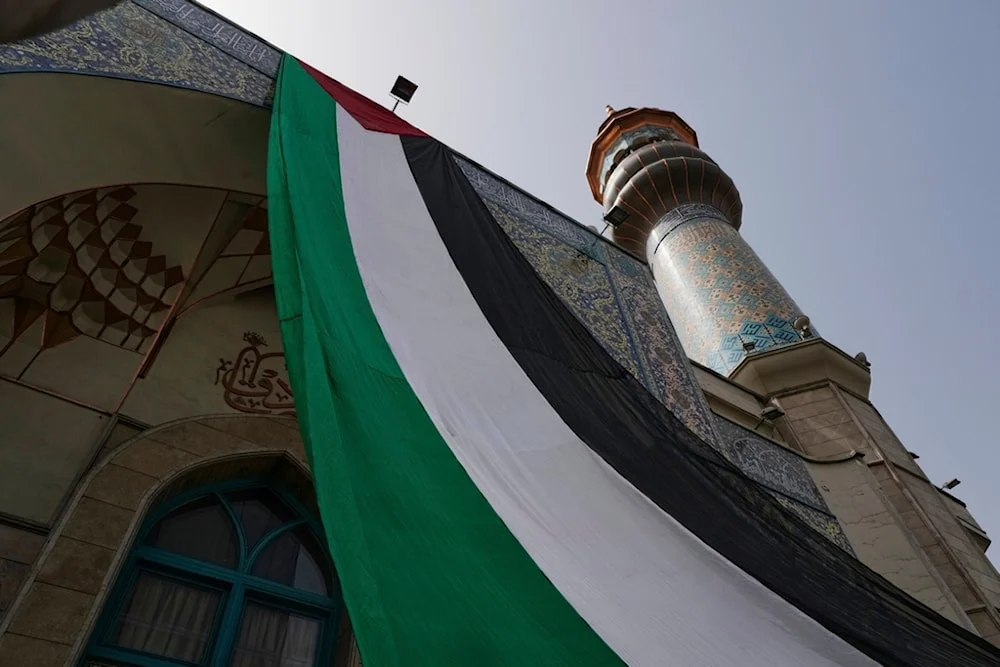
A huge Palestinian flag hangs on a mosque during an anti-¨Israel¨ protests at the Felestin (Palestine) Sq-in Tehran, Iran, April 9, 2025. Photo: AP.
A huge Palestinian flag hangs on a mosque during an anti-¨Israel¨ protests at the Felestin (Palestine) Sq-in Tehran, Iran, April 9, 2025. Photo: AP.
The Iran-Gaza debate has exposed a renewed media attempt to suggest Tehran abandoned the disaster-stricken Palestinian enclave and to sow division within the Resistance front.
Western and regional media outlets have turned the question of Gaza’s place in the US-Iranian memorandum of understanding into a new propaganda front, using selective omissions and politically charged framing to push the false narrative that Tehran has abandoned Gaza and the Palestinian cause.
The latest wave of commentary focused on the absence of an explicit reference to Gaza in initial statements on the US-Iranian understanding. Many depicted the Palestinians in Gaza as waiting for details of the deal amid fears of being left out, while some online posts went further, claiming that Gaza had become the “present absentee”. One news outlet claimed that while Iran was working to show its support for Lebanon, Gaza was completely absent, even from the statements of Iranian officials.
At first glance, asking where Gaza stands in any regional agreement may seem natural, especially as the Israeli genocide on the besieged Strip continues. Yet the way the question has been raised in several media reports and online campaigns points to a familiar narrative: one aimed at sowing division between Iran, Palestine, Lebanon, and the wider Axis of Resistance.
Some framed the matter as though Lebanon’s inclusion in the memorandum meant Gaza had been pushed aside. Others went further, presenting the issue as proof that Iran was prioritizing one front over another or that the Palestinian cause had been left outside any emerging regional settlement.
Recurring media pattern
This narrative is not new. During the Israeli war on Lebanon in 2024, similar claims circulated suggesting that Iran had abandoned Hezbollah, especially after the martyrdom of Hezbollah Secretary-General Sayyed Hassan Nasrallah.
The Jerusalem Post, for instance, questioned whether Iran would send forces to aid Hezbollah, claiming that Tehran was blocking such initiatives because the damage would outweigh the benefits. Amwaj also framed the issue through the question: “Has Tehran abandoned Hezbollah?”
Later, when the November 27 ceasefire agreement was reached in Lebanon after the support war waged for Gaza, another wave of commentary claimed that the Lebanese Resistance had abandoned the besieged enclave. Reuters, on the eve of the agreement, framed the prospect of a Lebanon ceasefire as leaving “Gazans feeling abandoned.”
Today, the same pattern is being repeated. Gaza is being placed inside a political and media narrative that seeks to fracture the Resistance front and present Iran as though it had left the Palestinian cause outside any regional settlement.
It is worth noting that the first clause of the memorandum of understanding signed between the United States and Iran mandates an immediate and permanent cessation of military operations across all fronts.
This clause alone weakens the claim that Gaza has been excluded from the broader regional equation, especially as Iran has repeatedly treated the confrontation with the Israeli occupation and the United States as one indivisible matter.
Further reinforcing this position, Iranian Foreign Minister Abbas Araghchi told senior Hamas official Bassem Naim during a phone call that Tehran would continue supporting the Palestinian people “until they fully achieve all their legitimate national rights,” according to Iranian state TV.
Araghchi also said Iran would raise “Israel’s” ongoing aggression against Palestine at international forums and informed Naim that the Palestinian issue would be addressed in Iran’s ongoing negotiations. His remarks directly counter claims that Gaza has been left outside Tehran’s diplomatic priorities.
The phone call came as Tehran and Washington launched their first round of technical talks in Switzerland with Pakistani and Qatari mediation, agreeing on arrangements and mechanisms for the next phase of negotiations.
Western claims shattered by Iran’s record
The contradiction becomes clearer when looking at how Western media and policy circles have long presented Iran to their audiences. For years, Iran has been portrayed as the main supporter and funder of Resistance movements in the region, including Palestinian factions.
The Council on Foreign Relations, for instance, described what it called “Iran’s regional armed network,” saying that “Israel”, a key US ally, faces regular attacks from groups backed by Tehran, specifically Hamas, Hezbollah, and Palestinian Islamic Jihad, which share Iran’s hostility toward “Israel” and oppose its existence.
Regardless of the labels used by Western media, the logic is clear: either Iran is a long-standing supporter of Palestinian Resistance movements, or it is not. It cannot be portrayed for years as the central backer of those forces, only to suddenly be accused of having no connection to Gaza when a regional agreement begins to reshape the balance of power.
This is the core of the pro-Resistance response: Gaza’s position cannot be reduced to whether it appears in a declared or undeclared clause in the first public statements about any political understanding.
As Ahmad al-Darzi argued in an article for Al Mayadeen Net, reducing Gaza’s importance to the presence of a negotiating clause reflects a narrow understanding of strategic support. For Iran, the Palestinian cause has not been a passing matter, but one of the pillars of its regional policy for the past 47 years.
The writer added that Tehran views the confrontation with the Israeli occupation and the US administration as one inseparable strategic package. From this perspective, any understanding that forces Washington to recognize new balances of power in Iran’s favor is also a gain for Gaza and for the entirety of the Resistance front.
Iran Closes Strait of Hormuz After US-Israeli Violations of MoU
Resistance voices reject abandonment claims
In response to the campaign, several commentators rejected the claim that Iran had forgotten Gaza.
Commentator Badr Hage wrote that “the level of hypocrisy, lying, and denial is unmatched,” adding, “They lie as naturally as they breathe.”
“The first item in the Iranian-American memorandum of understanding was Lebanon. They do not want that. All their calculations and the propaganda of their mouthpieces were built on the claim that Iran had abandoned Lebanon. When they were slapped in the face, just as Netanyahu was slapped, some ‘concerned’ voices about Gaza began claiming that Iran had forgotten Gaza,” Hage said.
He added that Gaza’s Resistance and its people “were, and remain, the peak of heroic and self-sacrificial confrontation by the Palestinian people,” saying this was achieved “thanks to Iranian weapons.”
Hage contrasted this with the role of Arab regimes, saying that what they offered Palestine and Lebanon was “siege and the accusation of betrayal against Lebanese and Palestinian fighters.”
مستوى النفاق والكذب والإنكار لا مثيل له. يكذبون كما يتنفسون. البند الاول في وثيقة التفاهم الايراني- الاميركي كان لبنان. لا يريدون ذلك، كل حساباتهم ودعاية أبواقهم ان ايران تخلت عن لبنان، وعندما صفعوا كما صفع نتنياهو بدأت بعض الأصوات "الحريصة" على غزة تدعي ان ايران نسيت غزة. مقاومة…
— Badr El-Hage بدر الحاج (@BadrHage) June 18, 2026
Other commentators suggested that Gaza could be part of the next phase of the agreement. One post said, “Gaza apparently is in the Iran final deal. Iran is out here fighting for humanity, you just gotta salute them at this point. israel is getting thrown to the wolves, beautiful.”
Gaza apparently is in the Iran final deal.
Iran is out here fighting for humanity, you just gotta salute them at this point 🫡
israel is getting thrown to the wolves, beautiful.
— JonnyUtd (@Fx1Jonny) June 23, 2026
Another post cited Iranian university professor Seyed Mohammad Marandi as saying he had spoken to the negotiating team and confirmed, “During the next two months, the Iranians will be pushing for Gaza.”
The post added, “Now we pray this works out so we get regional peace.”
Iran's Professor Seyed Mohammad Marandi Addresses the Inclusion of Gaza in the Iran Deal
Professor Marandi has spoken to the negotiation team and CONFIRMS:
"During the next two months, the Iranians will be pushing for Gaza."Now we pray this works out so we get regional peace. https://t.co/UGytyToUYY pic.twitter.com/xyHoFnpkzw
— Ryan Rozbiani (@RyanRozbiani) June 23, 2026
TRT World also reported that Iran had hinted at the possibility of including Gaza within “broader regional peace plans,” while the commander of the IRGC’s Quds Force warned “Israel” of a new “flood” in besieged Gaza.
After Lebanon, Gaza
Lebanese writer Nasser Kandil framed the issue as part of a wider regional transformation brought about by Iran’s confrontation with Washington and the Israeli occupation.
“Iran told the master of the world order that the essence of sovereignty is human blood, that silence is equivalent to death, and that the price will be calculated in dollars until the killing stops, or the system falls and collapses,” Kandil wrote.
He added that once “the American conceded to the equation” and the ceasefire was reached, Iran “deserved the beautiful morning of Al-Quds and the declaration of the end of this long night.”
“After Lebanon, Gaza will be a symbol of pride, and all wars will stop, as long as Hormuz stands opposite the South,” Kandil wrote. “Blessed is the bitter negotiation, and blessed is the free diplomat, who has become the guardian of humanity and the guardian of the law.”
صباح القدس للتفاوض المر – ناصر قنديل 22-6-26
صباح القدس لاسود التفاوض المر، والصوت الحر، زئيرهم وقت الانسحاب، وإغلاق الباب، يسمع في أرجاء العالم، من حارب ومن سالم، فالانسانية مريضة بالصمم، لم تسمع صوت الألم، وكانت اجبن من ان يخرج الأقوياء فيها، ويأخذون على يد الوحش ويعيدونه إلى… pic.twitter.com/xbdHYlLA1f— nasserkandil (@nasserkandil) June 22, 2026
For pro-Resistance voices, the issue is therefore not whether Gaza has been abandoned, but how the question itself is being used. The campaign, they argue, is less about concern for Gaza and more about reviving a familiar attempt to divide the Axis of Resistance.
Iran’s record of support for the Palestinian cause, the memorandum’s call for an end to military operations across all fronts, and the latest statements pointing to Gaza’s place in broader regional efforts all point in one direction: Gaza has not been abandoned, and will never be.