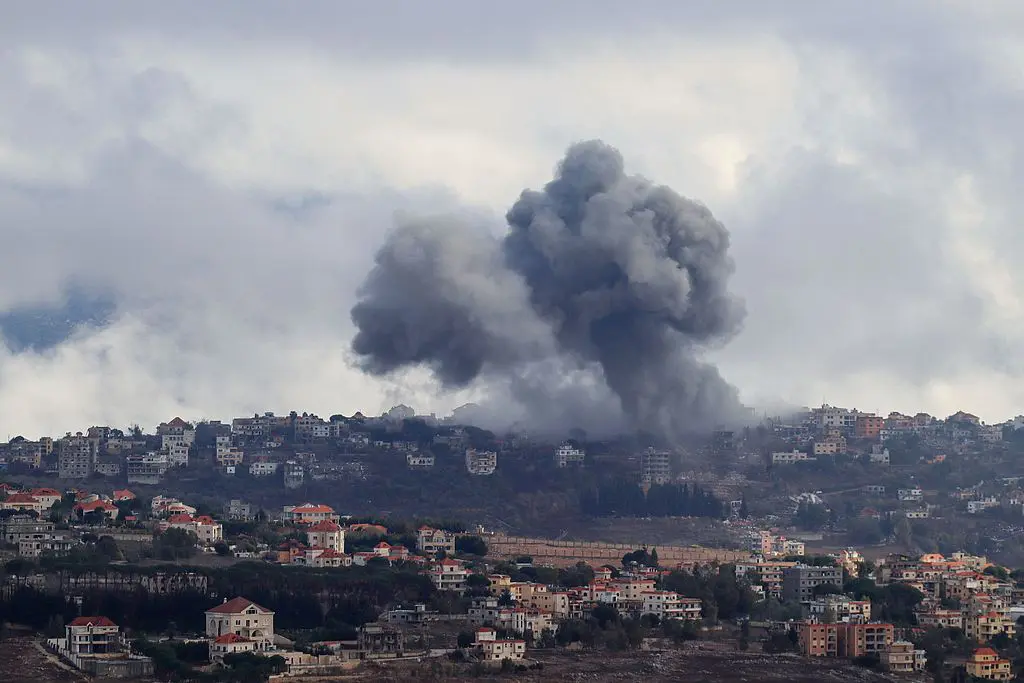
Civilian neighborhoods, production centers, and infrastructure destroyed by Zionist bombings. Photo: @GlobalWatchCGTN.
Civilian neighborhoods, production centers, and infrastructure destroyed by Zionist bombings. Photo: @GlobalWatchCGTN.
On April 7, on his Truth social media network, President Trump issued the following threat to Iran: “A whole civilization will die tonight, never to be brought back again.”
What is terrifying is not only the intention of a president of a nuclear power to prepare for the extermination of an entire civilization but also the silence and morbid curiosity with which this monstrous statement has been received by the dominant “public opinion” across the world.
Few were horrified by the public and official threat to kill millions of people—children, adults, and the elderly—and to devastate their culture, their history, their religion, their economy, their geography, their institutions, and their descendants—for all of that is a civilization. Some rushed to see how this ultimatum affected international oil and gas prices in their countries. Others, with indifference, simply swiped their phone screens to watch another amusing video, while a large number of powerful psychopaths set their timers to count down the time remaining to witness the next spectacle: whether Trump would backtrack dramatically or whether they would watch live the apocalyptic extinction of a nation of 90 million people. It made no difference to them which outcome occurred.
If anyone wonders how it was possible that in 1944, while a civilization was being cremated in Auschwitz, the German middle classes enjoyed the summer with overflowing joy on the Baltic coast, they need only observe the indifferent calm of today’s rulers in most countries of the world, and of their intellectual representatives, in the face of the genocide in Gaza or the strident threats of the US president.
The comparison is not forced. In 1943, SS leader Heinrich Himmler, in a speech in Poland, outlined the operational method for the “extermination of the Jewish people.” Replace the word “people” with “civilization,” and you have the same genocidal sentence now being directed at Iran. The difference is that Himmler stated that it “would not be spoken of publicly.” Today, however, it is proclaimed through all media outlets.
This shift in what is publicly normalized—what is treated with indifference or even amusement according to the moral standards of voters—is striking. It is not only about the personal traits of presidents who monopolize the performative force of official language. It also reflects a social predisposition toward the unthinkable and the abhorrent, typical of times when prevailing belief systems are collapsing and a new one has yet to emerge.
How did President Trump move from planning the decapitation of a sovereign country’s leadership to announcing the possible extermination of an entire nation? One could say that in less than a month, Trump and his cabinet have moved through three conceptions of the state, all of them unsuccessful in achieving their objectives.
The first, closer to monarchical absolutism, equates the regime of a country with the person of the sovereign. In this view, decapitating the leader destroys the political cohesion of the society, reducing it to a defeated and submissive mass under an external sovereign who decides life or death. Hence, killing Iran’s supreme leader—Ali Khamenei—became the primary objective of the US bombing campaign.
The success of this objective was immediate. Trump announced military operations on February 28, and on March 1, the death of the Iranian leader was confirmed. Yet contrary to expectations, the government did not collapse nor did the Iranian people take to the streets waving US flags. Instead, the society entered into a state of collective mourning.
After the failure of this absolutist interpretation, the administration moved to a Weberian conception of the state: the monopoly of coercion. Destroying that monopoly externally was seen as the way to collapse the government and eliminate the repressive machinery supposedly preventing Iranians from celebrating their “liberation.”
Thus, US and Israeli forces destroyed Iran’s air force, navy, and command structures and assassinated key political and military leaders. Still, the Islamic government neither collapsed nor surrendered.
On the contrary, through a decentralized logic embedded in the population—reminiscent of guerrilla warfare but now using drones, fast boats, and RPGs—Iranian forces managed to neutralize advanced US and Israeli defense systems and force the evacuation of multiple US bases in the Persian Gulf.
This miscalculation has proven costly. By late March, the Financial Times estimated expenses of around US $30 billion, with no regime change achieved and no control over the Strait of Hormuz. Meanwhile, oil prices surged, threatening global economic growth, and domestic fuel prices in the US rose sharply, carrying political consequences.
These failures have further clouded the administration’s reasoning, leading it to adopt a racialized conception of power. Drawing on Samuel Huntington’s idea of “civilizations,” they concluded that to eliminate Iran’s government, they must destroy its civilization itself.
But how does one annihilate, in a single night, the culture, history, institutions, and religion of 90 million people? Traditional colonial methods take decades or centuries. Mass extermination in camps would take years. To erase a civilization overnight inevitably implies an atomic “final solution.” This is the underlying threat.
Later that same day, April 7, Trump announced a two-week truce. Markets rebounded, Armageddon was shelved, and global tolerance for barbarity retreated into hypocritical silence. However, as in 1943, the boundaries of what is considered “normal” have shifted further toward the abyss.
It is often said that Trump, his words, and his actions reflect the decline of an empire and an old world order. That may be so—but they should also be seen as the unsettling tremor marking the beginning of a new one. As Hegel reminds us, history advances stumbling along the darker side of human passions and selfish desires. In this sense, Trump is the very embodiment of this liminal time.
Humanitarian Aid from Hell: The Extermination of Palestinians is Being Disguised as Help
(Telesur) by Álvaro García Linera
Translation: Orinoco Tribune
OT/CB/SL