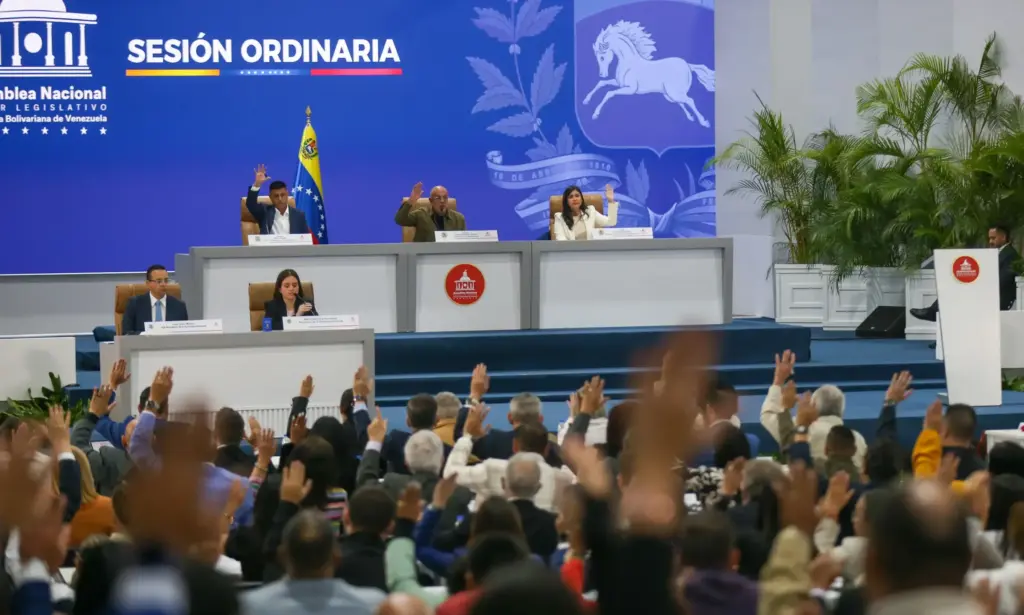
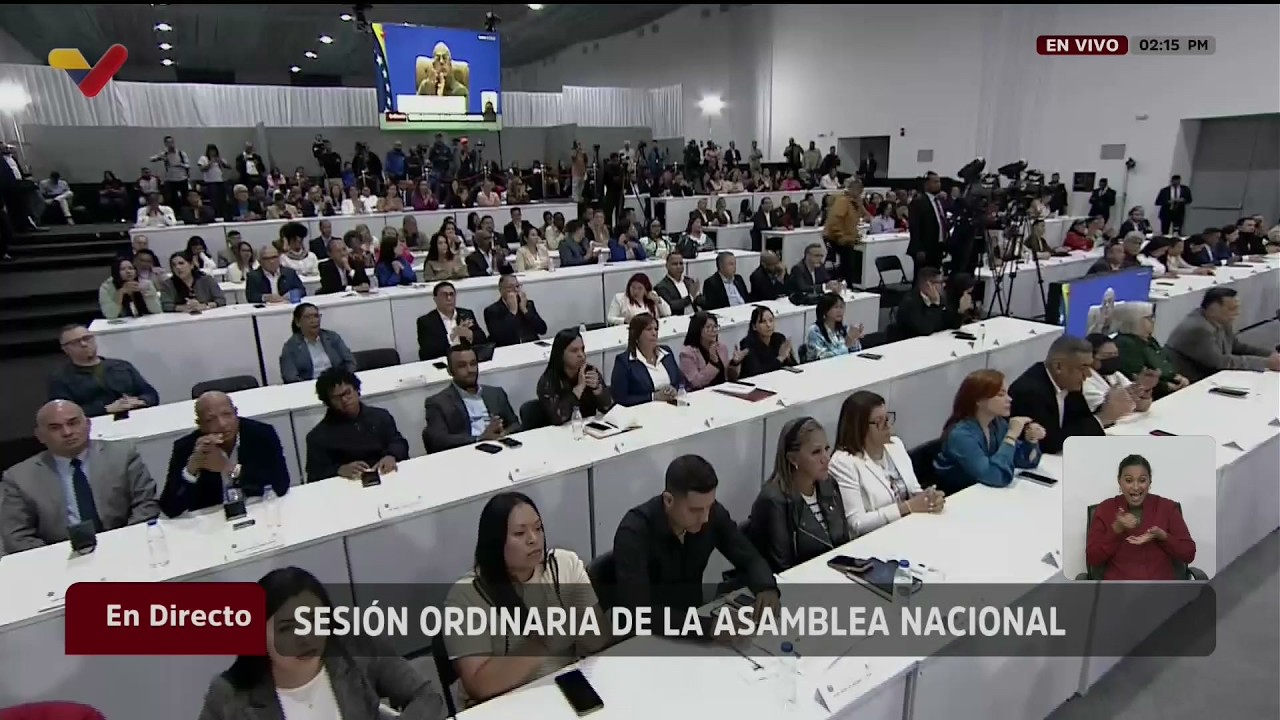
Ordinary session of the Venezuelan National Assembly on Tuesday, July 14, 2026. Photo: AVN.
Ordinary session of the Venezuelan National Assembly on Tuesday, July 14, 2026. Photo: AVN.
The Venezuelan National Assembly (AN) has passed the Partial Reform Project of the Law Against Real Estate Fraud in its first discussion, in order to revitalize the sector in the aftermath of the June 24 double earthquake.
During the session this Tuesday, July 14, the AN First Vice President, Pedro Infante, stated that the reform’s main objective is to promote the construction of new housing under an approach adapted to current realities. However, Chavista analysts have noted that it, in fact, dismantles a number of key protections for tenants and loosens regulations for real estate developers at a time when access to housing is at its most necessary.
“It is about promoting housing construction,” Infante claimed. “The state has the capacity to do so through the Great Housing Mission Venezuela. And in these times of unity and helping each other, we need everyone’s effort.”
“And this law reform aims to fundamentally resolve, colleagues, to guarantee better conditions, legal certainty, and financing capacity,” he continued, “so that the private sector can initiate an aggressive, accelerated process of housing construction and attend to those 30,000 people, the more than 10,000, 15,000 families that were affected by the terrible double earthquake of last June 24.”
Infante claimed that the specific aim is to unblock the “rigid price scheme” that prevents the absorption of variations in the costs of materials and supplies during the execution of a housing project, “allowing the parties to freely agree on mechanisms for stabilizing the outstanding balance based on the real fluctuations of the construction market.”
The parliamentarian added that this will help resolve the issue of the restrictive legal limit that otherwise sets a maximum of 24 months for the completion of a housing project. “Then it can be established that the execution time will be subject to the free will and mutual agreement of the parties,” he stated.
Protecting cash flow and financial agility
Another issue addressed in the bill is “protecting cash flow.” Infante said that “the termination procedure for non-payment is being made more flexible than in the previous regulations.” Previously, a developer had to wait 90 days for non-payment and obtain prior administrative authorization from the relevant ministry. This reform proposes empowering the builder to terminate the contract directly if the buyer defaults on payments for two consecutive months, making for a more precarious position for people suffering sudden tragedy.
Another key element proposed by this legal reform is that it eliminates the joint liability imposed by the previous law on banking institutions that grant loans for project development. This also encourages the participation of banks as facilitators of resources, eliminating regulatory risks that paralyze development lending, and enabling bailouts for corporations to take risks on spending when that money is needed elsewhere.
He noted that it is essential to “untie the knots, create better conditions of legal certainty, but also of legal balance, because on the one hand, legal certainty for the builder; on the other hand, stimulate public and private banks for the financing of housing construction projects; but on the other hand, with the balance of protecting the acquirers, the buyers of housing. The necessary balance so that all the capacity of the state, added to the private capacity in housing construction, is made available to the plan.”
He emphasized that it is essential to “guarantee our people, in the shortest possible time, the right to housing and, within the framework of this tragedy of the double earthquake, we can provide a prompt response. Then, in a few weeks, a few months, we will be vacating the schools that are now temporary camps and our people can be in their homes, with their belongings and embracing their families.”
Despite a common agreement about the need for special measures to tackle the magnitude of the natural disaster, Chavista analysts warn that this strategy actually serves to give more privileges to private corporations to the detriment of the interests of the most vulnerable.
Stimulating the real estate rental market
The AN also approved the draft Law of the Special Regime for Leasing Real Estate Intended for Housing. Infante explained its main task is to stimulate the market for rentals or leases of housing.
He stated that, according to estimates, there must be around 200,000 homes that “are available or are likely to enter the rental housing market.” Therefore, the aim is to “strengthen everything related to legal security in order to simultaneously protect the right of ownership, the homeowner who becomes the landlord, and the tenant.”
The parliamentarian believes that this legal tool will achieve a “legal balance” so that the “knots” that are holding back the rental market can be “untied.” In Venezuela, many house and apartment owners avoid the rental market due to the many benefits granted by Chavismo over the years to tenants that prevent landlords from exploiting them.
Infante said that a fundamental pillar of this law “is the dejudicialization and speed of proceedings, seeking to implement alternative justice, mediation, and arbitration as an expedited way to resolve disputes, reducing response times and alleviating the burden on the ordinary justice system.”
Venezuela Reports 4,490 Fatalities and Over 120,000 Families Assisted Following Earthquakes
Prohibitions in high-risk areas and price indexing
Regarding economic and operational matters, “the project introduces substantial changes. It formally prohibits leasing in high-risk areas or precarious structures,” the parliamentarian emphasized, adding that it is their responsibility to be vigilant in this regard.
He noted that “the parties freely agree on a rental fee and its indexation, in case of extension, technically taken by the consumer price index established by the Central Bank of Venezuela, preventing speculation but protecting the real value of money against the inflationary phenomenon.”
Infante said that this “distributes the financial burden of major and minor repairs equitably, below the technical threshold of 30% of the rent. And it balances the risk by allowing security deposits or insurance policies of up to three months, requiring immediate reimbursement within 15 consecutive days after completion, following verification of the property’s condition.”
He explained that the bill on residential property rentals protects citizens by creating a formal and attractive market for investment, providing indexed economic incentives, bank and insurance guarantees, and expedited dispute resolution mechanisms. “This bill consists of four chapters comprising a total of 27 articles.”
He emphasized that all rental agreements, whether established or created after the enactment and approval of this law, will be governed by it, but excludes all previous lease agreements. “I want to make that clear,” he concluded. “We are stimulating both housing construction and the rental housing market, providing more housing solutions for our people.”
(Ciudad VLC) with Orinoco Tribune content
Translation: Orinoco Tribune
OT/JRE/AU