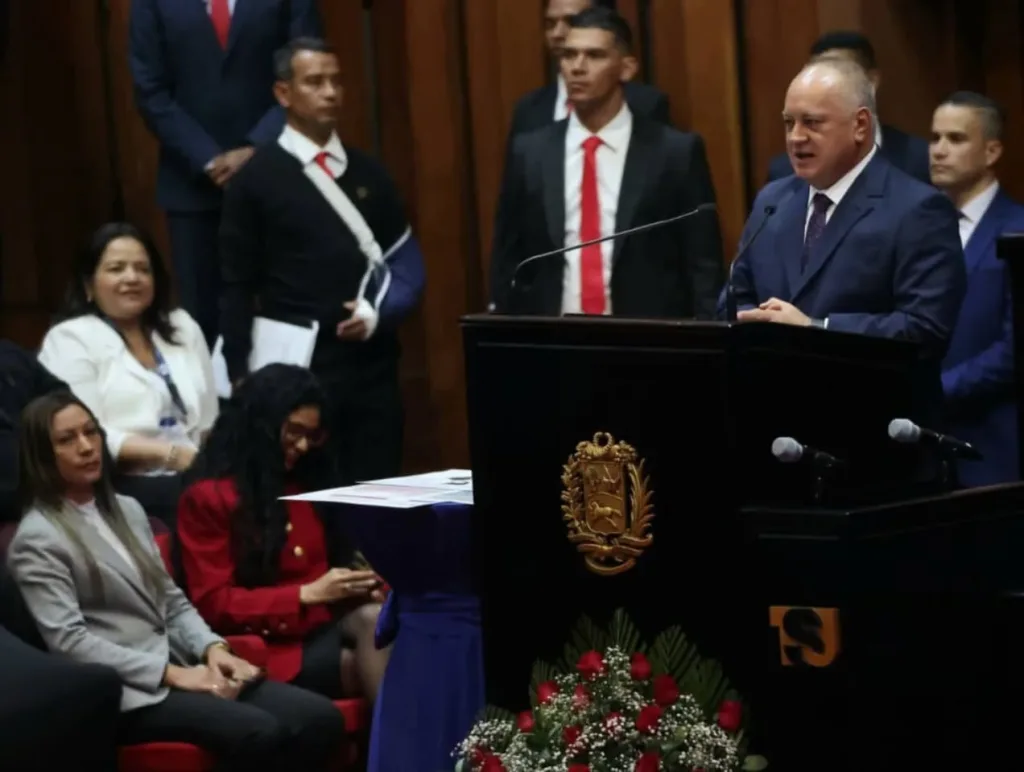
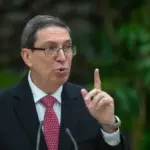
Venezuelan Minister for the Interior Diosdado Cabello delivers his address at the Congress on Drug Use and Juvenile Delinquency: Justice with a Humane Face, at the Supreme Court of Justice headquarters in Caracas, November 7, 2025. Photo: Con El Mazo Dando.
Venezuela has seized 64 tons of drugs this year “without bombing or killing anyone,” reported the minister for the Interior, Justice and Peace of Venezuela, Diosdado Cabello.
He made this remark on Friday, November 7, in his address at the Congress on Drug Use and Juvenile Delinquency: Justice with a Humane Face, held at the headquarters of the Supreme Court of Justice (TSJ).
He emphasized that the fight against drug trafficking in Venezuela is being carried out with vigor, including the arrest of public officials.
“We critique ourselves: police officers, attorneys, and even mayors have been arrested, because drug traffickers set up a power structure and need territorial control to move drugs more freely,” Cabello stated.
The minister explained that these criminal networks required the complicity of local authorities for the safe transit of shipments, and that some mayors received money “for playing dumb” and allowing criminal groups to operate freely in their jurisdictions.
He reaffirmed the Venezuelan State’s firm stance against this scourge. “They know that they cannot get through here, through Venezuela, and we are dealing decisively with drug trafficking,” he asserted.
In this same vein, Cabello praised the work of the Bolivarian National Armed Force (FANB) and other national security agencies in neutralizing aerial and maritime routes used to transit drugs through the country, as well as dismantling camps, clandestine laboratories, and illegal aircraft.
Cabello highlighted the country’s preventive approach, which includes social rehabilitation. He referred to the instruction given by President Nicolás Maduro to the Bolivarian National Police (PNB) and the communes’ Peace Quadrants to patrol school zones as a key measure to curb drug use among youth in a timely manner.
The minister explained that this measure is aimed at building a bond of trust. “Police officers get out of their vehicles every time they pass by a school. The children recognize them as friends, and it also acts as a deterrent,” he noted, given that school areas are often targeted by traffickers to sell drugs.
He emphasized the difference in approaches between Venezuela and the US. While the United States has a model that drives consumption, “Venezuela has a model to curb these vices.”
Venezuela reaffirmed goal of zero domestic drug trafficking
Minister Cabello reaffirmed Venezuela’s goal to achieve zero domestic drug trafficking.
He called on those with family members struggling with addiction to help them. “It is very painful for us to learn that a young person ends up committing suicide because of drug debts,” he remarked.
Cabello emphasized that the Venezuelan justice system has improved significantly in this regard. “If someone is caught trafficking drugs, they are arrested and tried. There is no possibility of being released,” he said. He added that the “Judicial Tribes” that operated in the country earlier “are gone.”
In this context, he stated that the legislative process has also been transformed. “Here, laws are not proposed by a law firm; they are proposed by the people and approved by the National Assembly,” he said.
He also congratulated the Supreme Court of Justice for the work that its officials are carrying out, going into communities to resolve the people’s problems. “I have seen them many times going into the neighborhoods to serve the people, face to face. This did not use to happen here before—now the judicial system is closer to the people,” he said.
Thus, Cabello dismissed the United States’s accusations that Venezuela is failing to meet its obligations in the fight against drug trafficking. “Does the US have a campaign to help its people?” he asked. “It does not, because it wants the population to live like zombies, so that they do not complain.”