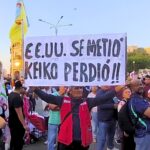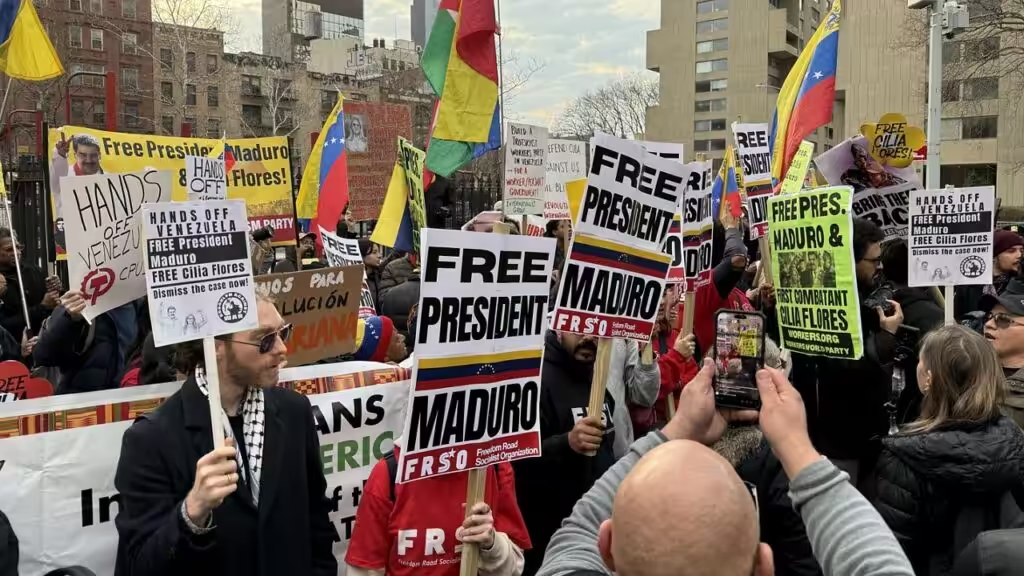
Protesters in New York demanding the release of Venezuelan President Nicolás Maduro and his wife, Deputy Cilia Flores, on Thursday, March 26, 2026. Photo: Joshua Deckert/Spectrum News NY1.
Protesters in New York demanding the release of Venezuelan President Nicolás Maduro and his wife, Deputy Cilia Flores, on Thursday, March 26, 2026. Photo: Joshua Deckert/Spectrum News NY1.
Caracas (OrinocoTribune.com/)—Venezuelan President Nicolás Maduro and his wife, Deputy Cilia Flores, have appeared before the Court for the Southern District of New York for a second hearing. The proceeding was marked by a defense request to dismiss the trial on the grounds that the US government is violating the Sixth Amendment by using illegal sanctions to prevent the Venezuelan government from paying for their legal defense.
Corporate media reports indicated the hearing began this Thursday, March 26, at 11:45 a.m. after the presiding judge, Alvin Hellerstein, entered the courtroom approximately 45 minutes late. The Venezuelan presidential couple had arrived at the courthouse early that morning—around 4:00 a.m.—in a convoy of three closed, windowless vans.
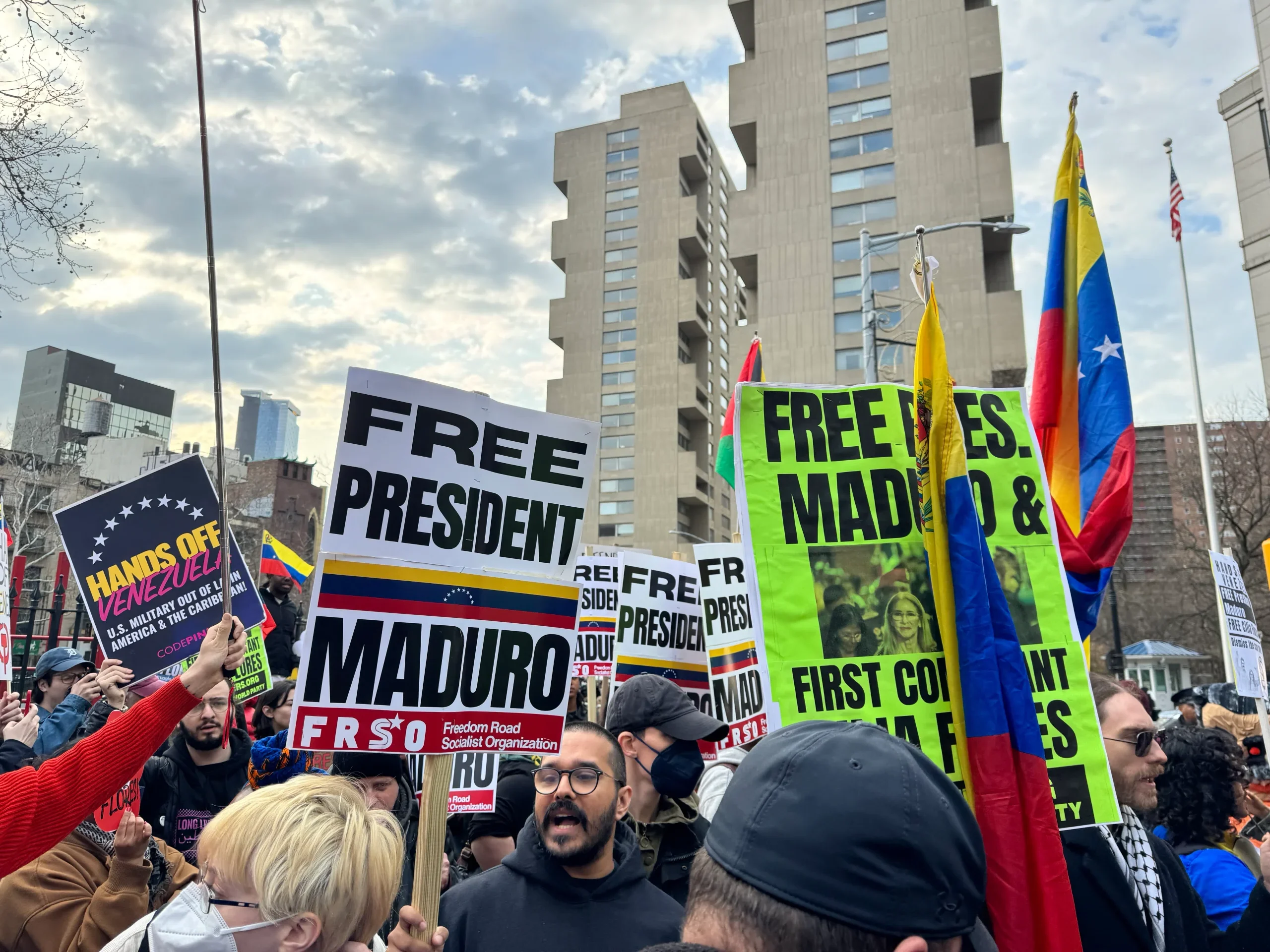
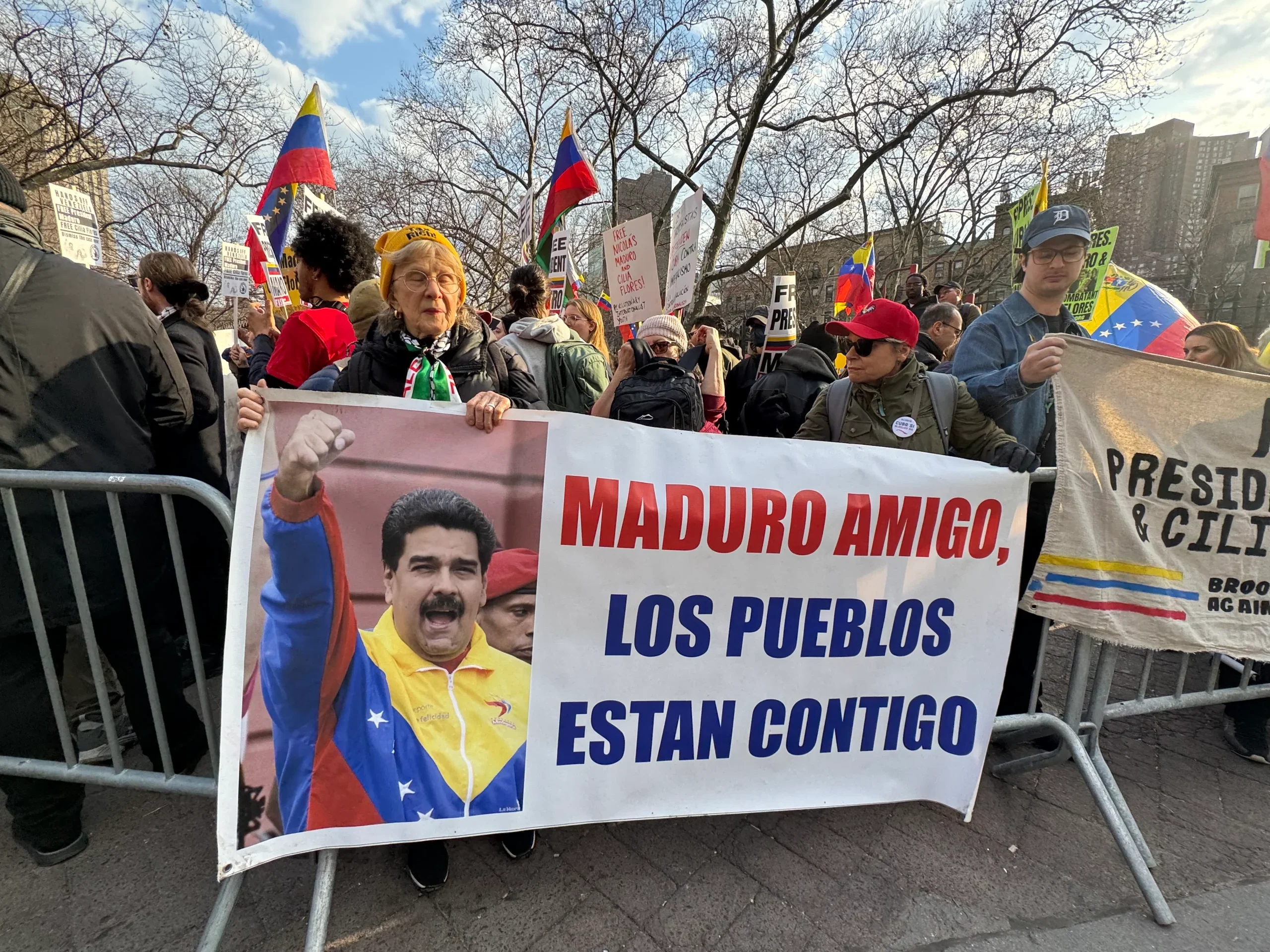
A massive press presence was reported outside the court, alongside a small number of far-right Venezuelan opposition members. These were challenged by significant protests in support of the Venezuelan president outside the court, as well as demonstrations and acts of support across Venezuela and in several locations around the world, including Chicago, Seattle, and London.
President Maduro and Cilia Flores were kidnapped in Caracas on January 3, following a violent bombing of the country by the US empire that resulted in more than 100 people murdered. Hours later, the US Department of Justice leveled “drug trafficking-related” charges against them, notably omitting the fact that the widely circulated media claim that President Maduro led the fictional “Cartel of the Suns” has already been debunked.
Nearly 3 months since the US bombed Caracas & kidnapped a sitting president.
100+ killed. Nicolás Maduro & Cilia Flores seized in an illegal imperialist operation.
Now they’re blocking his right to a defense — sanctions preventing his legal team from being paid.
The world is… pic.twitter.com/0rPmNe85LZ— Orinoco Tribune (@OrinocoTribune) March 26, 2026
Judge challenges freezing of legal fees
During the session, Judge Hellerstein questioned the validity and logic of the US prosecution’s arguments for keeping legal fees frozen, and even noted that the license required for these payments may have been “arbitrarily withheld” by the US Department of the Treasury.
According to journalists present, Hellerstein prioritized due process principles over foreign policy considerations, emphasizing that the defendants’ right to a defense is paramount and supersedes US sanctions—a principle enshrined in the Sixth Amendment to the US Constitution.
“I see no permanent national security interest in the right to defend oneself,” the judge stated, refuting the position of US prosecutors who seek to prevent the Venezuelan state from paying the fees of its highest authority.
US prosecutor Kyle Wirshba attempted to justify the restriction by arguing that allowing access to these resources would undermine the nature of the illegal sanctions. This stance was met with skepticism by the judge, who questioned the appropriateness of maintaining such blockades amidst the current diplomatic rapprochement between Venezuela and the US.
Defense argues against burdening US taxpayers
The defense team, led by attorney Barry Pollack, insisted that the US government is violating constitutional rights by preventing Venezuela from covering defense costs. Pollack argued that forcing the use of public defenders would be an unnecessary financial burden on US taxpayers, given that funds are available from Venezuela. Many analysts see the US prosecution argument as a tactic building on another arbitrariness of a judicial process marked by irregularities.
The lawyer stressed that it makes no sense to exhaust public resources when there is “someone other than the US taxpayer ready, willing, and able to finance that defense.”
Judge Hellerstein acknowledged that while the government has technical authority to freeze assets, the right to due process takes precedence over national security interests. The judge hinted at the possibility of ordering the US government to unfreeze the funds for legal fees, as reported by journalist Matthew Russell Lee of Inner City Press covering the hearing live on social media.
Amid the media attention surrounding President Maduro’s hearing, US philanthropist Fergie Chambers, who is associated with socialist organizations, hinted at the possibility of a private citizen paying the Venezuelan president’s legal fees, and questioned whether such an action would violate US legal norms. Analysts claim that while the offer is legally valid, it might be counterproductive to the current defense strategy, which seeks a dismissal of the charges against Maduro based on the violation of his constitutional rights.
Sovereign immunity and the Noriega comparison
Legal experts claim that even if the initial process concludes without dismissal, the US prosecution will find it extremely difficult to justify the violation of President Maduro’s sovereign immunity as a sitting elected head of state.
Many analysts have compared the case to that of Manuel Noriega in Panama; however, Noriega was not a sitting head of state at the time of his capture. Others argue that simply because the US empire did not recognize President Maduro after 2018, he could be prosecuted. Nevertheless, many of the charges presented on January 5 relate to alleged incidents occurring before 2018.
Maduro reaffirms his legitimacy
According to reports, President Maduro and Deputy Flores sat next to their defense team using headphones to listen to the translation of the proceedings. The Venezuelan president reiterated his firm stance, categorically rejecting the accusations.
“I am not guilty. I am a decent man, the constitutional president of my country,” the president declared, reaffirming that his arrest and trial lack any legitimate legal basis.
Deisy Francis Mexidor, a reporter for Prensa Latina who was present, noted that the couple remained calm. “There was a really huge number of journalists,” she stated. “I saw him sit down… he was accompanied by his respective legal representatives. I saw him calm.”
President Maduro and Deputy Flores have been subjected to illegal deprivation of liberty for 83 days so far. Since their initial court appearance on January 5, 2026, they have remained in solitary confinement at the Metropolitan Detention Center in Brooklyn, New York City.
President Maduro’s Upcoming Hearing in US ‘Not an Act of Justice,’ Expert Warns
Trump’s interference in the judicial process
Prior to the hearing, Donald Trump made a number of unfounded accusatory statements, demonstrating clear interference in a judicial process already denounced as illegitimate by the defense and public opinion.
“He’s a dangerous man who has killed a lot of people,” Trump attempted to tell reporters. “He sent people to our country. He emptied the prisons in Venezuela to send them to our country… He was one of the main suppliers of the drugs that come into our country.”
These claims, uttered without any evidence whatsoever, appear intended to publicly influence a case originating from a violent and illegal US colonial military operation.
Below are some exclusive photos of the protests outside the court in support of President Maduro and Deputy Flores, courtesy of Gloria Grillo:
Special for Orinoco Tribune by staff
OT/JRE/AU