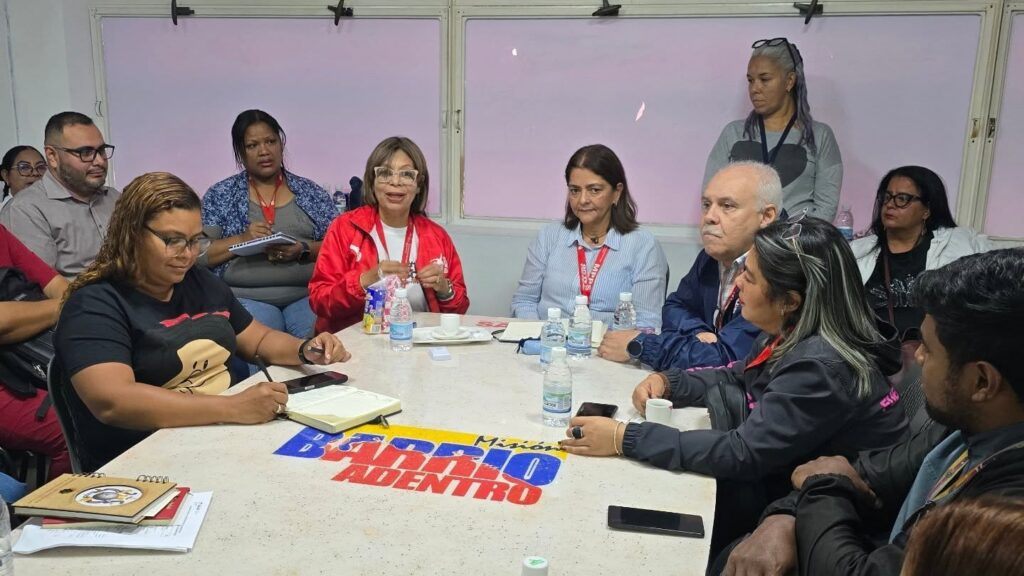
A meeting of the members of the Barrio Adentro Medical Mission in Caracas, Venezuela. Photo: Facebook/Misión Barrio Adentro.
A meeting of the members of the Barrio Adentro Medical Mission in Caracas, Venezuela. Photo: Facebook/Misión Barrio Adentro.
The authorities of Venezuela and Cuba paid tribute to the 23rd anniversary of the launch of the Barrio Adentro Medical Mission on Thursday, April 16, with a floral offering at the shrine of Liberator Simón Bolívar in Caracas, Venezuela. Cuban Ambassador to Venezuela Jorge Mayo and Venezuelan Deputy Minister for Health Mauricio Vega led the ceremony commemorating the creation of this social program, born from the vision of Presidents Hugo Chávez and Fidel Castro.
The Barrio Adentro Mission is the Bolivarian Revolution’s structural response to the dehumanization of the neoliberal model, which treats health as a commodity. This program, enshrined in Article 83 of the Constitution of the Bolivarian Republic of Venezuela, constitutes the Venezuelan state’s obligation to guarantee the right to life through public policies of collective social welfare.
The Cuban ambassador called the Barrio Adentro Mission “an exemplary and popular mission that embodies the ideal of integration of the peoples.” The Venezuelan Deputy Minister spoke about the roots of the program, when Cuban doctors went door to door in marginalized communities across Venezuela to set up clinics.
The timeline of this social policy reveals a constant expansion of specialized services that were previously inaccessible to the majority. Since its founding in 2003 by President Hugo Chávez, the mission has achieved historic milestones despite the illegal US sanctions and economic blockade.
With the creation of Misión Milagro in 2004—which provided specialized services to restore eyesight—and the inauguration of Comprehensive Diagnostic Centers, Comprehensive Rehabilitation Centers, and High Technology Centers, Venezuela has been able to decentralize high-complexity medical care.
These advances were reinforced with the launch of the National Program for the Training of Comprehensive Community Medicine, which in 2011 graduated its first cohort of doctors: professionals trained with an ethic of social service and community commitment, fundamental pillars to withstand the impact of unilateral coercive measures.
In the last decade, during the administration of President Nicolás Maduro, the mission achieved the historic goal of 100 percent coverage across the entire national territory, integrating cutting-edge programs such as the Humanized Birth Plan and the National Genetics Center.
During the COVID-19 emergency of 2020, the joint effort of the Cuban Medical Mission and Venezuelan personnel led to the completion of 116 million screenings—an unprecedented figure in Latin America that helped Venezuela contain the pandemic through primary care.
At 23 years, the mission reaffirms its enduring and supportive nature through constant participation in massive popular planning in the health sector. After more than two decades of uninterrupted work, there are over 10,000 operational health institutions and a historic total of 1.6 billion consultations carried out, making it a robust public system against external aggressions.
Currently, the Venezuelan government promotes medical training and the use of new technologies such as ozone therapy, demonstrating that health sovereignty is a tool of liberation strengthened through the unity of peoples.
The Cuban Medical Mission emphasized that in these 23 years, Cuban healthcare personnel have saved the lives of more than 1.49 million Venezuelans, demonstrating the success of binational solidarity. The Venezuelan government also highlighted the importance of teaching in the training of new Venezuelan doctors who today join this humanitarian task.
The commemorations will continue on Friday, April 17, with an event at the Latin American School of Medicine, reaffirming the commitment to continue liberating the homeland through health and solidarity.
(Telesur)
Translation: Orinoco Tribune
OT/SC/SH