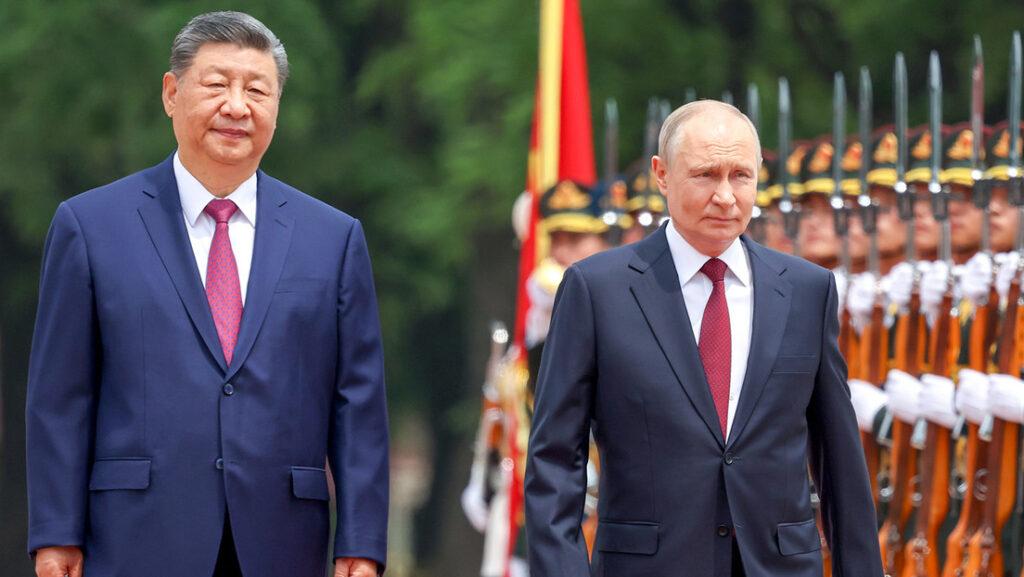
China's President Xi Jinping and Russian President Vladimir Putin: Alexander Kazakov/Sputnik.
China's President Xi Jinping and Russian President Vladimir Putin: Alexander Kazakov/Sputnik.
The presidents of Russia and China, Vladimir Putin and Xi Jinping, held a round of talks this Wednesday that concluded with the signing of a broad set of joint documents and declarations.
The Russian leader stated that relations between Moscow and Beijing “have reached a truly unprecedented level” and continue to develop.
Strengthening of military cooperation
In a joint declaration, the leaders stated that Moscow and Beijing will continue strengthening cooperation in the military sphere.
“The parties will continue strengthening the traditional friendship between the Armed Forces of both countries, deepening mutual trust in the military sphere, improving cooperation mechanisms, expanding the practice of joint exercises, air and maritime patrols, strengthening coordination and interaction in bilateral and multilateral formats, and jointly responding to various challenges and threats, as well as supporting global and regional security and stability,” the document states.
Condemnation of attacks against Iran
Putin and Xi agreed in their communiqué that the US and Israeli attacks against Iran “violate international law and the fundamental norms of international relations” and gravely undermine stability in the Middle East.
Moscow and Beijing stressed the need for the parties in conflict to resume dialogue and negotiations as soon as possible in order to prevent the expansion of the crisis zone.
The parties also underlined that actions such as “the treacherous launching of military strikes against other countries; the hypocritical use of negotiations as cover to prepare such attacks; the assassination of representatives of the governments of sovereign states; the destabilization of the internal political situation in those states and the provocation of regime change there; and the brazen kidnapping of national leaders to subject them to trial gravely violate the purposes and principles of the United Nations Charter.”
Latin America as a zone of peace
Both leaders expressed their support for the status of Latin America and the Caribbean as a zone of peace, as well as for the struggle of Latin American states “to autonomously choose their paths of development and their partners.”
The document states that Moscow and Beijing oppose any action that violates the purposes and principles of the UN Charter or threatens the sovereignty and security of other countries, and it underlines their opposition to interference by external forces in the internal affairs of the region “under any pretext.”
Towards the consolidation of a multipolar world
Moscow and Beijing have increasingly aligned around the idea of a multipolar world—a global order that, they assert, should no longer be dominated by the West and, in particular, by the United States.
In this context, the parties adopted a joint declaration on the establishment of a multipolar world and a new type of international relations:
“Attempts by certain states to unilaterally manage world affairs, impose their interests on everyone, and limit the possibilities for the sovereign development of other countries, in the manner of the colonial era, have failed. The system of international relations of the 21st century is undergoing a profound transformation, evolving towards a lasting polycentric state and towards the formation of a new type of international relations.”
“The majority of states, taking into account the accumulated historical experience, have become fully aware of the advent of a new era and of the need to follow the path of forming a more cohesive international community, as well as of mutual respect for fundamental interests, equality, justice, and mutually beneficial cooperation, without dividing the world into opposing regions and blocs,” adds the document.
Against the US Golden Dome
The parties noted the destabilizing nature of the US plan to build a Golden Dome air defence system for strategic stability.
They stated that this initiative “completely negates the key principle of maintaining strategic stability, which provides for the inseparability of the interrelationship between strategic offensive and defensive weapons.”
Against the glorification of Nazism and the rewriting of history
Moscow and Beijing stated that they will continue “firmly defending the correct view of the history of the Second World War” and the immutability of its outcomes, and will “oppose attempts to deny, distort, and falsify the history” of that conflict.
“The parties intend to continue strengthening cooperation in the fight against the glorification of Nazism, fascism, and militarism, as well as against attempts to revive these destructive ideologies and the denial of the facts of genocide,” the document reads, adding that the parties strongly condemn the glorification of those who fought on the side of the Nazis, fascists, and militarists; collaborated with the; and committed war crimes and crimes against humanity.
Support for mutual sovereignty
Both parties expressed their support for each other’s sovereignty: Russia backed the one-China principle and recognized Taiwan as an inalienable part of Chinese territory.
Beijing, in turn, supports the efforts of the Russian side “to guarantee security and stability, national development and prosperity, sovereignty, and territorial integrity and opposes external interference in Russia’s internal affairs.”
New horizons of cooperation
Both parties highlighted the high pace of economic cooperation that has consolidated in recent years. Putin and Xi paid particular attention to the energy sector and agreed to continue strengthening their comprehensive partnership in the field of energy.
Special attention was paid to nuclear energy, where the parties expressed their intention to continue forward with construction projects for the Tianwan and Xudapu nuclear power plants, to ensure the timely completion of construction works and commissioning of the facilities, and on that basis, to deepen cooperation in the field of peaceful nuclear energy.
Featured image:
Translation: Orinoco Tribune
OT/CB/

Cameron Baillie is an award-winning journalist, editor, and researcher. He won and was shortlisted for awards across Britain and Ireland. He is Editor-in-Chief of New Sociological Perspectives graduate journal and Commissioning Editor at The Student Intifada newsletter. He spent the first half of 2025 living, working, and writing in Ecuador. He does news translation and proofreading work with The Orinoco Tribune.