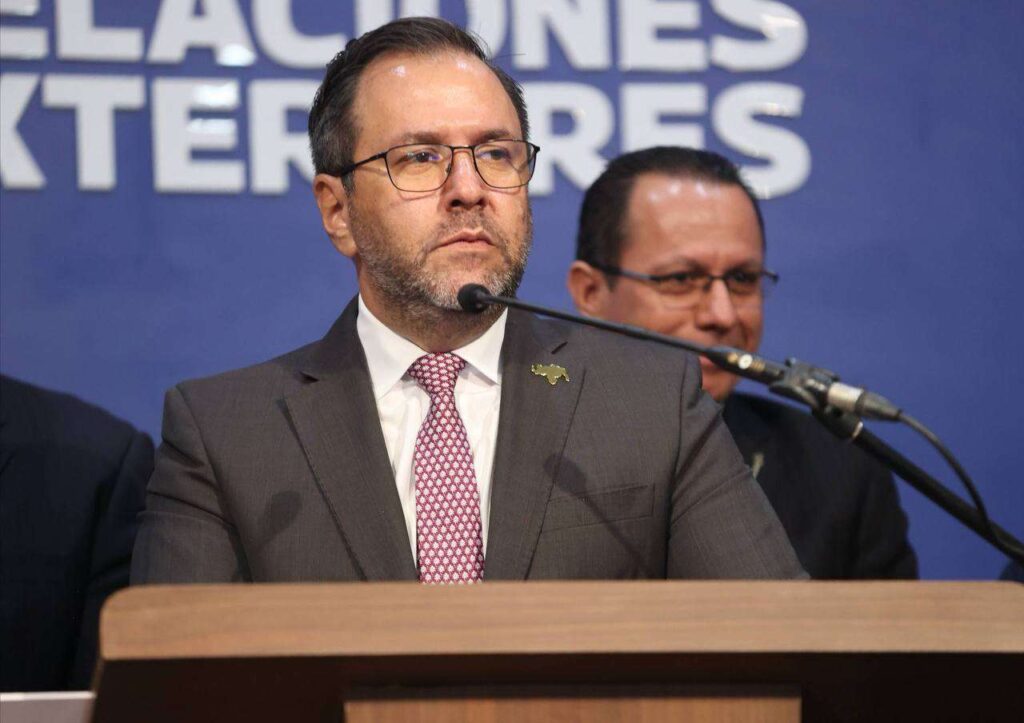
Foreign Minister Yván Gil addressing the international community. Photo: MPPRE.
Foreign Minister Yván Gil addressing the international community. Photo: MPPRE.
Foreign Minister Yván Gil has announced that Venezela is requesting compensation from the authorities of Trinidad and Tobago for ecological damage caused by an oil spill reported at the end of April.
The foreign minister noted Trinidad and Tobago’s apparent failure to provide timely notification, describing the omission of information regarding the still as a direct violation of existing international conventions.
Accompanied by Freddy Ñáñez and Juan Carlos Loyo, ministers of ecosocialism and of fisheries and aquaculture, respectively, alongside other officials, FM Gil detailed how Venezuelan satellite monitoring detected the contamination plume from 28 April onwards.
Despite the severity of the event, the first official response from the administration of Trinidad and Tobago administration came only on May 10—a day after Venezuela issued a public environmental alert.
The head of Venezuelan diplomacy described the situation as extremely concerning, noting that days passed without receiving any data on the incident and adding that more than 876 spills have been recorded in the same area between 2015 and 2023.
Minister Gil highlighted that the spilled petroleum has reached Venezuelan waters and coastal zones, affecting an estimated area of more than 1,600 square kilometres of Venezuelan territory. Direct threats have also been reported to 12 strategic wetland systems and four national parks in eastern Venezuela—specifically the Paria Peninsula, Turuépano, Mariusa, and the Orinoco Delta Biosphere Reserve.
Economic impact on artisanal fishing
Artisanal fishing activity is recording significant operational and commercial losses across the affected region. More than 500 fishermen in the eastern part of the country are suffering the direct impact of the spill, which threatens the habitat of some 140 commercial species of fish and extensive mangrove areas.
Acting with the authority of Venezuela’s Acting President Delcy Rodríguez, a contingent comprising the ministries of ecosocialism and fisheries, the National Aquatic Spaces Institute, the Bolivarian National Armed Force, and Petróleos de Venezuela is carrying out containment operations in the area.
“So far, the crews have achieved 70% coverage of the critical areas, collecting more than 12 tons of contaminating material for subsequent technical analysis,” Gil stated.
Through diplomatic channels, Venezuela requested immediate access to the technical data on the hydrocarbons involved and the containment measures applied, while evaluating the corresponding legal mechanisms to seek reparation for the damage caused by this environmental event.
International obligations and environmental impact
Foreign Minister Gil recalled that the government of Trinidad and Tobago is strictly obliged to report to Venezuela immediately upon the occurrence of any environmental incident.
The administration of Trinidad and Tobago must also urgently provide data on the type of product spilled and the mitigation measures employed—such as the use of dispersants, barriers, or naval vessels—given that Venezuelan authorities have had to work without timely information, in contravention of international conventions.
In response to this lack of information, the Venezuelan state has sent various official communications to assess the geographical damage and request that the Trinidad and Tobago government assume its corresponding responsibility. “We call on the government of Trinidad and Tobago to take responsibility and assume the tasks and costs involved in reversing this environmental damage so that we can work together with our authorities who have been deployed from the very first moment, monitoring the entire situation,” said FM Gil.
Role of Venezuelan citizens and technical deployment
In closing, Foreign Minister Gil acknowledged the joint effort between community organizations, Venezuela’s broader population, and state technical teams in aerial, maritime, and ground monitoring operations.
The minister extended special thanks to the artisanal fishermen’s councils and riverside communities of Delta Amacuro, Sucre, and the Paria Peninsula for their immediate mobilization in defence of their main source of livelihood in the face of the environmental emergency.
He also highlighted the operational support provided by Petróleos de Venezuela’s (PDVSA) specialized crews, which deployed all necessary resources for control of the hydrocarbon spill.
Finally, Gil assured the populations of the affected regions that Venezuela’s authorities will maintain their presence in the area and will pursue all available actions in international forums to compel Trinidad and Tobago to honour its obligations in light of the magnitude of the damage caused.
Oil spill damage
According to the assessment presented by the minister, the spill has affected “more than 500 fishermen.” Gil added that the consequences include “operational limitations on the fishing fleet, which generates significant costs, as well as restrictions on commercialization.”
The foreign minister added that Venezuelan response teams “have addressed a large percentage—70% of the affected area has been attended to—collecting more than 12 tons of hydrocarbon material that we are currently analyzing in order to determine its type.”
(Últimas Noticias) by Olys Guárate, with additional content by Orinoco Tribune staff
Translation: Orinoco Tribune
OT/CB/SL