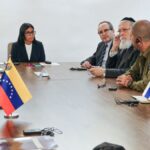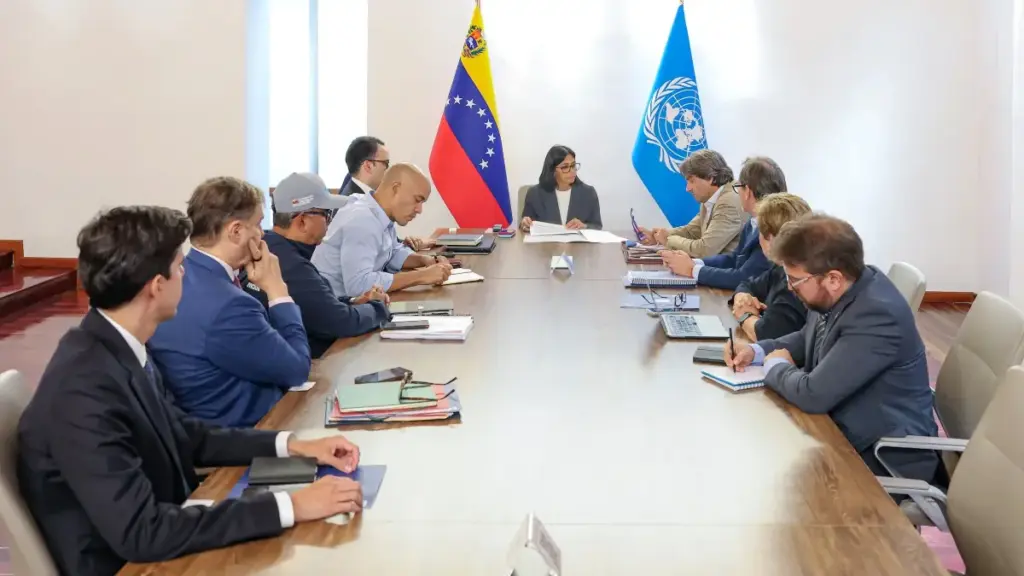
Venezuelan Acting President Delcy Rodriguez leads a meeting with the UN office in Caracas to coordinate post-earthquake plans. Photo: Venezuelan Presidential Press.
Venezuelan Acting President Delcy Rodriguez leads a meeting with the UN office in Caracas to coordinate post-earthquake plans. Photo: Venezuelan Presidential Press.
Venezuelan Acting President Delcy Rodríguez met Wednesday with United Nations Resident Coordinator Gianluca Rampolla to discuss ongoing assistance for victims of the June 24 earthquakes and to outline key directives for the nation’s post-disaster recovery plan.
The high-level meeting aimed to strengthen the operational management model for emergency response while reinforcing principles of information centralization, transparency, sovereignty, unified efforts, and optimized ground operations.
Following the meeting, Rampolla reported that the UN is working in full coordination with Venezuelan state institutions to deliver high-level technical support.
Accompanying Rampolla were Luis Francisco Thais, representative of the United Nations Development Programme (UNDP); Janeth Fernández, advisor for post-disaster needs assessment; and economic advisor Luis Bárcenas.
Representing the Venezuelan government alongside Rodríguez were Education Minister Héctor Rodríguez, Vice President for the Economy Calixto Ortega, Public Works Minister Juan José Ramírez, Foreign Affairs Minister Félix Plasencia, and Deputy Foreign Minister for Europe and North America Oliver Blanco.
The acting president expressed gratitude to the multilateral bodies represented by the UN coordinator, noting their integration into the broader national and international mobilization assisting affected populations.
Venezuela assists over 23,000 displaced citizens in temporary camps
An updated official report released Wednesday afternoon confirmed that the seismic disaster has left 5,398 people dead and 16,740 injured. The total number of survivors rescued alive stands at 6,462.
Authorities report that the state is providing aid to 128,324 families, with 23,335 citizens currently accommodated across 107 temporary shelter camps. The latest figures show 17,907 displaced individuals, 856 damaged structures, and 190 completely collapsed buildings. Relief distribution has reached 10,964 tons of food and 44.6 million liters of drinking water.
Field operations currently involve 2,278 international specialists, 30,989 deployed state personnel, and 31,745 volunteers. Seismologists have recorded 1,462 aftershocks since the primary quakes on June 24.
(Telesur)
Translation: Orinoco Tribune
OT/JRE/SL