By Ben Norton – Feb 6, 2021
Ecuador’s third-place presidential candidate Yaku Pérez and his US-backed party Pachakutik supported coups in Bolivia, Brazil, Venezuela, and Nicaragua. His supposedly “left-wing” environmentalist campaign is being promoted by right-wing corporate lobbyists.
Ecuador’s historic February 7 election could bring a popular revolutionary movement back from the dead and help fuel a new wave of socialist governments in Latin America.
The contrast between the two main presidential candidates could hardly be more stark: On one side is a conservative banker backed by Ecuadorian elites and the United States, Guillermo Lasso; and on the other is a youthful left-wing economist, Andrés Arauz, who follows in the footsteps of socialist former President Rafael Correa and wants to return to his Citizens’ Revolution.
But a third candidate who has stayed in the race until the end, despite all polls showing him significantly behind, has helped to divide Ecuador’s left-wing vote by running what has been marketed as a progressive environmentalist campaign.
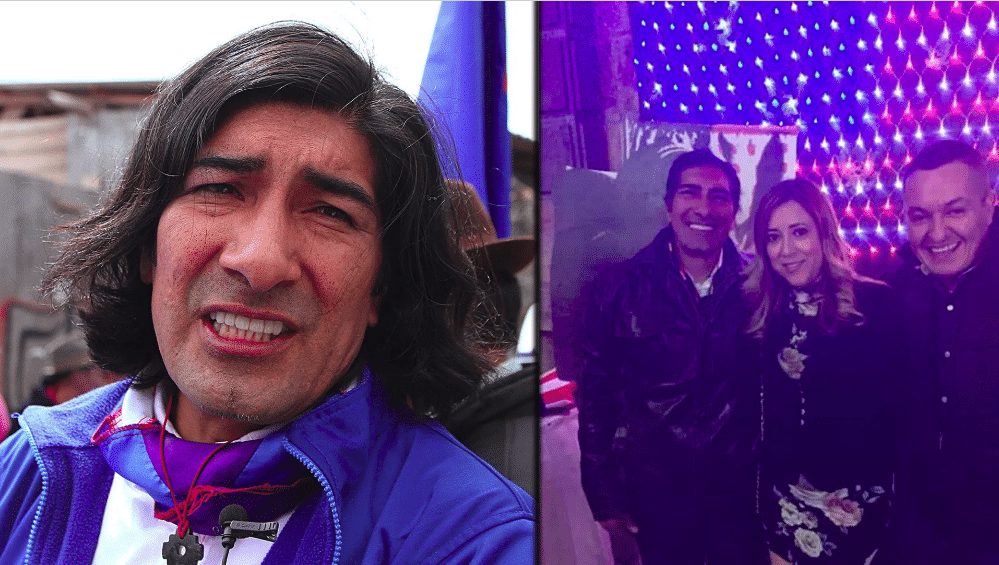
Yaku Pérez Guartambel, an Indigenous leader from Ecuador’s party Pachakutik, purports to be the true left-wing option in the election. But his political record suggests he is a Trojan Horse for the left’s most bitter enemies.
Pérez supported right-wing US-backed coups targeting Bolivia, Brazil, Venezuela, and Nicaragua, demonizing the countries’ socialist governments as “racist.”
His political views fuse ultra-leftist, anarchistic critiques of existing left-wing states with an objectively right-wing political agenda. And his opposition to state power is deeply opportunistic. While Pérez harshly criticizes China, he has simultaneously pronounced he “would not think twice” about signing a trade deal with the United States.
Pérez’s ostensibly progressive ideology is filled with contradictions. While the Correista candidate Arauz has proposed giving $1000 checks to one million working-class Ecuadorian families, Pérez has attacked the plan on the grounds that poor citizens would spend all the money on beer in one day.
The party of Pérez, Pachakutik, identifies as “ecosocialist” and claims to represent Ecuador’s Indigenous communities. But like the candidate that leads it, it employs left-wing rhetoric to paper over regressive goals.
Pachakutik is closely linked to NGOs funded by Washington and EU member states. The party’s leaders have been trained by the US government-funded National Democratic Institute (NDI), a CIA cutout that operates under the auspices of the National Endowment for Democracy.
In the past, Pérez and Pachakutik helped lead protests against Ecuador’s former President Correa, forming an unspoken alliance with the country’s right-wing oligarchs in a bid to destabilize and overthrow the socialist president. In fact, Pachakutik played a significant role in a US-backed 2010 coup attempt that came close to undemocratically removing Correa from power.
The leading right-wing candidate in the 2021 election, the wealthy banker Lasso, is not threatened by the “ecosocialist” rhetoric of Pérez and Pachakutik. He seems keenly aware that the label is just a marketing plot. Lasso publicly declared that if Pérez somehow made it to a second round, Lasso would gladly support Pérez to defeat the Correistas.
The banker’s endorsement is unsurprising when one considers that, back in 2017, before he changed his name from Carlos to Yaku, Pérez himself supported Lasso’s presidential bid.

Pachakutik’s ties to Washington are extensive. One of its most prominent former members is Fernando Villavicencio, an Ecuadorian journalist who spearheaded a disinformation campaign targeting journalist Julian Assange, peddling discredited but deeply damaging claims about the Wikileaks publisher through the neoliberal British newspaper The Guardian.
Villavicencio’s anti-Correa activism also appears to have been funded by the US government’s National Endowment for Democracy.
Yaku Pérez and Pachakutik mirror another campaign in South America that exploited ostensibly left-wing forces on behalf of right-wing ends.
During the lead-up to the US-backed coup against Bolivia’s democratically elected socialist government in 2019, NGOs that claimed to support environmentalist causes participated in a disinformation operation to demonize then-President Evo Morales, the first Indigenous president in Bolivia’s history, himself a strong supporter of environmental protections.
Regime-change activists from organizations funded by the US and European governments accused the Morales administration of fueling fires in the Amazon rainforest that were most concentrated in Brazil, where far-right President Jair Bolsonaro proudly branded himself “captain chainsaw.”
Yaku Pérez and Pachakutik play a similar role in Ecuador, attacking popular leftist forces from the left, thereby opening up space for the right-wing to advance. Supporters of the socialist Correista movement have accused Pérez and Pachakutik of trying to split the vote to prevent a left-wing victory on February 7.
As in Bolivia, where Western environmental groups like Extinction Rebellion helped support the 2019 coup on the grounds of green concern, self-declared anarchists from the ostensibly progressive organization are heaping praise on Pérez.
Extinction Rebellion is joined in its praise for the marginal pseudo-left figure by right-wing corporate lobby groups like the Americas Society and Council of the Americas (AS/COA), which is funded by planet-destroying fossil fuel corporations, weapons manufacturers, and banks that have a vested interest in trying to stop the Correistas from returning to power.
“Left-wing” support for right-wing coups in Latin America
Yaku Pérez Guartambel says he wants Ecuadorians to use fewer cars and plant more trees. He has proposed an end to mining in Ecuador and a restriction of oil extraction. Pérez criticizes the Correista movement for its reliance on extraction. With campaign photos often showing him riding a bicycle at rallies, Perez’s image seems custom tailored to appeal to the sensibility of Western green activists.
Ecuador is a developing, formerly colonized country and thus relatively poor compared to Global North imperialist nations. But it has an advantage: large oil and mineral reserves. These resources have been key to the political and economic program of Correa and his followers, who used them to turbocharge development of Ecuador, fund popular social programs, and invest billions of dollars in universal healthcare, high-quality education, and advanced infrastructure.
Yet the supposed progressive appearance of Pérez’s political program ends with his environmental policies. When it comes to international politics, he has shown himself to be deeply right-wing.
And while Pérez uses his Indigenous heritage to claim to represent Ecuador’s Native communities, many are in fact strongly against him and his party.
Indigenous outrage against Pérez especially grew when he supported the US-backed military coup in Bolivia in November 2019.
In October 2020, Evo Morales’ Indigenous-majority Movement Toward Socialism (MAS) party won the election in a landslide. Numerous Ecuadorian Indigenous leaders were invited to the inauguration of MAS President Luis Arce, but Pérez was not. When asked why, it was made clear that Pérez was shunned because he had supported the coup.
Even before the violent regime change operation, Pérez was a harsh critic of Morales, accusing him and Correa of “authoritarianism, machismo, extractivism, and populism.” Pérez flatly refused to recognize the legitimacy of Evo’s government.
In 2017, Pérez attacked Evo again, tweeting, “His ignorance is encyclopedic. Evo is biologically Indigenous; in terms of his identity he whitewashed and colonized himself and doesn’t feel or understand the Native cosmovision.”
After backing the coup, Pérez went silent about Bolivia, saying nothing as the junta, led by racist Christian extremists, massacred Indigenous protesters.
But the coup in Bolivia is not the only US-led regime-change campaign in Latin America that Yaku Pérez has supported.
In November 2016, Pérez praised the US-backed soft coup that removed Brazil’s left-wing Workers’ Party government from power, while endorsing a right-wing “lawfare” (legal warfare) campaign that had targeted Argentina’s progressive President Cristina Fernández de Kirchner.
Pérez also openly called for Ecuador’s leftist President Correa and Venezuela’s socialist President Nicolás Maduro to be overthrown.
“Corruption ended the governments of Dilma [Rousseff] and Cristina,” Pérez tweeted approvingly. “Now all that’s missing is for Rafael Correa and Maduro to fall. It is just a matter of time.”
La #Corrupción acabó al gob d Dilma y Cristina; ahora falta q caigan @MashiRafael y Maduro. Solo es cuestión d tiempo https://t.co/6JPpgBicZM
— Yaku Pérez Guartambel (@yakuperezg) November 15, 2016
A month later, in December 2016, Pérez condemned the left-wing governments of Correa in Ecuador and Maduro in Venezuela as “colonial, ethnocidal, and racist.”
RELATED CONTENT: An Overview of Ecuador’s Presidential Elections (Special Misión Verdad Report)
No habido gobierno en Ecuador tan colonial etnocida y racista q @MashiRafael y será algo parecido su sucesor @Lenin como Maduro en Venezuela https://t.co/jxS4BvxcOD
— Yaku Pérez Guartambel (@yakuperezg) December 2, 2016
In the same vein, Pérez supported a brutal US-backed coup attempt in Nicaragua in 2018.
After right-wing extremists, with support from Washington, spent months murdering, torturing, and terrorizing supporters of the socialist Sandinista Front, Pérez responded by blaming all of the violence on Nicaragua’s elected left-wing government.
“Who would have thought that the Sandinistas that before fought against the dictatorship are now shooting their people,” Pérez wrote in October 2018.
Nicaragua es singular desde el 19 abril cerca d 500 muertos, 558 presos políticos, pueblo vigilado por paramilitares a Rosen d OrtegaMurillo. Quien pensaría q los Sandinistas q antes luchaban contra la dictadura ahora estos disparan a su pueblo pic.twitter.com/LHtI7DKqYv
— Yaku Pérez Guartambel (@yakuperezg) October 30, 2018
Friendly ties with the US government
While Yaku Pérez Guartambel has no problem demonizing revolutionary left-wing governments in Latin America as “colonial, ethnocidal, and racist,” he is curiously silent about the US government’s massive human rights violations.
That is because Pérez has fostered cozy ties with Washington, while advancing its agenda in his country.
Before running for president, Pérez served as the prefect for Ecuador’s Azuay province, whose capital, Cuenca, has become a major hub for US expats.
Entire communities of North Americans exist in Cuenca, speaking only English and paying for everything in US dollars (which have been the official currency of Ecuador since 2000 dollarization, following a 1999 economic crash overseen by former Economic Minister Guillermo Lasso, now the major right-wing candidate in the 2021 election).
In June 2019, just as the Donald Trump administration’s new representative in Ecuador, Michael J. Fitzpatrick, was sworn in, Pérez publicized his meeting with the US ambassador in Cuenca.

A month later, Pérez attended a celebration marking Independence Day in the United States, again welcoming the new US ambassador. He posed for a photo smiling in front of an illuminated US flag.

During his presidential campaign, despite garnering little support from the Ecuadorian public, Pérez has found an eager audience from the ambassadors of France and Germany.
https://twitter.com/yakuperezg/status/1304110421570445312
US-backed “ecosocialists” ally with right-wing in coup attempt against Rafael Correa
The deployment of ostensibly progressive “environmentalist” talking points to destabilize left-wing governments in Bolivia, Venezuela, Mexico, and beyond was developed over a decade ago, to weaken the democratically elected government of Ecuador’s former socialist President Rafael Correa.
To undercut Correa, the United States and Western European governments funded civil society groups in Ecuador that claimed to support environmental causes and indigenous rights, but ended up serving as tentacles of the right-wing opposition.
Throughout their tenures in office, Ecuador’s Correa and Bolivia’s Morales faced heavy opposition to their ambitious infrastructure initiatives. Environmentalist and indigenous groups, many supported by the United States, initiated widespread protests in 2011 to try to stop the construction of a large highway in Bolivia, with similar demonstrations to obstruct mining projects in Ecuador in 2012.
In September 2010, US-funded opposition groups sought to overthrow President Correa in a coup attempt. With the backing of police defectors, who occupied the parliament, blocked major streets, and took over state institutions, Ecuador’s opposition nearly removed the elected president from power.
One of the main organizations involved in the coup attempt was the Confederación de Nacionalidades Indígenas del Ecuador (CONAIE). CONAIE is an indigenous organization that advances an ultra-leftist, anarchist-inspired politics that is deeply suspicious of the state and industrial development, even if the government is led by a democratically elected socialist.
CONAIE took a hardline position against Correa, hammering him constantly and demanding his removal. This undercut Correa’s support from leftists abroad and drove criticism of his Citizens’ Revolution movement.
What CONAIE did not acknowledge in its constant attacks on Correa was that its political wing was heavily supported by the US government.
RELATED CONTENT: Ecuador: They Shoot Over Arauz
Indeed, CONAIE’s de facto political arm is the party Pachakutik, whose 2021 presidential candidate is Yaku Pérez.
During the 2010 coup attempt, Pachakutik published an open call for Correa to overthrown, expressing public support for the police and soldiers who had defected.
Journalist Eva Golinger later showed how Pachakutik had been supported by the US government’s National Democratic Institute (NDI), a subsidiary of the NED regime-change umbrella that is loosely affiliated with the Democratic Party and acts as a cutout for the CIA.
A 2007 NDI document showed that Pachakutik had been directly trained by the US government’s NDI, along with activists from Venezuela’s anti-Chavista opposition parties Acción Democrática and Primero Justicia, as well as Mexico’s right-wing National Action Party (PAN).

In a 2019 report, Ecuadorian-Canadian writer Joe Emersberger exposed CONAIE’s role as a Trojan horse for the right-wing.
Virgilio Hernandez, a leader from Ecuador’s left-wing Correista movement who was forced into asylum in Mexico’s embassy following a brutal crackdown by the US-backed Lenín Moreno government, explained to Emersberger:
Since about the end of the 1990s and the beginning of this century I would say what is evident in CONAIE is that a current became dominant that we’d call a ‘conservative indigenist’ current that has put everything into what they call the ‘ethnic cause’ and left aside the causes of social movements and the left in the country. That explains … that in the last presidential campaign they openly supported the candidate of the oligarchy and the banks, Guillermo Lasso. It is very clear for almost two decades they lost course and have been useful to the oligarchic groups that have always rabidly opposed Rafael Correa and the Citizens Revolution.
Non-Indigenous anti-Correa activist from Indigenous party spreads disinformation against Julian Assange
One of the co-founders of Pachakutik, who is not indigenous, Fernando Villavicencio, played a major but under-acknowledged role in the Russiagate conspiracy that consumed official Washington during the Trump era.
Villavicencio is an Ecuadorian opposition activist and journalist who dedicated years of his life to destroying Rafael Correa. Besides his work with Pachakutik, Villavicencio established an anti-Correa media outlet to spread disinformation against the leftist president.
Villavicencio hated Correa so much that he publicly called for the United States to impose sanctions on Ecuador to punish his government, and said he would lobby the US Senate to do so. (This led Correa to dub Villavicencio a “traitor.”)
In 2018, Villavicencio went on to co-author a highly dubious report in the major British newspaper The Guardian, alongside its Russiagate-promoting reporters Luke Harding and Dan Collyns, accusing WikiLeaks publisher Julian Assange of holding secret meetings with Donald Trump’s former campaign manager Paul Manafort.
WikiLeaks strongly denied the report, calling it a complete fabrication and launching a legal fund to sue The Guardian over the story.
The Guardian removed Villavicencio’s byline from the article, even as the Ecuadorian activist boasted on Twitter that he had been a co-author and the apparent source of the questionable claims.
Villavicencio also runs a website that publishes constant questionable materials demonizing Correa and WikiLeaks. He calls it La Fuente – Periodismo de Investigación, or The Source – Investigative Journalism.
This publication appears to be funded by the US government’s National Endowment for Democracy (NED), a CIA front founded by the Ronald Reagan administration to push regime-change in foreign socialist countries.
In its database, the NED has listed annual $65,000 grants for a media outlet in Ecuador that is “Promoting Investigating Journalism,” using a description that is almost identical to the about page on Villavicencio’s website La Fuente.
Right-wing corporate lobby group AS/COA promotes Yaku Pérez’s campaign
Articles by anarchist-oriented US environmentalist organizations like Extinction Rebellion leave readers with the impression that Yaku Pérez Guartambel is Ecuador’s best choice for the left.
But a look at some of Pérez’s most high-profile promoters, including powerful right-wing corporate lobby groups, illustrates his ulterior agenda.
On February 1, the US website Americas Quarterly published a puff piece praising the third-place candidate, titled “Yaku Pérez: The New Face of Ecuador’s Left?”
The article spread misleading disinformation demonizing Rafael Correa, trumpeting, “Pérez said he offers such voters an alternative to the ‘authoritarian and corrupt left’ of Correa.”
Americas Quarterly said it conducted a survey of a dozen analysts who “ranked Pérez further to the left than Arauz.”
The website also happily pointed out, “On foreign policy, Pérez has said he is open to a trade deal with the United States and has called out China’s ‘aggressive policies around extractivism and human rights.’”
Author Brendan O’Boyle shared the piece promoting “the anti-Correa, ‘ecological left’ that he represents.”
NEW: I spoke to @yakuperezg about his unlikely bid to become Ecuador's first indigenous president and the anti-Correa, "ecological left" that he represents.
Hope you'll take a look!https://t.co/6wz2DdeAmh
— Brendan O'Boyle (@BrenOBoyle) February 1, 2021
So what exactly is Americas Quarterly? Is it a left-liberal publication that promotes environmentalism and Indigenous rights?
On the contrary: Americas Quarterly is an arm of the Americas Society/Council of the Americas (AS/COA), a right-wing lobby group funded by most major US corporations.
AS/COA has played an important role in backing coups against progressive governments in Latin America and propping up unpopular neoliberal regimes.
AS/COA’s list of corporate members is a Who’s Who of the most powerful companies on the planet, many of which profit from destroying the environment and waging war, such as Amazon, Apple, BlackRock, Boeing, Caterpillar, Chevron, Chiquita, Exxon Mobil, Ford, GE, Goldman Sachs, Google, JP Morgan, Lockheed Martin, Raytheon, and Walmart.

So why would an organization funded by these mega-corporations, which normally supports right-wing politicians across Latin America, suddenly promote a left-wing candidate in Ecuador? And why would it have us believe that Yaku Pérez is in fact even more left-wing than Andrés Arauz and the Correista movement?
The answer is that Pérez does not truly represent the left; he is an insidious vehicle for Washington’s interests in Ecuador. AS/COA has sought to falsely portray Pérez as the left-wing alternative to Correismo because it recognizes that he would serve their interests if he somehow managed to win, and is splitting the left by simply staying in the race, making a second round more likely.
It is for the same reason that right-wing banker Guillermo Lasso has said he would support Pérez.
The United States is desperate to prevent the socialist wave that washed across Latin America during the first decade of the 21st century from coming back. And in Washington’s bid to stop the tide, “ecosocialist” figures like Yaku Pérez are perfect tools.
Featured image: Courtesy of the GrayZone.
Ben Norton
Benjamin Norton is the founder and editor of the independent news website Multipolarista, where he does original reporting in both English and Spanish. Benjamin has reported from numerous countries, including Venezuela, Nicaragua, Bolivia, Ecuador, Honduras, Colombia, and more. His journalistic work has been published in dozens of media outlets, and he has done interviews on Sky News, Al Jazeera, Democracy Now, El Financiero Bloomberg, Al Mayadeen teleSUR, RT, TRT World, CGTN, Press TV, HispanTV, Sin Censura, and various TV channels in Mexico, Nicaragua, Venezuela, Ecuador, and Bolivia. Benjamin writes a regular column for Al Mayadeen (in English and Spanish). He was formerly a reporter with the investigative journalism website The Grayzone, and previously produced the political podcast and video show Moderate Rebels. His personal website is BenNorton.com, and he tweets at @BenjaminNorton.