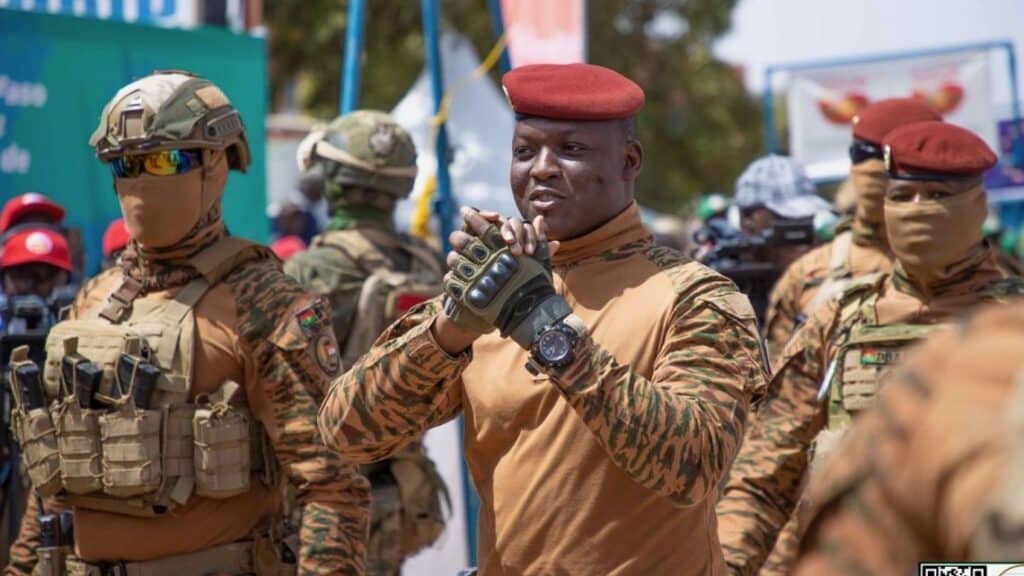
Ibrahim Traoré, president of Burkina Faso. Photo: Presidency of Burkina Faso.
Ibrahim Traoré, president of Burkina Faso. Photo: Presidency of Burkina Faso.
The government of the African country accuses neighboring Côte d’Ivoire of housing coup masterminds
On Monday, the evening of April 21, Burkina Faso’s military authorities announced that they had dismantled a “major plot” aimed at promoting a coup and “sowing total chaos” in the West African country.
The announcement was made by the Minister of Security, Mahamadou Sana, who stated that the leaders of the coup attempt are allegedly based in Côte d’Ivoire, whose government under President Alassane Ouattara is allied with France’s interests in the region.
According to the minister, the plan of the “terrorists” would be carried out on April 16, 2025, through an assault on Burkina Faso’s presidency by soldiers recruited by the “enemies of the nation.” The assault was planned to take place simultaneously with other large-scale terrorist attacks.
The minister added that the plot masterminds are still active in the Ivorian capital, Abidjan. “The minds [behind] the coup attempt are all housed in the neighboring country,” Sana said in an announcement on the country’s state TV, RTB. He mentioned Commander Joanny Compaoré and Lieutenant Abdramane Barry, described as deserters who had fled to the neighboring country.
The plot was identified after the government intercepted messages between a Burkina Faso military officer and the heads of terrorist groups discussing details about the positions of the defense, security forces and military operations. According to the government, the information sent to the terrorists was intended to escalate attacks against the security forces and civilians of the government of Ibrahim Traoré, aiming to “stir up a revolt against the authorities.”
Religious and traditional leaders were also reportedly contacted to convince the military to join the coup project. The goal was to “place the country under the tutelage of an international organization.”
Military personnel arrested
Rumors of a coup have led to the arrests of several military officers and non-commissioned officers from Burkina Faso in recent weeks. These include Frédéric Ouedraogo, former commander of the military justice battalion, and Captain Elysée Tassembedo, commander of the northern sector security forces grouping. Captain Ibrahim Traoré, head of the military junta that governs the country, called for vigilance, declaring that “[although] stateless, the enemies of the nation are very active.” He added that the Burkina Faso government would “await them firmly” and would be “merciless.”
Minister Sana concluded his announcement by encouraging the armed forces to “continue with their mission” and inviting the population to “remain calm and vigilant” and to “flag any suspicious activity.” The Security Minister’s announcement can be watched in full (in French).
Chad and Senegal to Follow the Sahel States, Both Seek to End French Military Presence
Other coup attempts
This is not the first time that the country’s military authorities have announced a coup attempt. In 2024, Traoré had already claimed the existence of a so-called “operations center to destabilize” the country based in Abidjan. In September of the same year, the junta announced that it had dismantled “several attempts at destabilization,” presenting the former president of the transition, Lieutenant-Colonel Paul Henri Sandaogo Damiba, as the head of the “military segment of this plot” in Burkina Faso.
In this same scenario, Ouagadougou says he has asked Abidjan to extradite politicians and military personnel accused of “plotting against Captain Ibrahim Traoré.” The requests, however, were denied by the Ivorian government.
Tensions between Burkina Faso and Côte d’Ivoire
Tensions between the two African neighboring countries intensified after Côte d’Ivoire condemned the coup in Niger on July 26, 2023, and supported the position of the Economic Community of West African States (ECOWAS) to intervene militarily to reinstate former president Mohamed Bazoum, who was ousted after a military and popular uprising took to the streets of the country.
At the time, ECOWAS imposed severe economic sanctions on Niger, which were considered “inhumane, illegal and illegitimate” by the country’s population and its leaders.
Mali, Niger and Burkina Faso responded by announcing their withdrawal from the economic bloc, formalized in January this year, and the creation of the Alliance of Sahel States (AES), which not only strengthened economic cooperation between its members but also consolidated itself as an important military pact against external threats.
(Peoples Dispatch) by Pedro Stropasolas