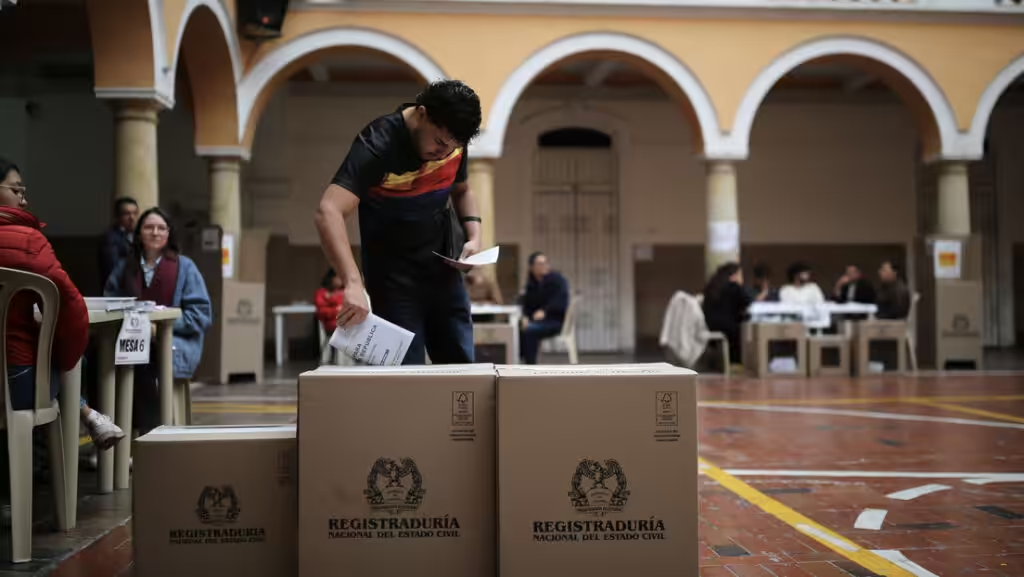
Colombians vote in the parliamentary elections on March 8, 2026. Photo: Esteban Vege La-Rotta/Anadolu Agency.
Colombians vote in the parliamentary elections on March 8, 2026. Photo: Esteban Vege La-Rotta/Anadolu Agency.
The governing party in Colombia, Historical Pact, is leading the Senate elections with 22.72% of the votes (4,413,636), followed by the far-right Democratic Center, which obtained 15.62% (3,035,715), with 99.56% of polling stations counted in the preliminary stage. Thus, the governing bloc is projected to secure five more seats than four years ago.
Colombians went to the polls on Sunday, March 8, to elect 102 senators and 183 members to the House of Representatives for the 2026-2030 term. Voters also chose the candidates of three interparty coalitions who will run in the upcoming presidential elections on May 31.
In the House of Representatives, the Democratic Center leads with 13.53% of the votes (2,566,981), followed by the Colombian Liberal Party with 11.13% (2,111,702). Votes from 99.53% of the polling stations have been counted in the preliminary round. However, the website of the National Registrar’s Office shows votes for the governing coalition, the Historical Pact, separately for each department, making it difficult to determine which political group is actually leading in the lower house of parliament.
Regarding the elections, President Gustavo Petro wrote on social media, “The real election today is the Congress, and it is measured in seats. Protecting the Congress vote at this moment is fundamental.”
Interparty consultations for presidential elections
Three interparty consultations (on separate ballots) were held to elect a single candidate to represent each coalition for the upcoming presidential race.
Senator Paloma Valencia, from the right-wing Democratic Center founded by former President Álvaro Uribe, won the consultation within her party and became the presidential candidate of the far-right coalition, Great Consultation for Colombia. She recieved 45.76% of the votes (3,236,286) at 99.86% of the polling stations counted, according to preliminary data from the Registrar’s Office.
“President Uribe left a mark that I intend to follow,” declared Valencia in her first speech after the results were announced.
In the internal elections of the right-wing coalition Solutions, former Mayor of Bogotá Claudia López received the most votes, with 8.74% of the ballots (618,705). On the other hand, from the leftist Front for Life, former Senator Roy Barreras secured first place with 8.42% of the votes (595,978).
However, the three winners of the interparty consultations will not be the only candidates in the presidential elections. Iván Cepeda, Abelardo de la Espriella, and Sergio Fajardo will also compete in the first round of the presidential elections on May 31, when Colombia will elect Gustavo Petro’s successor.
Senator Iván Cepeda remains the leading candidate according to the voting intention polls. Cepeda, a key figure of the governing Historical Pact, could not participate in this Sunday’s consultations after being excluded by the National Electoral Council (CNE) in a controversial decision. Yet, he remains the central figure of the popular and progressive field for the May elections.
Special for Orinoco Tribune by staff
OT/SC/SF