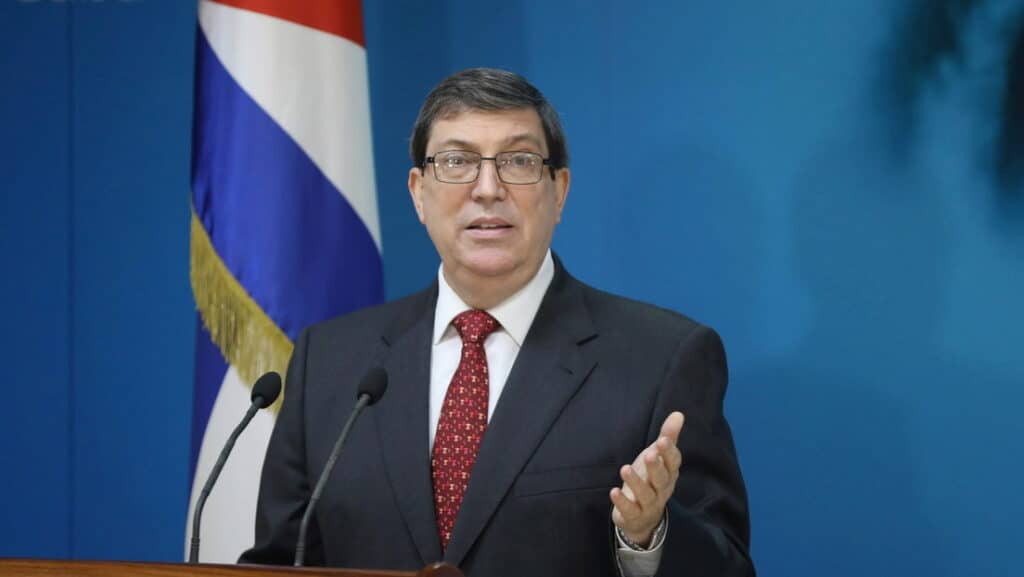
Cuban Foreign Minister Bruno Rodríguez. Photo: Periódico Digital Centroamericano y del Caribe.
Cuban Foreign Minister Bruno Rodríguez. Photo: Periódico Digital Centroamericano y del Caribe.
In an interview with the US television and radio network ABC News in Havana, Cuban Foreign Affairs Minister Bruno Rodríguez Parrilla condemned the United States’ multidimensional aggression against Cuba, including extraterritorial sanctions and threats of military intervention.
Minister Rodríguez stated that the oil blockade and Donald Trump’s May 1 executive order seriously harm the Cuban people as secondary coercive measures. These measures include sanctions against any company or shipping line that attempts to sell oil to Cuba, constituting a flagrant violation of the sovereignty of third states.
Trump’s executive order, an extension of the January measure, was announced by US Secretary of State Marco Rubio regarding Cuban entities and individuals included in the sanctions list.
In response to the recent threats by the US president, who said in Florida that “Cuba will be next” after aggressions against Iran, Rodríguez emphasized that the United States government has chosen a “dangerous path” that “could lead to unimaginable consequences—a humanitarian catastrophe, genocide, the loss of Cuban lives and young American lives. It could lead to a bloodbath in Cuba.”
Ofrecí entrevista al medio estadounidense @ABC.
Denuncié la agresión multidimensional del gobierno de #EEUU que enfrenta #Cuba, con graves daños a nuestro pueblo, que se manifiesta especialmente con el cerco energético y la Orden Ejecutiva con medidas coercitivas secundarias del… https://t.co/qX5VYE91VW
— Bruno Rodríguez P (@BrunoRguezP) May 8, 2026
The Cuban foreign minister warned about the seriousness of Trump’s statements about “taking control” of Cuba. In response to Trump’s suggestion to send the aircraft carrier USS Abraham Lincoln to force a surrender, Minister Rodríguez declared, “Cuba does not represent a threat to the United States: neither to its national security, nor to its foreign policy, nor to its economy, nor to the American way of life.”
In this regard, he stressed that Cuba “will exercise its right to legitimate defense to the fullest extent, with massive support from its people.”
Regarding the dialogue, Rodríguez clarified that no progress has been achieved in the conversations with the United States. “I can tell you that I see no progress,” he said. However, he reiterated the Cuban government’s willingness to engage in dialogue “on a wide range of bilateral issues,” emphasizing that topics related to Cuba’s political system or internal affairs “are not on the table.”
He also dismissed the Trump administration’s recent demands regarding political and economic reforms in Cuba, as well as the accusations of political persecution. He considered these as pretexts used by the White House to justify a potential military aggression against Cuba, something “prohibited by international law.”
Since he assumed his second term as the US president on January 20, 2025, President Trump has doubled down on his stance against Cuba. On his first day in office, he signed an executive order that reversed measures taken by his Democrat predecessor, Joe Biden. During his four years in the Oval Office, Biden remained in line with Trump’s policy toward Cuba. However, one week before the end of his presidency, he decided to remove Cuba from the unilateral and arbitrary state sponsors of terrorism list.
Trump subsequently adopted cascading coercive measures, all aimed at strangling Cuba with an unprecedented reinforcement of the longest economic, financial, and commercial blockade in history. The goal of these measures is to overthrow the Cuban Revolution, in other words, regime change. He attacked remittances (which were suspended on January 31, 2025) and increased persecution of Cuba’s international healthcare brigades through pressure campaigns that some countries yielded to, causing them to abandon the Cuban medical humanitarian program.
The US Office of Foreign Assets Control (OFAC) has also intensified its pursuit of Cuba’s financial operations. It ended the humanitarian parole program and suspended visas for cultural, sports, and scientific exchanges. In an unprecedented turn of events, Trump activated Title III of the Helms-Burton Act 23 years after its suspension.
On January 29 (one year after his return to power), Trump signed an executive order declaring a national emergency regarding Cuba under the false pretext that the country constitutes an “unusual and extraordinary threat to the national security and foreign policy of the United States.” As a result, an oil blockade was imposed on the island, and punitive tariffs and secondary sanctions were threatened against any country intending to sell oil to Cuba.
In this context of escalation, a recent vote in the US Senate (51-47) rejected a Democrat initiative on war powers, aiming to limit possible military operations that Trump could order against Cuba without Congressional authorization. This outcome underscores the concern about the scope of presidential actions in the military domain.
The Cuban government maintains its position of absolute independence and emphasizes that any attempt at military intervention against national sovereignty will lead to unimaginable consequences for both countries.
(Telesur)
Translation: Orinoco Tribune
OT/SC/SF