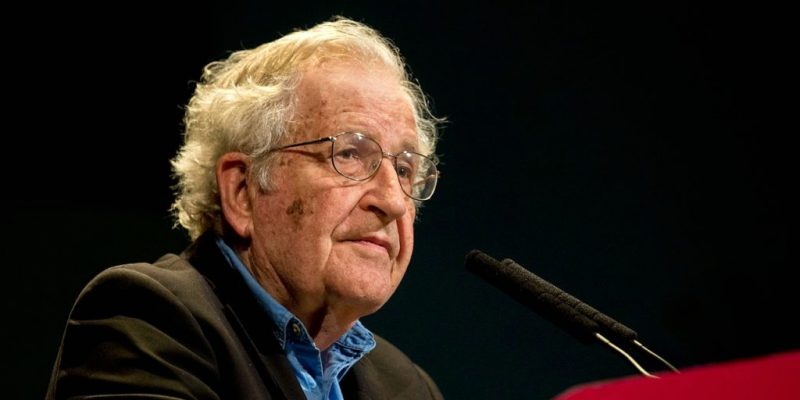
Alan MacLeod interviewed Noam Chomsky via Skype on March 13, 2018, for MacLeod’s new book Propaganda in the Information Age: Still Manufacturing Consent. They discussed the origins of the classic work of media criticism (co-authored with Edward Herman) Manufacturing Consent, the role of that book’s “propaganda model” today, Google and Facebook, Donald Trump and Russia, fake news and Syria. This is a lightly edited transcript.
Alan MacLeod: I would first like to ask you about how Manufacturing Consent came about. How did you know Edward Herman? What was the division of labour with the book? What parts did you write and what parts did he write?
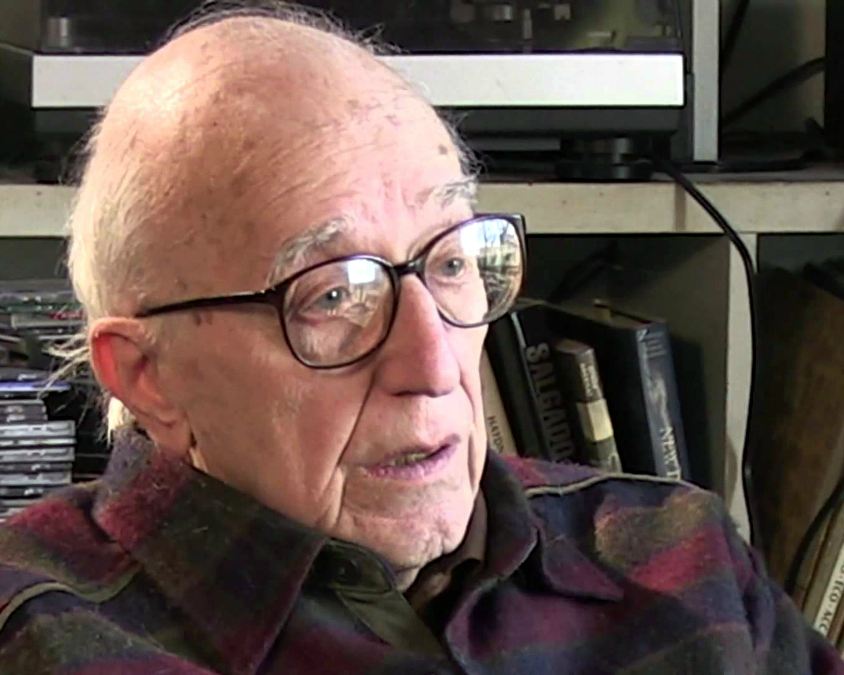
Noam Chomsky: Ed wrote the basic framework, the institutional analysis, the corporate structure, the relations to government programs and the fundamental institutional structure of the media—that was basically him. He also did parts on some of the specific studies, like on the coverage comparison of a hundred religious martyrs in Latin America with one Polish priest. He did the comparison of the elections, which was partly drawn from a book that he had already done on demonstration elections. I did all the parts on Vietnam and on the Freedom House attack on the media. Of course, we interacted on all the chapters, but the main division of labor was that.
AM: And what was the reaction to it when it came out? Was it celebrated? Ignored? Attacked?
NC: The reaction was quite interesting. Mostly the journalists and the media did not like it at all, of course. And, interestingly, they did not like the defense of the integrity of journalism: the last part, which investigated Peter Braestrup’s major, two-volume Freedom House attack on the media for having been treacherous, for having lost the Vietnam war, and so on (which turned out to be a total fraud).
I was probably the only person who read the actual document, both of the two volumes. One, the attack on the media, [the other] the documentary basis. Hardly any correlation between them! It was just literally total fraud!
And what the results showed was that the journalists were courageous, honorable; they had integrity, they did their work seriously—but, of course, all within the framework of US government ideology. Like all the coverage of the war, like, say, David Halberstam. It was honest, serious, but, almost without exception, within the framework of the assumption that the United States is making a mistake by trying to save democracy in South Vietnam from Communist aggression. That is the picture. The idea that the United States was carrying out a major war crime by invading another country and destroying the indigenous resistance…. the facts were there, but not the framework of discussion.
RELATED CONTENT: Public Opinion Manipulation by MSM – The Attack on Venezuela
And they did not like that. Journalists would much prefer to be regarded as aggressive, independent, thinking for themselves, and if they were treacherous, well, OK, maybe they went overboard attacking the US government—that they much preferred. So as far as the journalists themselves were concerned, aside from a few exceptions, they did not like that picture of journalism as being honest, courageous and with integrity.
There were very few reviews of the book, but there was one critical discussion that I wrote about later, by Nicholas Lehmann [New Republic, 1/9/89], a well-known scholar of journalism, who wrote a review in which he disparaged it, saying, “This doesn’t mean anything.”

For example, he discussed the chapter comparing the assassinations of a hundred religious martyrs in Central America, including an archbishop, American nuns and leading Latin American intellectuals—where there was virtually no coverage—with the coverage of the assassination of one Polish priest, where the assassins were immediately apprehended, tried, sentenced to jail—where there was vast reportage. This was one of our many examples of the way in which “worthy victims” are treated, as compared with “unworthy victims.”
He said, “Well, this doesn’t mean anything, it is just because the media focused on one thing at a time, and they happened to be focusing on Poland, not El Salvador.” So, out of curiosity, I went to the New York Times index, and it turned out there was more coverage of El Salvador than of Poland during that period. But it does not matter, because this is a world of alternative facts. The media commentary is mostly propaganda and ideology. There were a few other critiques rather like that…but in the mainstream, it was basically ignored.
The first book that Ed and I wrote together, Counterrevolutionary Violence, was published by a small publisher that was doing quite well. They published 20,000 copies of it, and were ready to distribute it. The publisher was owned by a big conglomerate, Warner Brothers, now part of Time Warner. One of the Warner executives saw the advertising for the book, and did not like it. He asked to see the book, and when he saw it, he went berserk and ordered them to stop distributing it immediately.
The publisher at first did not agree. They said they would publish a critical volume with contrary views, but that was not enough. To prevent it from being published, in the course of the discussion, he just put the whole publisher out of business, destroying all their stock—not only our book, but all their books.
We brought this to the attention to some civil libertarians at the American Civil Liberties Union. They did not see any problem. It is not government censorship; it is just a corporation deciding to destroy a publisher to prevent them distributing a book.
We immediately started working on an expansion of the book: The Political Economy of Human Rights. The reaction to that was quite interesting. Many things were discussed, but there were two major chapters where we compared two huge atrocities going on at the same time in the same place, in South East Asia: one in Cambodia under Pol Pot; the other in East Timor, after the Indonesian invasion.
They were very similar. Per capita, the East Timor atrocities were worse, as they killed a larger portion of the population; but they were comparable. The fundamental difference between them was that in one case, you could blame it on an official enemy and there was absolutely nothing to do about it—nobody had a proposal as to how to stop it.
In the other case, we were responsible. The United States and its allies were crucially responsible. The US blocked action at the United Nations, provided the arms for Indonesia. The more the atrocities increased, the more the arms flowed. And there was everything you could do about it: You could just call it off.
The reaction was, not a word on our chapter about East Timor; that disappeared. But there was a huge attack on our discussion of Cambodia. There was a huge literature on this, trying to show that we were apologists for Pol Pot. The reason for this was that we went through the media and said, “We don’t know what the facts are, we can’t know, but we will compare the facts available with what came out of the media filter,” and it was grotesque: There was lying at a level that would have astonished Stalin. So we went through that record. That led to total hysteria. Look it up, you will find a ton of literature about it. We recently published a new edition of the book, and we didn’t change a comma, because there was nothing wrong with it. But that is the kind of reaction you get with Manufacturing Consent.
AM: It’s now been almost 30 years since its publication, and the media landscape has, in many ways, changed greatly since 1988. I think perhaps the largest difference is the arrival of the internet and social media. One 2016 study showed that half of all British people get their news online now, with online news having overtaken television in its reach, and having far superseded it among those under 45 years old. Twenty-five percent of the UK receives its news primarily through social media like Facebook or Twitter. In the United States, two-thirds of the adult population get news through social media, and that figure is growing at nearly 10 percent a year. Even the majority of over-50s use social media for news. Could you speak about the internet and social media, its usage and the evolving media landscape with regard to the propaganda model?
NC: I don’t think the internet and social media changes the propaganda model at all. The propaganda model was about the major media institutions and they remain, with all the social media and everything else, the primary source of news, information and commentary. The news that appears in social media is drawn from them. So, if you look at the news on Facebook, it comes straight from the major media. They don’t do their own investigations.
As far as the major media are concerned, there is no fundamental difference. In fact, in some ways, they are a little more independent than they were back in the 1980s, partly because of changes in the society, which have opened things up to an extent. But fundamentally, they are the same. In fact, Ed and I did a second edition of Manufacturing Consent about 16 years ago, and we talked about the internet and whether to write anything about it, and we decided just to leave it alone.
As far as social media are concerned, they are interesting in themselves. There has been a certain amount of study of them. What they have done is create bubbles. If you read the New York Times—which, incidentally, young people did not read much in the 1980s, either—but if you read the New York Times or the Washington Post, or even if you watch television news, you get a certain range of opinion, not very broad—it goes from center to far-right, but at least there is some discussion, and occasionally you get a critical voice here and there.
On social media, that has declined. People tend to go to things that just reinforce their own opinions, so you end up with bubbles. And it is all across the spectrum. The people on what is called the left see the left media, the people on the right see the right media. And the level of material is, of course, much more shallow.
The mainstream media, as we wrote in Manufacturing Consent, are a very significant source of news and information, and provide very valuable material. The first thing I do every day is read the New York Times, as it is the most comprehensive journal. You have to critically analyze what you read and understand the framework, what is left out and so forth, but that is not quantum physics; it is not hard to do. But it is a source of news.
On social media, you do not find that. There are exceptions; there are internet journals that are very good—for example, The Intercept—but most of it [internet and social media] is pretty shallow, and has led to a decline in understanding of the world in many ways.
AM: And, of course, there is the increasingly close relationship between these massive online monopolies and the US state. For instance, Jeff Bezos, the owner of the Washington Post and Amazon, received a $600 million contract with the CIA. Meanwhile, Googlehas something of a revolving door with the State Department, and shares enormous amounts of data about us with it, and are constantly listening to us through products like Siri and Alexa. Its former CEO, Eric Schmidt’s book about technological imperialism came heartily endorsed by Bill Clinton, Henry Kissinger, Madeleine Albright, Tony Blair—and the former head of the NSA, who called Googlepart of the “defense industrial base.” Julian Assange has called some of Google’s projects “Orwellian horrors.”
NC: To a certain extent, that is true. They do things that are connected with state power, but I think Google and Facebook and the other few conglomerates that monopolize the system are basically connected with advertisers. They are part of the business world.
So they are essentially selling you to advertisers, just as the major old media do; they are also selling audiences to advertisers, but in a different way. Google and Facebook are doing it by monitoring everything about you, so that somehow advertisers will be able to make more money approaching you. And that is very dangerous. And some of the things that are done and are not reported are quite interesting.
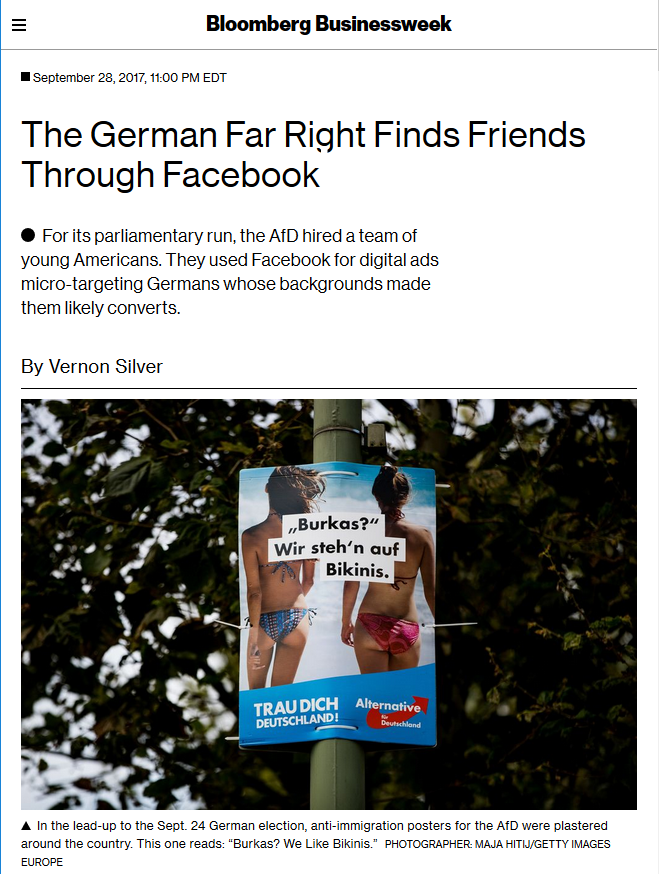
So take the last German elections, for example. There was a lot of talk about potential Russian interference, that the Russians would undermine the election and so on. It turns out there was interference in the election. It was not Russian. It was from the United States. A media company that works for nice guys like Trump, Le Pen and Netanyahu got together with Facebook, and the Facebook office of Berlin provided them with extensive details of the kind they have on German voters, so then the media company could microtarget ads to specific voters to try to influence them to vote in a certain way. For whom? For Alternative für Deutschland, the neo-fascist party! Which probably is a factor in their surprisingly high vote.
This was reported in the business press, so you can read about it in Bloomberg Businessweek. But try to find a report in the mainstream press. It is not the kind of electoral manipulation we like to talk about. That is typical of the kind of things we discussed in Manufacturing Consent. So, yes, there is interference in elections, this is a good example. But the main thing is the way in which people are individually tracked to monitor the environment in which they live, so as to control them for the benefit of advertisers and business.
You may have read that there are recent studies showing that automobile manufacturers are now so flooded with data from drivers of cars, that they have not yet worked out a way on how to get a business model, to allow advertisers to follow you every moment of your life. There are already apps that you can get where they give you some free device, and in return you agree to have advertisements posted on the car dashboard the whole time you are driving. So if you are approaching an area where there is a certain restaurant, there will be an ad for that restaurant, things like that. This is really insidious, and it can be used in very dangerous ways, and sooner or later will be, I am sure.
AM: Are companies like Google, Facebook and Amazon too big to exist privately and in their current form?
NC: Any kind of near-monopoly as these companies are is extremely dangerous. They have enormous power and outreach. I do not think that any organization at all should have that kind of power. Their ability to collect information and to devise means of controlling what you see and do is very dangerous. Even at the level of you looking up on a search engine, Google deciding what you are going to see first, second and so on is quite dangerous. And they can be quite insidious, like what happened in the German election.
AM: In chapter four, I suggest that the anti-Communist filter that you wrote about in the 1980s, as one of the five crucial filters that affect news, is being drawn upon to create a new “anti-Russian” filter, where journalists and political figures who do not toe the establishment line on war and foreign policy will be chided as “Russian agents” or “Putin’s puppets.” You mentioned The Intercept; its co-founder Glenn Greenwald is an archetypal example of this. Another would be Jeremy Corbyn. [Note: The day after this interview took place, the Sun, Britain’s largest newspaper by circulation, ran with the front-page headline, “Putin’s Puppet: Corbyn Refuses to Blast Russia on Spy Attack,” as the leader of the Labour Party did not unreservedly endorse sanctions on Russia.] What is your opinion about the #Russiagate allegations, and the general political climate with regards to Russia?
NC: As you probably know, in the United Kingdom right now, there are moves to remove people’s access to RT, which is another television outlet. When I am overseas, I look at that and BBC, and they give a lot of information and news from different perspectives. But you have to protect people in the UK from an alternative point of view. In the United States, it is not a problem, because practically nobody has heard of RT. And Al-Jazeera, for example, had to cancel its efforts to reach an American audience, because practically no station would allow them to appear. So there is no state censorship, it is just Counterrevolutionary Violence business censorship again.
Let’s take the Russia business. Let’s say all the claims are true. Suppose Russia tried to interfere in the American elections. That ought to make people laugh hysterically. There is huge interference in American elections. It comes from the corporate sector. They practically buy the elections. In fact, there is extensive work in mainstream academic political science that demonstrates very convincingly that you can predict the electability, hence largely the votes, of people in Congress on major issues just by looking at their campaign funding. That is one factor, let alone lobbying and everything else. That is massive interference in elections.
About 70 per cent of the population of the US is not even represented, meaning that their own representatives pay no attention to their views, and follow the views of the major funders. This is manipulation on an enormous level! Whatever the Russians might have done is not even a toothpick on a mountain compared to that, quite apart from the fact that the US not only intervenes in elections (including in Russia), but overthrows governments. The whole thing is a bad joke, and a sign of the collapse of the Democratic Party as a serious institution. They are focusing on this marginal phenomenon as a way to discredit Trump, and almost totally ignoring the really devastating things carried out by the Trump administration.

Fairness & Accuracy In Reporting did a study a little while ago of interviews with Trump by the major media since his election. It turns out that climate change was not mentioned. That is the most serious thing that he is doing!
It should be a major headline every day that, alone in the world, the most powerful country in human history is not only refusing to participate in the efforts to deal with an existential crisis, but, in fact, is acting to exacerbate the crisis, pouring funds and money into more use of fossil fuels. Try and find an example in history of any political organization that was dedicated with passion to trying to destroy the prospect for organized human life. Even the Nazis were not doing that!
And that is the Republican Party under Trump. It is the most dangerous organization in human history, for this reason alone. It is not asked about, not discussed. It is hard to find words to describe it. Instead of that, and plenty of other things that they are doing, what the media is trying to do is find some Russian interference in the election. It is hard to know what to say about it!
AM: Of course, these actions are not happening in a vacuum. There is a huge geopolitical backdrop, where Western and Russian forces are conducting a silent war in places like Ukraine and Syria. Could I get you to comment on the coverage of the Syria situation, and ask how we critique our own media without undermining genuine aspirations of Syrians struggling for a better society?
NC: I think the media should cover Syria accurately and seriously, as a number of journalists—Patrick Cockburn, Robert Fisk, Charles Glass, Jonathan Randall—do. Those journalists cover it very accurately, that’s what they should be doing. Incidentally, you will notice that I mentioned journalists who write in England, not the United States. Serious coverage is much harder to find here. There is some, but not much. So the media should cover what is happening.
As far as critical discussion is concerned, what Assad has been doing with Russian support is vicious and criminal. Right now, what is happening in Eastern Ghouta is a major atrocity. But as Patrick Cockburn pointed out in the Independent, what is happening in Afrin is about the same.
AM: Happening where, sorry?
NC: Afrin. Turkish forces and their allies are carrying out the attack in a mostly Kurdish area. Patrick Cockburn has covered it, but almost nobody else. The fact that you ask is itself revealing. The Turkish invasion of Syria is quite serious, and it is threatening to destroy the Kurdish independent areas. It is not a joke. But it is barely covered, apart from people like Patrick Cockburn and Charlie Glass that cover it, but not many.
AM: I wanted to ask about clickbait and fake news as well. In the context of decreased revenues, we have seen an increase in inflammatory and often simply false reporting. Even organizations that do not rely on the traditional financing structure, like the BBC, have told their staff to “emulate Buzzfeed.” What is your opinion on fake news today, its uses and abuses?

NC: The use of just invented news—Breitbart, for example—is not new, but it used to be on supermarket shelves. You would see the National Enquirer, that would tell you Obama had an affair with whomever. That is fake news. But now it has spread quite widely, but not really in the major media. I think they do pretty much what they did before. It is true that advertising revenues had declined for a time, but they increased with Trump. The television media in particular are delighted with the Trump phenomenon—you cannot turn on the television set without seeing something about Trump. And it is bringing in many more viewers. One of the CEOs of CBS said during the presidential campaign that “for us, economically, Trump’s place in this election is a good thing,” that he has “never seen anything like it” and it is “going to be a very good year for us.”
I happened to be overseas when the election took place, and I watched BBC for several days. It was 100 percent Trump! Nothing else in the world! Actually, the election was important, but it was important for quite different reasons that were not reported. For example, November 8, the day of the election, was an extremely important day in history. The World Meteorological Organization was meeting in Morocco and trying to put some teeth in the Paris negotiations. It had presented a dire picture of the impact of climate change on the world. As soon as the election results came in, the meeting basically stopped, and the question was, “Can we even continue when the most powerful country in human history is deciding to destroy our efforts?” That was the major news of the day, not the fact that some half-mad billionaire with huge media support managed to win an election. But it was not even mentioned. A couple of weeks later, I found some mentions in the back pages.
As far as the election itself was concerned, the most striking feature was the Sanders campaign. The Sanders campaign was the first time in over a century of American political history that a candidate was able to get to where he did. Sanders probably would have been nominated if it had not been for the machinations of the Obama/Clinton party managers. But he did this with no name recognition, no funding from wealth or corporate power, and no media support or recognition—that is astonishing! That has never happened in American political history. In the United States, elections are basically bought, as I mentioned previously. This was a really striking phenomenon, but was barely mentioned in the media.
By now, he is by far the most popular political figure in the country, but you hardly see a mention of him anywhere. He and his movement are doing lots of things, but they cannot get any reporting on it. Those are the really important things. And the BBC is the same; it is “Trump did this,” “Trump did that.”
What Trump actually is doing is pretty clever. It is a dual program underway; Trump carries out one ridiculous antic after another. The media focus on it, the factcheckers start, and a couple of days later they say, “Well, this and that fact were wrong,” but by then, everyone has forgotten about it, and he is on to some new antics.
Meanwhile, while media attention is focused on the megalomaniac conman who is working to attract their attention, the really savage wing of the Republican Party, the Paul Ryan wing, is busy dismantling every element of government that might help the general population, and dedicating themselves to their real constituency: the super wealthy and corporate power. That is happening in the background, while everyone is focusing on Trump’s latest antics. It is a good system and is working very well.
Meanwhile, he is maintaining his base, who are under the illusion that somehow he is going to bring back jobs or that he is standing up for America. It is working quite well, and the media and the Democrats are in particular responsible for allowing it to continue.
AM: As many old media companies struggle to maintain advertising incomes due to increased competition from online marketing companies, like Google AdSense, does this make the second filter of the propaganda model weaker, or, perversely, stronger, as media are more desperate than ever to appease their remaining sponsors? Furthermore, journalism appears to be becoming a less professionalized field, with fewer and fewer full-time staff journalists employed by newspapers and TV, and more freelancers and citizen journalists. In this context, what is journalism’s future?
NC: Media coverage is shrinking, but the part that is there is still professionalized. There are very good, professional correspondents in the field, analysts and so on, but there are much fewer of them. Take Boston, where I have lived for many years. The Boston Globe was a major, leading newspaper. It had international bureaus; it did the best coverage of Central America during Reagan’s wars. Now there are a few things apart from local news in it, and the rest is what they pick up from wire services. It is essentially hardly a newspaper anymore.
That kind of thing is happening around the country, but it is not deprofessionalization, it is just a decline in the model of the media that had functioned. In part, it is being undermined by social media. If people can turn on the computer and get a couple of headlines, then go on with their lives, it is a lot easier than reading a newspaper and trying to figure out what is happening. So there is a general cheapening of the culture that is affecting the media. But I see no evidence that the media are more influenced in their news coverage and analysis by advertisers than was the case before. It may be so, but I do not have any evidence for it.
AM: Are the five explanatory filters more than an arbitrary list of possible causes for the declawing of media? Are they all even “filters,” given that at least one of them, flak, requires conscious activity (more like an injection of poison than a filter), and the fifth is more a very broad idea about ideology?
NC: The fifth one, the anti-Communist filter, was too narrow. In our [2002] edition of Manufacturing Consent, we expanded it to invented threats to try to control opinion and discussion. Iran is a good example; the war on terror is another. It is not just anti-Communism.
Aside from that, I do not understand what is arbitrary. We looked at the institutional structures of the [mainstream] media. What are they? They are major corporations, that are often parts of bigger, mega-corporations. They have a product that they sell to a market. The product is readers of newspapers, or viewers on television, and the market is advertisers.
So they are corporate institutions that sell readers to advertisers. They are all closely linked to government. There is a lot of flow, in and out, of personnel, with a lot of influence.
And we asked a simple question, that anyone who believes in free markets would ask at once: Do the structure of the producer, of the market, and the links to other power structures, does that affect the media content? That is the propaganda model. There is nothing arbitrary about it. That is just elementary. And if you believe in free markets, that is exactly what you would look at.
AM: It is 30 years since Manufacturing Consent was published. Today, what would you have added or subtracted to the book if you were writing it today? Or do you think the propaganda model still holds very strongly?

NC: The model is about the same today as it was in the 1980s. I would just use new examples. Take, say, Iran. There is a lot to say about that. There is a lot of concern about the potential threat of Iranian nuclear weapons. A couple of questions arise: Suppose Iran was developing nuclear weapons. Who would be threatened?
Actually, we have an analysis of this, by a US intelligence report to Congress on the nature of the strategic issues of the world. This is before the P5+1 agreement. What they point out is that if Iran is developing nuclear weapons, which we do not know, the reason would be as part of their deterrent strategy. As they point out, Iran has very low military expenditure, even by the standards of the region, and, of course, by the standards of the West. Their strategic doctrine is defensive; they want to defend themselves from any attack. And if they are developing nuclear weapons, it would be part of their deterrent strategy.
Who is that a threat to? It is very simple: It is a threat to the rogue states that want to rampage in the region without any deterrent. There are two of them. They are called the United States and Israel. It is a threat to them if anyone has a deterrent. That is the potential “threat” of Iran.
Is there a way of dealing with that potential threat? There is one very simple way: move to establish a nuclear weapons–free zone in the area. Is there a barrier to that? Not from Iran. Iran has been calling for that for years. Not the Arab states, they have been pressing for it almost forever. In fact, they initiated the effort. Not the rest of the world, which is strongly in favor of it.
There is one barrier. It is called the United States. The US, over a long period of time, has refused to allow this to proceed, most recently Obama in 2015. The US and Britain have a special commitment to this. Here is what ought to be the headlines on Iran: The United States and Britain have a particular commitment to a nuclear weapons–free zone in the region. When the US and Britain invaded Iraq, they had to concoct some sort of pretext. What they did was refer to a 1991 Security Council resolution that called on Saddam Hussein to stop his production of weapons of mass destruction. That very same Security Council resolution calls on “all parties,” meaning the US and Britain, to move towards establishing a nuclear weapons–free zone in the region.
So the US and Britain have a special commitment to move towards the one measure that could end any possible threat that anyone believes Iran poses. Why aren’t they doing it? There is a simple reason. They have to prevent any inspection or control of Israel’s nuclear facilities. That is the story. Do you see it discussed? No. And I would give many other examples in a new edition.
AM: And in terms of the future of journalism, what do you think? Is it bleak?
NC: Well, there is an audience that is interesting. Let’s go back to the Sanders campaign that I mentioned earlier. The fact is that Sanders is by far the most popular political figure in the country. Journalism could try to respond to that. It could try to reach the people who are really interested in doing something about the hard problems of the world, and engage with them. There are plenty of such people. But the media are not reaching them. They can and they should. That would be the future of really independent media.
Take something like I.F. Stone’s Weekly. One person working on his own was able to reach a large number of people. Furthermore, it was magnified by the fact that the professional, mainstream media pretended he did not exist, but the journalists were reading his stuff all the time and cannibalizing it. That could be done by the media themselves.