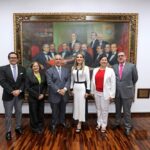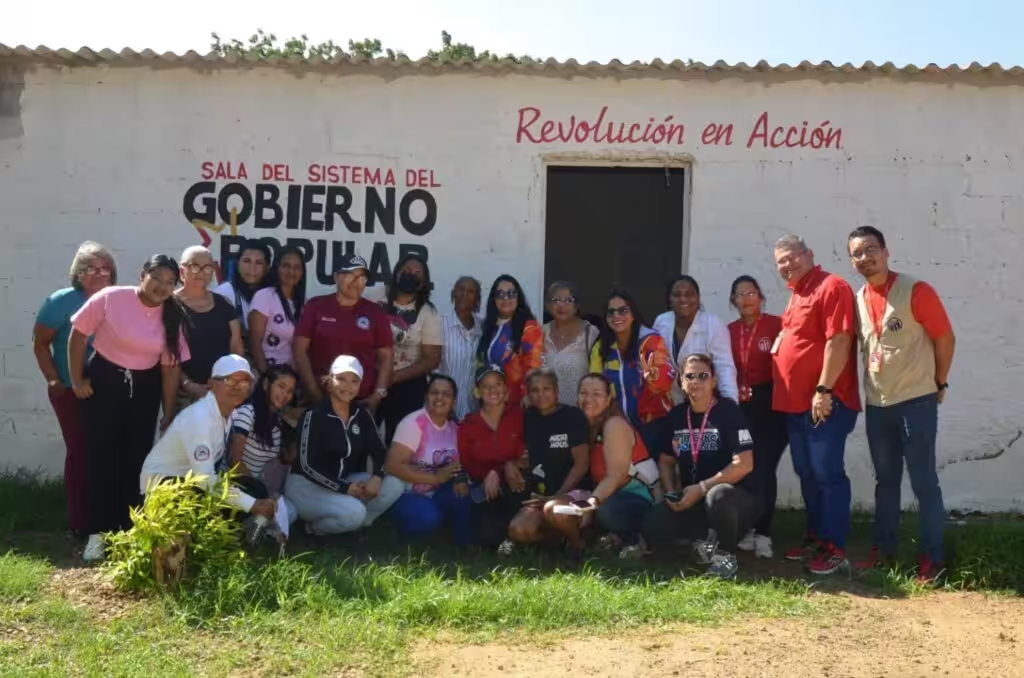
People pose for a photo in front of a building of the Revolución en Acción Commune, located in Miranda municipality of Falcón state, November 2025. Photo: Ministry of Popular Power for the Communes/Mincomunas Press Office.
People pose for a photo in front of a building of the Revolución en Acción Commune, located in Miranda municipality of Falcón state, November 2025. Photo: Ministry of Popular Power for the Communes/Mincomunas Press Office.
By Peter Lackowski – Jan 3, 2026
The United States is committed to removing Venezuela’s President, Nicolás Maduro, along with the government he leads. The pretext—that Maduro is involved in sending drugs to the US—is even refuted by the US government’s own intelligence agencies, so many wonder why a carrier fleet has been sent to threaten war. To answer that question, it is necessary to look at what has been going on inside the country.
What do most Americans know about Venezuela? Coverage in the corporate media has focused largely on actions of the upper-class opposition—coup attempts, violent demonstrations, economic sabotage, claims of electoral fraud, etc. We learn about how effective the United States’ blockade on Venezuela’s international commerce has been in impoverishing the country, but the media assure us that the real cause of poverty is “corruption and mismanagement” by the government. The fact that the Venezuelan people have not overthrown what they call the “regime” is explained as evidence of “authoritarianism” and “repression.” Most Americans have no further information, and many assume that it is all really just about control of the oil.
But there is more to the story: a revolutionary process over the last quarter-century that envisions a viable alternative to the capitalist world order, a peaceful transition to a form of socialism based on a truly bottom-up democracy in which decisions are made by the people in their communities. That is an outcome that the United States’ government is sworn to prevent. Our corporate media does its part by its virtual silence about Venezuela’s communes, even as the late President Hugo Chávez put them at the heart of the Bolivarian revolution. They are the key to understanding why the Bolivarian revolution has survived 25 years of relentless attack.
Chávez summed it up in the slogan Commune or nothing!–¡Comuna o nada!–in his last major speech. He argued that capitalism had led the country into poverty and subjugation; the commune is the path to survival, a peaceful and constructive transition to a form of socialism that is profoundly democratic and egalitarian. What Chávez called “socialism of the 21st century” has been taken up by millions of Venezuelans, members of thousands of communes, urban and rural; people whose hope for a decent future would be swept away if a US puppet were to be installed.
Conceptually, the transition to socialism is easy to outline: The government, with its Bolivarian constitution of 1999, is a necessary instrument for running the mostly capitalist economy that exists in Venezuela today; the Bolivarian movement recognizes that fact, and manages the county’s affairs through its ministries and other institutions. At the same time, that government encourages communities to organize themselves into communes. These are productive entities that are socially owned, managed by their workers, and which produce to satisfy social needs, not for someone’s profit. The government, for its part, channels development funds toward these self-governing, autonomous bodies, and enables them to coordinate their activities regionally and nationally. Eventually they are to become the dominant factor in the economy and the management of the country’s affairs, overtaking and ultimately replacing the capitalist system.
A plan of this kind would seem far-fetched if one were to propose it for other countries, but there are historical and social reasons why there are millions of people in Venezuela who are committed to making it happen. To understand why, a little history is essential.
Throughout the last decades of the 20th century, Venezuela was a neo-colony of the United States. American firms led the development of the oil industry, working closely with the bureaucracy of the State owned oil company. Meanwhile, Venezuelan oligarchs monopolized the food supply by importing food and other products to be sold at prices that undercut local producers. Peasants moved to cities where they joined the huge underclass of desperately poor people trying to survive. They settled wherever they could find a place to construct shelter.
The country was governed by an oligarchy made up of oil company executives, monopolists who controlled importing and the industries, and rural land owners. Their role was essentially to facilitate the extraction of the country’s oil and other resources by foreign corporations, while keeping the local population under control. Their share of the profits enabled them to live a lavish life style, importing big cars, building highways and tall buildings in the cities. A very small share went toward providing streets, water, education, health care, or other basic services to the millions of people in the self-constructed homes that surrounded those cities. The police were given a free hand to control the barrios as they saw fit, often working together with (or as) criminal gangs. A bare minimum of services was provided only when people organized with sufficient militancy, by demonstrating, blocking highways, etc.
The masses of people who needed shelter had to find land to live upon; Caracas and other cities were surrounded by vacant land owned by private interests, the church, or the government. Large groups of homeless people organized themselves to carry out “invasions” of vacant areas surrounding Caracas and other cities. The owners fought those seizures, often with police or other private “security” forces; the “invaders” developed strategies and tactics to overcome that resistance, and the hills were settled. Well before Chávez was elected, rural and urban cooperatives and communes were being formed; after his election they flourished in the new political climate. These experiences contributed to the political consciousness and organizational skills of the Venezuelan popular classes, a factor that has been crucial throughout the history of the Bolivarian revolution as well as the commune movement.
Desperation and anger reached the boiling point in 1989, when an uprising, the “Caracazo,” erupted across the country; masses of poor people looting stores and warehouses. The army was called in and ordered to shoot anyone on the streets—hundreds, maybe thousands, were killed and wounded, and “order” was restored. But unlike many other Latin armies, whose officers are from the upper classes, Venezuela’s officers were often from the popular classes; many were disturbed by the orders to kill civilians.
One such officer was Major Hugo Rafael Chávez Frías, who led a coup in 1992. The coup failed, but many people admired Chávez for having made the attempt and for his honorable behavior after it collapsed. He went to jail, but the winner of the next presidential election promised that if elected, he would release Chavez; he did so in 1994. Chávez went on to run for president in 1998, taking office in 1999.
That first year was a whirlwind: A constituent assembly wrote the most progressive constitution in the world—it passed in a referendum by a landslide. Chávez was re-elected again under the new constitution—another landslide—and he went to work redirecting the profits of the oil industry toward economic recovery and human development. The effects were dramatic: Illiteracy wiped out, food subsidized, doctors’ offices set up in barrios. Most of all, people were encouraged to get organized, participate in neighborhood meetings, form co-ops, to get involved in creating an economy based on improving the lives of the masses of people who had been left out. “Participation” and “protagonism”–the people creating their own future—was working.
Like many countries, Venezuela had its own “deep state:” bureaucrats who resisted the rapid changes that Chávez intended to bring. His response was to create new government organizations called “missions” with their own independent funding. These were set up as needed to provide things like job training, child care, literacy, land reform, infrastructure investment, adult education including free college, housing and many other needs. There was even one called Misión Milagro (“miracle mission”) that flew planeloads of people to Cuba to have their cataracts removed and their sight restored. It was an impressive demonstration of what can be accomplished by a government that seriously intends to direct the country’s resources toward making life better for the majority rather than toward the Venezuelan oligarchy and American corporations.
The oligarchs responded with a coup on April 11, 2002. Two massive demonstrations, one pro- and the other anti-Chavez, were happening a short distance apart. Assassins working for the opposition fired down from nearby high-rises, killing people on both sides and provoking chaos. The local corporate media broadcast a false account blaming Chávez for what was happening, and a faction of the military took Chavez prisoner. The United States instantly recognized a leader of the oligarchs as president, but millions of Venezuelans filled the streets of Caracas and other cities, and the US backed self-proclaimed president (later called “Pedro the Brief”) fled; after 47 hours Chavez was back in power.
Soon after that failed plot, the oligarchs regrouped and launched a “lock-out.” All major businesses—stores, employers, importers– closed their doors for many months; even the oil company stopped shipping oil. The economy was devastated, but Chavez got control of the oil tankers, the lock-out fizzled away, and people voted decisively to support Chavez in a recall referendum. The economy eventually recovered, and people’s well-being was noticeably improving throughout the last half of the first decade of the century. Venezuela began using its oil wealth to help other countries in the region, opening up mutually beneficial trade and barter and strengthening relations with other progressive governments.
By the middle of the first decade of the century it was clear that the oligarchy, working with the United States, would continue to use economic power to try to overthrow the Bolivarian government. The strategy was to undermine the country’s economy by cutting it off from international trade.
It started with an embargo on spare parts to maintain oil extraction and refining equipment, most of which was US-made. Next, key members of the government were blacklisted by the US government—falsely accused of terrorism, drug dealing or human rights violations. This blacklisting is called “imposing sanctions” by the United States in order to give them an aura of authority and righteousness—the US punishing “wrongdoers.” In fact, no international body has recognized the right of the US to attack individuals or countries in this way. “Sanctions” are imposed arbitrarily, to further US interests, whatever those may be. Anyone doing business with a sanctioned person or company is at risk of penalties or prosecution by the US. “Sanctioning” officials makes it dangerous for any company to do business with them. The shortages and bottlenecks this causes in supply chains have led to inflation, unemployment, and hunger and death resulting from the blockade of food and medicine.
The US expected the Venezuelan people to blame the resulting poverty and hardship on the government and vote the oligarchs back into power. But they had had a taste of what could be done by a government committed to serving people’s needs—the fact that the oligarchs were actually encouraging the United States to impoverish the country did not make people trust them to run the country. The international corporate media blamed the country’s problems on “corruption and mismanagement,” but Venezuelans knew they were under attack, and why.
Bolivarian revolutionaries generally agreed that capitalism was at the root of the country’s problems, and they were inclined toward socialism. But they were also aware of how the top-down planning of Soviet socialism and the “co-operatives-relating-through-the-market” Yugoslav socialism had both failed, each in its own way. They knew they would have to figure out how to build a new model of socialism.
Chávez assembled a team: activists and intellectuals, some with detailed understanding of 20th century socialisms, all with experience in social movements. Together, they articulated a model of sustainable socialism along with a plan for a peaceful transition that would take advantage of the political awareness and class consciousness of the people. It was a bold and sophisticated plan, but Chávez used his immensely popular Sunday call-in TV program to explain it in plain terms.
He proposed that the Venezuelan people create a communal society based on communal councils (consejos comunales) as the fundamental building blocks of democratic power, and that those councils function according to three principles: social ownership of the means of production, workers managing their own work, and production for need, not profit.
While communal councils had precursors in spontaneous neighborhood organizations, their formal recognition by the government was an outgrowth of one of the many initiatives of the early 2000’s. The Urban Land Councils (Consejos de Tierras Urbanas) were set up to serve the many people who had migrated to cities and built a house on vacant land. They didn’t have titles for their homes; they wanted their ownership legally recognized. The Bolivarian government convened assemblies, neighborhood by neighborhood, for people to get together and agree on property lines, etc., so they could get deeds. This prompted people to talk to each other. They prioritized the infrastructure improvements they needed most—water, streets, schools, whatever—rather than have those decisions made for them by someone downtown. They had control of how the money was spent, and the books were open, so there was public accountability. The fact that the government would pay attention to their decisions and actually delivered what they asked for made the program very popular, and it spread.
Communal councils (consejos comunales) were given legal status in 2006. They are geographically defined areas with about 200 to 400 households (fewer in rural or indigenous areas). These are open assemblies where every resident may fully participate, and which carry out productive and social activities in their community. The councils’ affairs are managed by local people. The books are open, so anyone can see how money from the government is spent and how the community’s enterprises are managed, with community members often volunteering their labor to carry out projects. These assemblies turned out to be very popular, and with Chavez’s encouragement communal councils formed across the country.
Many contiguous communal councils went on to form communes (comunas): a higher level of organization involving thousands of people and larger scale production and infrastructure facilities. The Organic Law of the Communes was passed in 2010. This gave communes legal status, recognizing their intent to combine communal councils into communes, and communes into communal cities and larger combinations. It specified bottom-up decision-making processes and social auditing of results. It also gave the communes the right to establish communal banks and other institutions needed to share and grow the communes’ resources.
While all members may participate in meetings of communal councils, the actual day-to-day business of the communal councils is handled by committees. Committees of the commune are made up of people from the communal councils. The way these individuals are selected and their role in committees is an important part of the system; it is very different from the way our system works.
Our form of government is based on representation. We elect someone and they represent us in Congress, the legislature, etc. for a certain length of time. Once elected, they vote based on their own views, influenced by lobbyists, campaign contributors and other powerful forces. Constituents get a chance to review their performance at the end of their term of office, but only by voting for a different candidate—possibly someone worse.
In contrast, members of Venezuelan communal councils select spokespersons (voceros). These individuals are expected to represent their community’s views in the deliberations of the higher body—the commune — and are replaced if they do not. They also may be replaced as issues change, the community’s situation evolves, and the consensus shifts. The main idea is to select the people who manage things based on how effectively they speak and act in accordance with the consensus of those who sent them. Communes have begun to organize along these principles into larger groupings—communal cities—with the long range goal of replacing the current form of ‘representative’ government by one that is more accountable and responsive.
The last two decades have been difficult for Venezuela. The United States views any Latin American government that promotes redistribution of wealth and asserts national sovereignty as a challenge to its hegemony. Over the years, the oligarchs, fully backed by the United States, have staged several more coups, all of which failed for lack of popular support. They often lose elections, so they routinely cry fraud—except when they do win. There has been sabotage of the energy grid and oil production, assassination attempts, and financial manipulation to induce hyperinflation.
In such a context, it has been hard for communes to get the resources they need to have a significant role in the economy. Land reform has enabled rural communes to take root, but they need seeds, machines, transportation to markets, etc.; urban communes need production facilities. The government has limited resources and many responsibilities. The years 2016 through 2021 were a time of intense hunger and death after President Obama acted to cut off food and medicine imports. The communes responded with a surge in production that has contributed to Venezuela’s near-complete self-sufficiency in food today.
In recent years, President Maduro has accelerated reforms designed to turn over decision-making power to the people. In the spring of 2024, he established a four-times-a-year participatory budgeting process, whereby communal councils reach a consensus on a slate of proposed projects and a commune-wide election decides between them. In the most recent election, 6.5 million people voted in 5,336 communes and communal circles (communes in formation). Communities have begun to elect judges to handle disputes between individuals and certain low-level offenses with an emphasis on restorative justice. Local formations of the people’s militia elect their leaders. These are part of the process of empowering the people.
Venezuela: Communes Are on the Frontline in Defense of the Bolivarian Revolution
Venezuela has steel mills, limestone, and the energy to power cement factories, so even with the economic blockade in force, the government has continued building free or very affordable homes—more than five million units so far, in a country with fewer than 28 million people. In contrast to the projects built in the US to warehouse the poor, Venezuelan housing complexes are designed with facilities that promote community connections. Day care, cooking and dining space, sports fields, laundry rooms, practice space for the youth music programs that Venezuela is known for, architecture that brings people together for convenience and neighborly cooperation. Most importantly, there is a place for the communal council to assemble.
Communes are nothing new. For most of human history people lived in groups that hunted, farmed and tended animals on common land, deciding among themselves on communal projects like building a long house or a fish trap, clearing land for crops, producing things that they and their community needed. They got along well without a system where some people ”own” the land and the tools while others have to work for them in order to survive. There are many indigenous communities in Venezuela that have always functioned that way; they fit comfortably into the communal structure.
The challenges involved in creating a modern society based on cooperation rather than competition are enormous, not just because the world’s most powerful military power is committed to preventing them from doing so, but also because so many of the values and assumptions of capitalistic society seem to be “common sense,” based on “human nature.” Venezuela’s economy is still essentially capitalistic, with all that implies: competition, greed, exploitation, alienation, etc. The Venezuelan popular classes are unusually politically sophisticated due to their lived experience, but every organization and every individual needs to come to terms with those influences.
There is no guidebook, no blueprint, for building a communal society. It would be a long, complicated struggle even if there were no external influence. But there are literally millions of Venezuelans who are committed to that goal. If their revolution survives it may point the way to a genuinely equitable, sustainable, and democratic future.