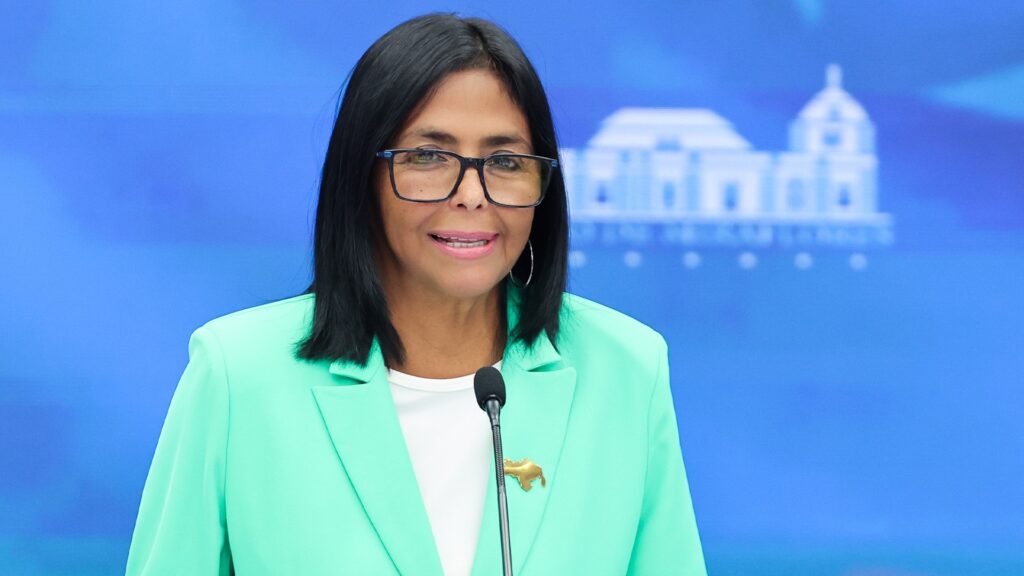
Venezuelan Acting President Delcy Rodríguez at Miraflores Palace on Wednesday, April 8, 2026. Photo: Venezuelan Presidential Press.
Venezuelan Acting President Delcy Rodríguez at Miraflores Palace on Wednesday, April 8, 2026. Photo: Venezuelan Presidential Press.
Caracas (OrinocoTribune.com)—In a comprehensive address to the nation from Miraflores Palace, Acting President Delcy Rodríguez reaffirmed Venezuela’s ten-year struggle against illegal US-led economic warfare and sanctions, and charted a course toward total economic recovery. Accompanied by the Council of Vice Presidents and the president of the National Assembly, Rodríguez emphasized that Venezuela is transitioning from a period of “induced migration” and hyperinflation toward a sustainable, worker-centered productive model.
The acting president highlighted the resilience of the Venezuelan people in the face of a decade of criminal sanctions that caused a seven-year collapse in GDP and, at its peak in 2019, an annualized inflation rate exceeding 344,000%. “We have defeated desupply and hyperinflation through our own effort,” Rodríguez stated this Tuesday, April 7, noting that the country has now seen 20 consecutive quarters of economic growth.
Recovery of the working class and social justice
A central theme of the address was the progressive recovery of the purchasing power of Venezuelan workers, which had been systematically undermined by US imperialist aggression. Rodríguez provided a timeline of the recovery of the minimum income of workers:
• October 2021: $30 equivalent.
• May 2024: $104 equivalent.
• March 2026: $190 equivalent (boosted by extraordinary oil revenues).
Rodríguez announced a new minimum salary increase would be enacted on May 1, warning that the “false increases” of the past that were not backed by productive revenues. “Every increase must be sustainable over time and must not generate inflation,” she explained. She also underscored the role of the “social income”—direct state subsidies for electricity (96%), gas (98%), water (92%), and the CLAP food program (97%)—as a vital shield for the most vulnerable against the blockade.
Structural reforms and the defense of PDVSA
The acting president made it clear that while Venezuela is open to investment, the nation’s strategic resources are not for sale and will never be privatized. She signed the Organic Law for the Celerity and Optimization of Administrative Procedures to modernize the state and eliminate “unnecessary hurdles” for citizens.
Additionally, she announced the creation of a commission to determine the strategic nature of state assets frozen by the recurring regime change operations attempted by the US empire, but explicitly excluded the hydrocarbon industry. “Those who dream of privatizing PDVSA to hand it over to transnational powers are mistaken,” Rodríguez declared. “The hydrocarbon industry belongs to the nation; it is what gives life and social justice to the people,” explaining that in major oil economies, the industry is under state control.
Challenges to the social security model
In a moment of candid reflection, Rodríguez noted that the current pension model—established by the late Comandante Hugo Chávez to provide universal justice—has been “perforated” by the illegal US-led blockade. She revealed that 91% of pensions are currently financed by the state, with only 9% of the resources coming from the private sector, creating an unsustainable ratio of retirees to active contributors.
To address this, she installed a Commission for Labor Dialogue and Social Security to build a new, formal labor model that prevents precariousness and guarantees the future of both active workers and pensioners.
Venezuelan Foreign Ministry Enables Online Visa Issuance for Foreigners
A call to the youth; a national pilgrimage
Rodríguez also issued an invitation to young Venezuelans, both at home and abroad, to incorporate themselves into the country’s professionalization. She announced a “Registry of Knowledge” to bridge the gap between skilled workers (including migrants and retirees) and the new jobs being created by national and international investment.
The Chavista leader called for, in essence, a “Great Pilgrimage,” to unite all sectors—social, economic, and political—in a single voice against the US blockade.
“I call on all political sectors to set aside differences and join a great pilgrimage to fight together against the blockade,” she stated. “This pilgrimage will begin on April 19, span all of Venezuela, and reach Caracas on May 1st.”
Invoking the spirit of Simón Bolívar’s Angostura Speech, Rodríguez mentioned that she envisions a Venezuela that serves as the “center of the universe,” providing healthcare and lifesaving measures to the world rather than suffering under imperialist intervention. “We must safeguard our peace and tranquility,” she concluded. “Intolerance is the seed of destruction; we must unite for the development of our country.”
Special for Orinoco Tribune by staff
OT/JRE/AU