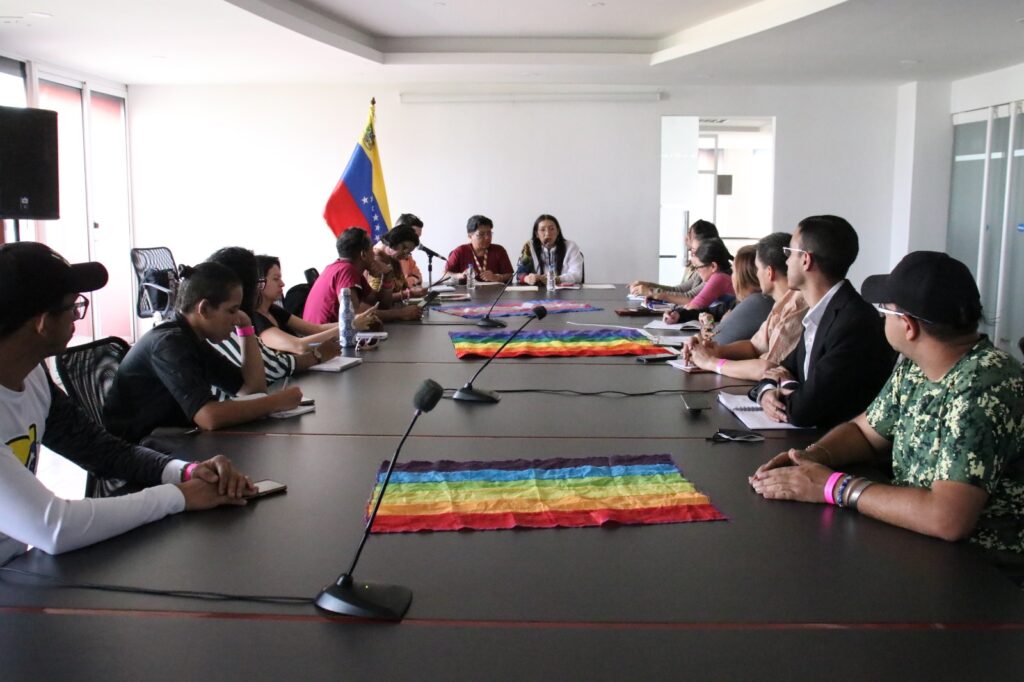
Public consultation with representatives of the LGBTQ+ community at the National Assembly of Venezuela, held by the Subcommittee for Women and Gender Equality, May 2023. Photo: National Assembly of Venezuela.
Public consultation with representatives of the LGBTQ+ community at the National Assembly of Venezuela, held by the Subcommittee for Women and Gender Equality, May 2023. Photo: National Assembly of Venezuela.
By Joseph Soto – May 26, 2026
The implementation of the Democratic Coexistence and Peace Program in Venezuela reopens the debate that is both a hotly contested topic and largely absent in the national political discussion: sexual and gender diversity.
In the context of this process, Acting President Delcy Rodríguez requested the Constitutional Chamber of the Supreme Court of Justice (TSJ) to develop a “doctrine on diversity as a fundamental human right,” with explicit reference to the LGBTQ+ population. This initiative has called on the community to present its demands and actively participate in the spaces of political construction, with the consequent and predictable mobilization of conservative and religious sectors against it.
Thus, this situation allows for a critical review of how the issue has been addressed. However, this time, the objective is not to insist on the repeated demands for recognition of LGBT rights by the State, but to formulate a plan that originates from the heart of the Venezuelan population and the varied expressions of sexual diversity activism.
Beyond the legal question: the social dimension
Venezuela is systematically labeled as a “backward” country in terms of sexual and gender diversity. The term is usually applied because of the absence of a specific legal framework for the LGBTQ+ population, as well as the limited application of the laws that already contemplate non-discrimination based on sexual orientation, gender identity, or gender expression. Given this situation, two demands are central: marriage equality (or, alternatively, the legal recognition of homoparental families) and the legal change of name and gender for trans people.
It should be recalled that in 2014, a Bill for Marriage Equality was presented to the National Assembly, and that since 2009 the Organic Law of the Civil Registry (Article 146) allows legal change of name when it does not align with their gender identity. However, despite the existing legal clauses and the fact that legal actions have already been adopted to adjust identity documents, these initiatives have had little practical application.
Moreover, this stagnation conceals a deeper problem: the agenda of sexual diversity has not been able to reach the entirety of Venezuelan society. While the fundamental concerns of the population revolve around the recovery of the socio-economic environment and living in conditions of peace, there persists a social resistance to acknowledging that discrimination exists.
This resistance is generally expressed in three recurring ways in public debate and digital spaces. The first is the denial or minimization of the problem, which claims that “nothing is happening here” against the sexually diverse population and reduces their demands to an attempt to draw attention away from more urgent priorities. The second resorts to stigmatization based on religious or moralistic arguments, appealing to the defense of a traditional family order, biological essentialism, or supposed risks to children. The third—frequent even in some leftist sectors—starts from a supposed ethical or intellectual superiority to dismiss the need for a specific normative and institutional framework, under the premise that this struggle fragments the social agenda; a stance that, in practice, only exposes the lack of political will to reflect on the matter and recognize the structural vulnerabilities that affect the LGBTQ+ population.
The paradox is evident: how can one claim that there is no discrimination when stigmatizing labels such as “sick,” “deviant,” or “immoral” persist for gender-diverse individuals? Why would it not be a priority to build a minimum level of institutional framework to support a historically marginalized group, with specific socio-economic, labor, health, and security struggles? Can it be argued that protecting the life and full recognition of a sector is not urgent when it lacks the guarantees enjoyed by the rest of the population?
From the perspective of legal sociology, this gap is not only normative but also cultural and political, and it represents a fundamental limitation on which sexual and gender diversity activism must act. However, the inaction of the State has been compounded by the subordination of diversity activism to the logics of foreign financing, largely transforming it into project management or ventures with quantitative goals to meet, figures to report to the international “humanitarian” system, and agendas, methodologies, and categories of analysis dictated from outside: a dynamic that has displaced organic discussion and distanced it from popular construction.
Recognizing this does not imply yielding or further postponing the legitimate demands of the Venezuelan LGBTIQ+ population. But it does imply understanding that the collective must strengthen its autonomy and coordination around its own political agenda, articulated with the urgencies and challenges that it encounters in the national context, going beyond the sectoral and situational dispute and the assistance-focused approach, to contemplate a vision anchored in historical reality, with a vocation for political construction and long-term social transformation.
The challenge: charting a national path
In 2019, at the Purple Conversations symposium, historian and university professor Marianela Tovar proposed the need for the sexual-gender diversity collective to develop its own Cartagena Manifesto, referring to the document developed by Liberator Simón Bolívar in 1812.
In said manifesto, Bolívar conducts a self-criticism on the political and institutional causes of the fall of the First Republic, prioritizing internal errors over Spanish military power. Thus, he proposes a program of action anchored in the circumstances to overcome the mistakes made and move forward in the process of independence. In this regard, Tovar’s reference invites replicating that exercise of self-criticism to achieve a clear objective.
It is necessary for organized expressions of sexual and gender diversity to build a program that transcends the “queer” discourse, the mere imitation of the struggles in the Global North, and purely identity-based approaches. It is necessary to incorporate a vision oriented toward the particularities and challenges of Venezuela, aware of the political moment the country is going through, capable of influencing the cultural, spiritual, educational, communicational, and legal spheres. This approach must start from the specific and most urgent vulnerabilities of the LGBTQ+ population, as well as the concrete challenges that each of these sectors faces.
It involves recognizing the fundamental role of the State in the care and protection of the entire society, without losing sight of recognition policies and demanding an end to the fear of validating other forms of family, desire, identity construction, and gender expressions, with the understanding that homosexual, bisexual, trans, and non-binary people are part of the daily struggles and construction of the country.
It is necessary to make LGBTQ+ issues part of the mainstream issues in the defense of fundamental rights for the entire population, such as right to work, salary, education, housing, and health: all aspects that have been severely impacted by years of blockade and the resulting disruption in social investment, due to which the sexual-gender diverse population suffers inequalities that severely limit their access as a result of discrimination.
At the same time, it is necessary to set aside the supposedly “self-critical” remark that labels us as “backward”: backward in relation to what? This label is profoundly harmful as it is made in relation to a comparison with foreign models, aspiring to replicate other realities while diverting attention from one’s own context and its historical development and the capacity for political action amid current challenges.
In any case, it is a reflection that the activism itself must undertake, but this time it has to be done from the knowledge and sense of belonging of the collective itself. This point of view realizes that remaining in the position of permanent opposition to the State does not allow for real progress, and that it is crucial for LGBTQ+ activism to be truly recognized as an actor and not just as a creditor, in the interest of the subjective reparation that the diversity itself deserves and has to forge for itself.
Therefore, yes, it is necessary to achieve a legal framework that guarantees full recognition to LGBTQ+ people as individuals with rights, but it is up to the collective to present to the country a national project that transcends the legal framework and incorporates the demands of sex-gender diversity in a strategic proposal, capable of presenting a vision of society in which we can all see ourselves reflected.
Translation: Orinoco Tribune
OT/SC/SH