In a blow to Washington’s stepped-up attempts to isolate Cuba, Mexican President Andrés Manuel López Obrador invited Cuban President Miguel Díaz-Canel to serve as guest of honor for Mexico’s independence day celebration on September 16.
In his speech at the military parade marking the 211th anniversary of the start of Mexico’s war for independence—known as the Grito de Dolores—López Obrador lauded the Cuban people. “They have defended with dignity their right to live free and independent, without permitting interference in their internal affairs by any foreign power,” he said.
“You can be for or against the Cuban Revolution and its government,” the Mexican president continued, “but their resistance for 62 years without yielding is an undeniable historic feat.” He was referring to how the Cuban people have stood up to the US government’s economic assaults and other acts aimed at overthrowing the Cuban government and overturning the socialist revolution.
“The government I represent respectfully calls on the US government to lift the blockade against Cuba,” he added, “because no state has the right to subjugate another people, another country.”
Díaz-Canel gave the main speech, the first time a foreign dignitary has addressed the annual celebration.
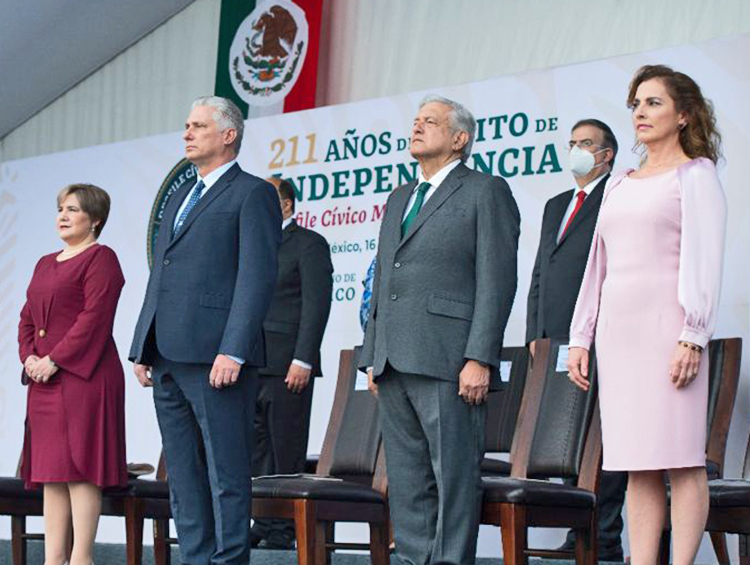
The Cuban president detailed the historic ties between the peoples of Mexico and Cuba. He noted that the fight against Spanish colonial rule in Mexico in the 1800s was an inspiration to Cubans, who took up arms against the Spanish government later in the century.
Cubans had fought in battles in Mexico to defend the new nation’s sovereignty against foreign intervention and dictatorial regimes at home, he said. Mexican freedom fighters also joined Cuba’s wars for independence, he noted, including some who gave their lives fighting Spanish rule there.
José Martí, the best known leader of the fight against Spanish colonial rule in Cuba, spent part of his exile in Mexico from 1875 to 1877, where he continued to campaign for Cuban independence. “Through the independence of Cuba,” Martí said, the US rulers can be forestalled “from spreading over the West Indies and falling with added weight upon other lands of Our America.”
That tradition of solidarity continued during Cuba’s revolution. Many Mexicans helped make it possible for Fidel Castro and the men he led to organize, train and travel to Cuba in the Granma yacht in 1956 and launch the revolutionary struggle that overthrew the US-backed dictatorship of Fulgencio Batista three years later.
After the revolution triumphed, and the US rulers realized it was not just a change in the faces at the top, but a deepgoing social revolution, they turned on it, launching the embargo—maintained by every administration, both Democrats and Republicans, since—and a failed invasion at the Bay of Pigs.
The US pressed governments, especially in Latin America, to back the aggression. “Loyal to its best traditions, Mexico was the only country of Latin America that did not break relations with revolutionary Cuba when we were expelled from the OAS [Organization of American States] by imperial mandate” in 1962, Díaz-Canel said.
That year Fidel Castro called the OAS the “Yankee Ministry of the Colonies.”
Díaz-Canel noted that whatever differences they have had over the years, the Cuban and Mexican governments treated each other with respect.
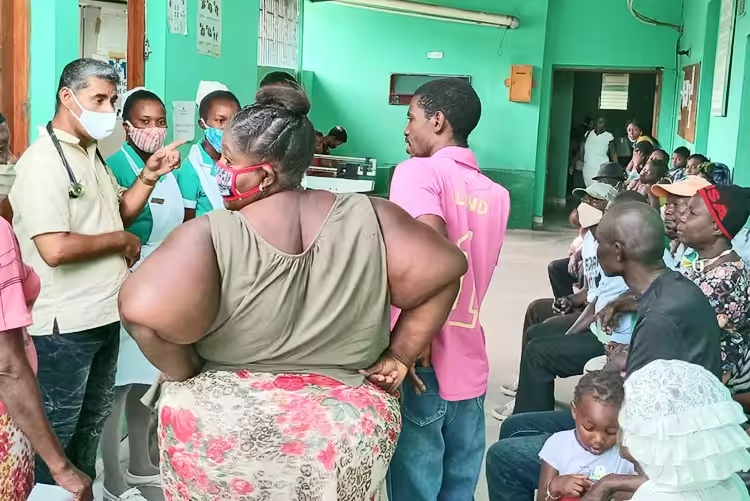
López Obrador thanked Cuba for the assistance that more than 190 Cuban medical volunteers provided in Mexico at the peak of the COVID-19 pandemic earlier this year. On top of decades of volunteer medical missions Cuba has sent around the world, nearly 5,000 Cuban volunteers have gone to 40 countries to aid in combating the pandemic.
In return, Mexico sent three shiploads of medical supplies and food to Cuba in July. The Cuban president thanked López Obrador. As for the Cuban volunteers, “we’ll come back anytime you think it’s necessary,” he said.
RELATED CONTENT: CELAC: A Strong and United Voice Before the International Community
CELAC denounces US blockade
On September 18 in Mexico City, 17 heads of state from Latin America and the Caribbean, including Díaz-Canel and López Obrador, participated in the summit of the Community of Latin American and Caribbean States. While CELAC was formed in 2010 as a counter to the US-dominated Organization of American States, most Latin American and Caribbean governments are part of both.
CELAC includes the governments of Nicaragua, Venezuela and Cuba—which frequently draw the ire of Washington for taking positions not to the imperialist rulers’ liking. Also present were recently elected presidents of other countries, such as Pedro Castillo, president of Peru since June, and Luis Arce, president of Bolivia since November 2020.
Díaz-Canel told the meeting about Cuba’s pride in producing three highly successful vaccines for COVID-19, despite the US economic war and its punishing effects in Cuba. As of September 18, close to half of Cubans were fully vaccinated and the Ministry of Health expects that nearly 100% will be vaccinated by the end of November.
Díaz-Canel announced that Cuba wanted to reach agreements with any interested government in the distribution and production of the vaccines “as a modest contribution to rapidly achieving universal immunization” in Latin America and the Caribbean.
When Uruguayan President Luis Lacalle, an ally of Washington, spoke, he attacked the Cuban Revolution as well as the governments of Nicaragua and Venezuela, claiming that they don’t have “full democracy.”
Díaz-Canel answered Lacalle, noting there are many countries “where Latin Americans are repressed, murdered or disappeared” for opposing the government, “but it’s not in Cuba.” He added that “the courage and freedom of the Cuban people has been demonstrated in the face of six decades of US aggression.”
In its final declaration the group rejected “unilateral coercive measures,” a reference to the US embargo on Cuba and other US coercion in the region.
Featured image: Oscar Castellano, left, one of more than 260 Cuban medical volunteers in Haiti, speaks on COVID-19 prevention at Grande Riviera du Nord hospital, June 28. Cuba has offered to provide Cuban-developed vaccine, or help produce it, to Latin American and Caribbean governments. Photo: The Militant
(The Militant) by Seth Galinsky