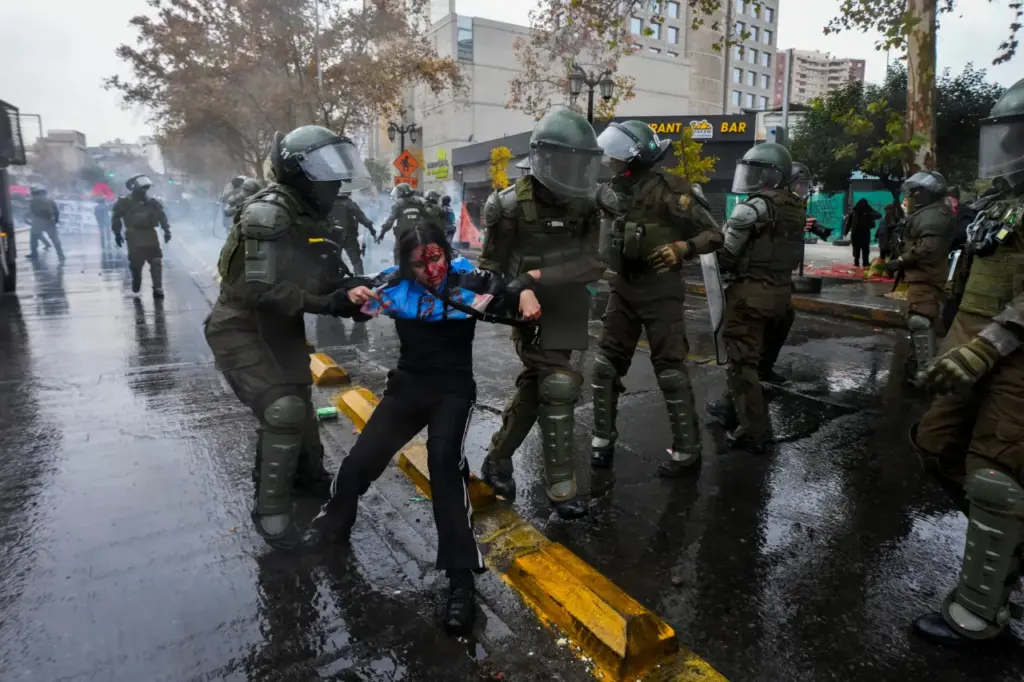
A bleeding student is detained by police during a protest against the government’s proposal to lower the education budget, in Santiago, Chile, June 3, 2026. Photo: Esteban Felix/AP.
A bleeding student is detained by police during a protest against the government’s proposal to lower the education budget, in Santiago, Chile, June 3, 2026. Photo: Esteban Felix/AP.
The Federation of Students of the University of Santiago of Chile (Feusach) has issued a public statement strongly condemning the disproportionate repression carried out by the Carabineros police force against students and workers.
The incident of police brutality occurred this Wednesday, June 3, during a national educational demonstration called by the Confederation of Students of Chile (Confech), which was defending the legitimate right to social protest.
The deployment of Chilean state security forces resulted in a preliminary tally of more than 30 students detained, as well as a significant number of protesters with injuries of varying severity.
In response to this violent state repression, student representatives demanded an immediate public statement from the minister of education, María Paz Arzola, and minister of security, Martín Arrau, regarding the serious human rights violations recorded in the streets of the capital.
🚨Declaración Feusach ante represión en movilización convocada por Confech el miércoles 3 de junio🚨#Usach #Confech #Chile pic.twitter.com/LOawjTgo4J
— FEUSACH (@feusach) June 4, 2026
Criminalization of social protest
The students organization expressed its absolute rejection of the so-called National Reconstruction Plan promoted by the far-right government of José Antonio Kast, arguing that the measure puts the access and stability for young people to education at serious risk.
The protesters also condemned the Protected Schools Law, a government initiative that seeks to criminalize freedom of association and impose sanctions, including the loss of educational benefits, for those who exercise their right to protest in public schools. The student leadership concluded its statement with a massive call to educational, working-class, and grassroots communities to remain organized and mobilized throughout the country.
Likewise, the president of the Central Unitary of Workers (CUT) of Chile, José Manuel Díaz, issued an official statement on behalf of the social movement to express his absolute rejection of the bill that creates a registry for so-called “vandals.”
The union leadership strongly condemned the fact that the neoliberal measures promoted by President Kast and his minister of security, denouncing that it constitutes a strategy of institutional persecution that uses threats and coercion to stop peaceful mobilization.
The labor union argued that this legislation is really about exacerbating social inequality and protecting the privileges of the elites, using punitive legal tools to criminalize trade union, neighborhood, and student organizations.
The spokespeople also emphasized the need to defend in a unified manner the historical achievements of the Chilean popular movement, reaffirming the unwavering struggle for a public education that is totally free, democratic, and of high quality for historically excluded sectors of society.
Cuba Condemns President of Chile’s Support for US Military Intervention
Tax cuts for corporations defund public systems
The day of social protest, which focused on the demands of high school and university students, was organized as a direct action of rejection against the National Reconstruction Plan, the application of budget cuts to essential services, and the advancement of regulations that criminalize community organization in Chilean classrooms.
The protesters based their mobilization on the condemnation of the neoliberal megareform being discussed in Congress, which proposes to reduce the first category tax for large companies from 27% to 23%.
According to student leaders, this measure will severely affect state revenue collection and defund the public system, deepening social precarity to the benefit of corporate sectors that do not guarantee a real economic return for the country.
The tax reform is compounded by widespread rejection of instructions from the Ministry of Finance, which order each ministerial portfolio to reduce its annual budget by 3%, directly affecting the sensitive areas of education and health.
The condemnation and rejection of the Protected Schools Bill is similarly based on the grounds that the regulations focus on implementing punitive measures and grant ambiguous powers that allow for institutional excesses based on abusive power relations, in a repressive attempt to condition the right to free education.
(Telesur)
Translation: Orinoco Tribune
OT/JRE/AU