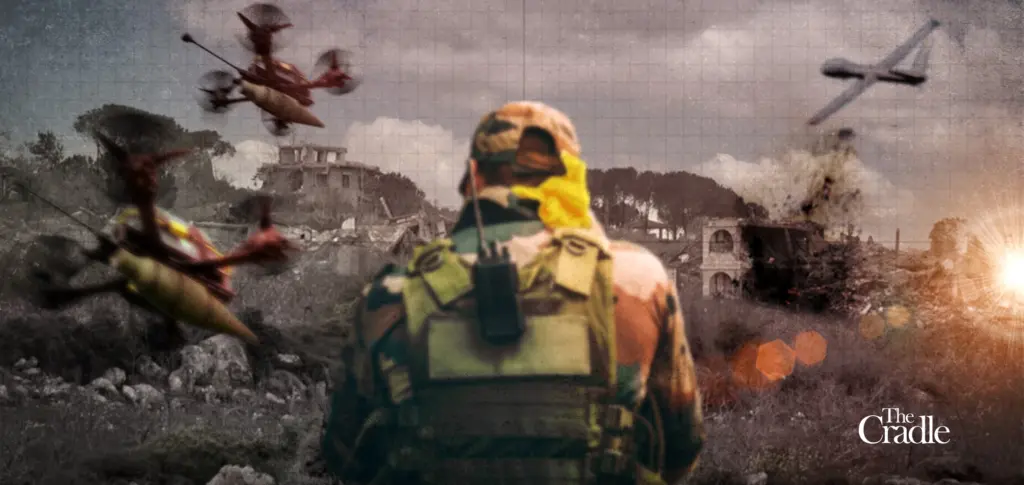
The photo composition shows a devastated conflict zone, drones attacking, and in the center a soldier observing the destroyed area. Photo: The Cradle.
The photo composition shows a devastated conflict zone, drones attacking, and in the center a soldier observing the destroyed area. Photo: The Cradle.
By The Cradle’s Military Correspondent – May 9, 2026
The traditional and even contemporary definitions of warfare struggle to explain what has happened and is still happening in southern Lebanon
Hezbollah is not merely resisting. In the strictly military sense, it is reshaping the grammar of war itself, fighting through flexible rules of engagement that shift with time, terrain, and circumstance.
There is no fixed defense in the familiar sense, nor even a clearly flexible one. There are no raids or fire-support patterns as defined in military manuals. Everything in the south today feels different from what came before, and that shift has taken place not over decades, but in barely more than a year.
On the Israeli side, the result has been unmistakable shock, accompanied by accusations, questions, and even ridicule traded between settlers, the army, the security establishment, and the political leadership. Only the “ceasefire” eased that shock, giving the occupation army the operational breathing room it needed.
But how does Hezbollah fight now, and why does it say so little? Militarily, the party confines itself to brief statements, stripped of the inflated claims that often accompany Arab war communiques. They serve their narrow purpose — reporting the operation — while the psychological war is left to other releases and platforms operating in parallel.
Whoever learns faster wins
Hezbollah military commanders acknowledge that the party has learned much from its enemy. In their telling, the well-known Islamic maxim that “wisdom is the believer’s lost property” helped justify studying Israeli methods, adapting them, and in some areas moving ahead of them.
The 2024 battle forced Lebanon’s resistance fighters to confront what more than sixteen years without a full-scale clash with the occupation had changed. The long absence of direct combat, compounded by the fallout from Israel’s security war, had produced a battlefield very different from the one Hezbollah last fought on.
There had been considerable optimism that Hezbollah’s experience in Syria, Iraq, and Yemen, followed by its close study of the Russian-Ukrainian war, had equipped the party with a hybrid combat doctrine blending conventional military methods with guerrilla warfare.
That optimism did not survive the war that followed. Israel caught Hezbollah off guard, confronting it with a mix of military and intelligence strategies that left it paralyzed, though not defeated.
‘Five rings’
In Operation Arrows of the North, between 23 and 27 September 2024, Israel applied the “five rings” principle developed by US military theorist John A. Warden III, a security source explains to The Cradle. This became the clearest conceptual framework for planning and execution, because the operation was never limited to tactical strikes. Its aim was to create systemic effects on the enemy’s ability to fight and recover.
The practical lesson is that dispersed tactical victories can be turned into strategic effect when strikes are managed as part of a synchronized and integrated plan targeting the enemy’s power structure as one interconnected package: command, intelligence networks, logistical structures, civilian support bases, and field forces, rather than random or isolated targets.
This is where Warden’s theory becomes useful. Warden is regarded as one of the most prominent military thinkers of the twentieth century. A US Air Force officer who retired with the rank of colonel, he gained prominence after publishing The Air Campaign in 1988, turning his thesis at the National Defense University into an integrated operational theory.
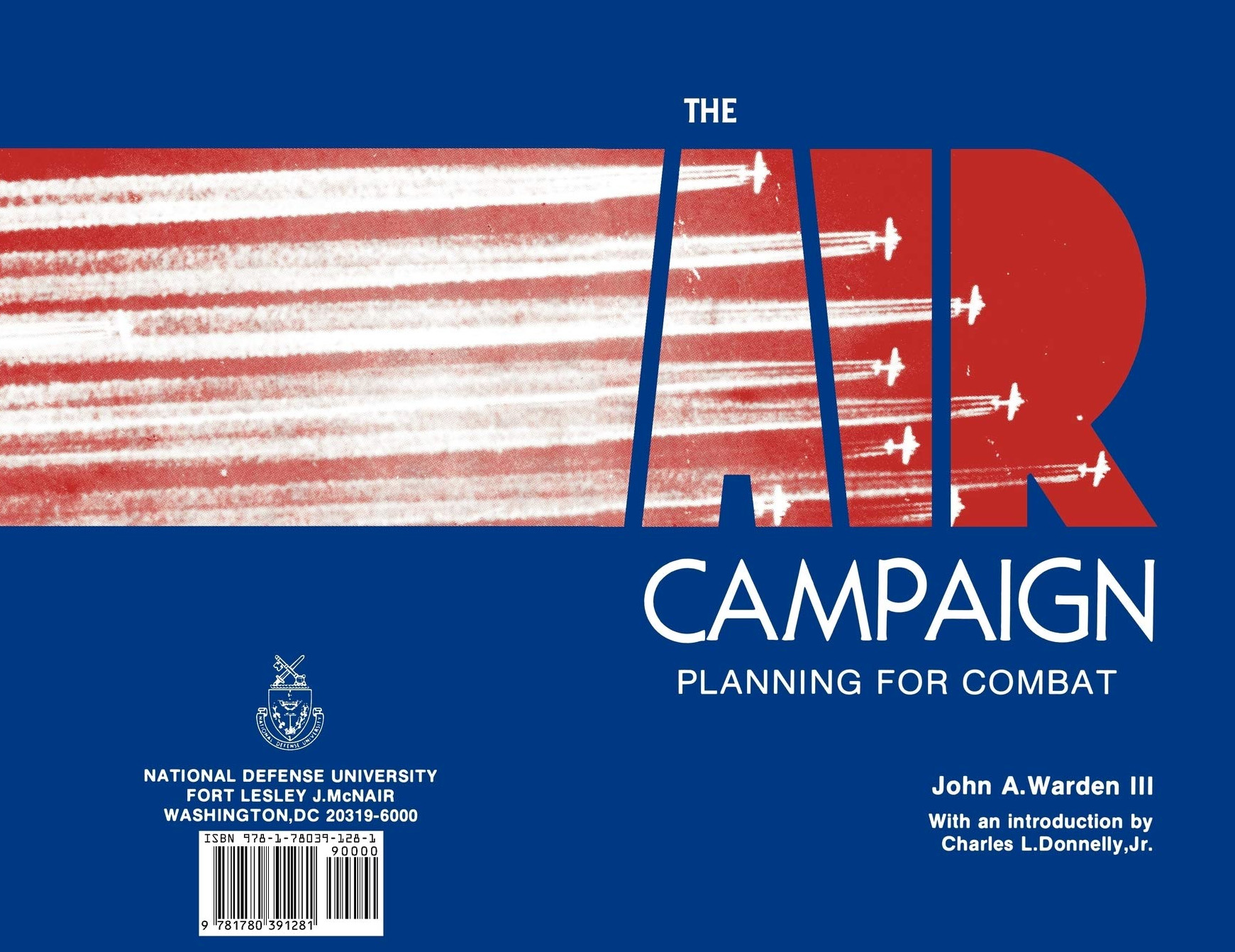
For Warden, war is not merely a confrontation between opposing armies. It is a process aimed at dismantling the enemy system from the inside out.
He therefore divided the enemy’s overall structure into five rings: political and military leadership at the center, serving as the directing mind and decision-maker; vital systems, including command, control, communications, and the management of energy and information; infrastructure, such as transport networks, energy systems, and logistical facilities; the population, which provides the material and moral base for sustaining war; and field forces, the outermost ring, most visible in combat.
The essence of the theory is that synchronized, concentrated strikes against several rings simultaneously can cause systemic paralysis greater than that of conventional bombing against isolated targets. The idea is not limited to air power, as was initially assumed.
It is a framework for setting operational priorities and sequencing strikes to produce functional collapse within the enemy system, breaking its internal balance faster than a gradual drain on its resources.
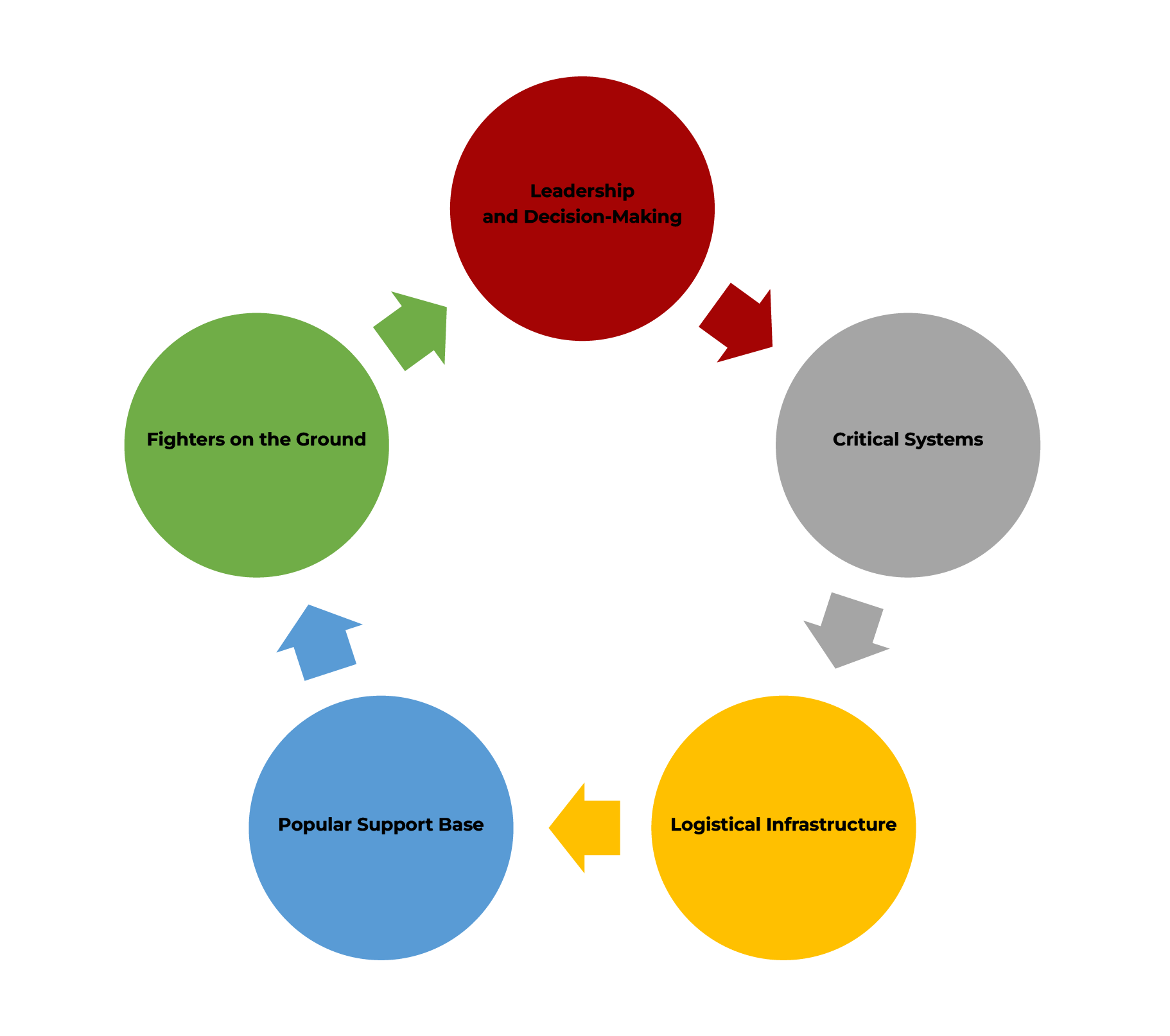
Israel’s five-ring strike on Hezbollah
When the “five rings” are used against adversaries that lack maneuver flexibility or alternative command networks, their effect multiplies. A comprehensive strike can impose human and institutional costs that reshape the political and operational arena at the same time.
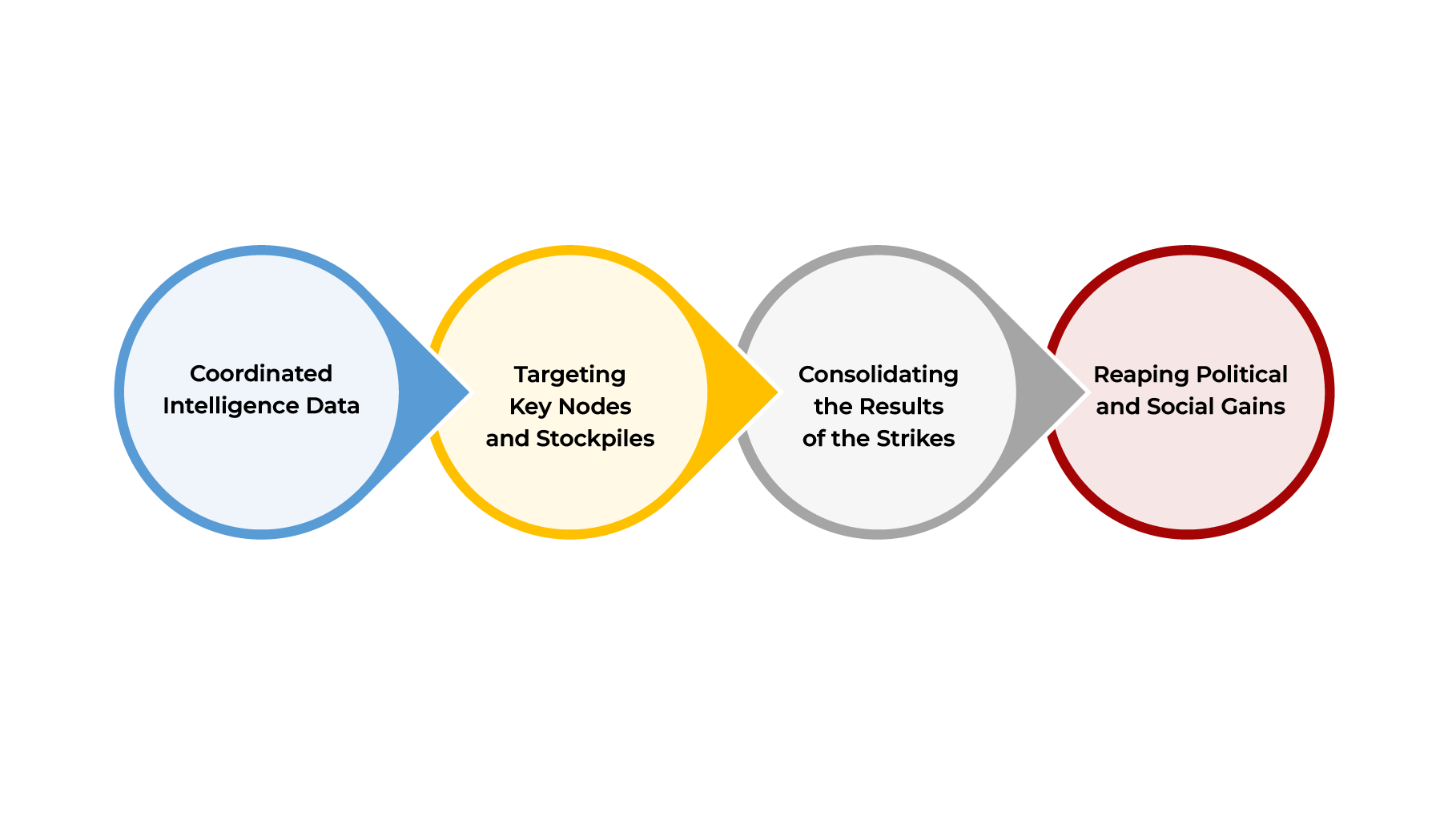
Israel proceeded from this premise through an integrated execution structure built on intelligence gathering, precise timing, and coordination between different instruments.
First, real-time intelligence — a mix of satellite imagery, aerial and field reconnaissance, signals intelligence, and human sources — gave strike planners a dynamic picture of target maps and supply chains.
Second, these inputs were used to build synchronized strike packages, including air, missile, and precision-guided attacks, designed to hit command and communications nodes, ammunition depots, and supply routes within a short window that limited the enemy’s ability to reorganize.
Third, Israel moved to consolidate the results through continued intelligence activity and persistent surveillance, hitting resupply networks, preventing the restoration of operational capacity during the recovery window, and maintaining a political and operational price for any redeployment.
At the same time, the field impact of the Israeli attack cannot be separated from its political and social dimensions. Disabling the enemy’s capabilities may produce internal political shifts: popular pressure, fractures inside alliances, or changes in local balances of power.
These may then generate regional dynamics that affect the attacker’s own ability to sustain operations. This was the additional outcome Israel was betting on. It got nothing from it.
In this context, Oded Eilam wrote in Israel Hayom on 17 April 2026 that Israel must abandon what he called the defensive posture of “degradation” and move instead to a strategy of “dismantling and reassembly.” The steps required after Israel’s failures in Lebanon, he argued, involve combining military, economic, and political action into “a decisive fist,” with all efforts focused on achieving a decisive outcome.
Eilam then maps the arenas he believes Israel should target. Beirut’s southern suburb, he writes, is not merely a “Shia stronghold,” but a “multi-layered center” of leadership, propaganda, community institutions, and, at times, financing infrastructure — the place where Hezbollah functions most clearly as an “organization within society,” not just an armed force.
The Bekaa, in his reading, is less a political symbol than a depth zone of social presence, logistics, financing, and smuggling routes, while Baalbek-Hermel forms Hezbollah’s “strategic rear,” with training centers, weapons storage, the Damascus–Baalbek supply axis, missile-production workshops, and rocket depots.
He pairs this with calls to strike Hezbollah’s welfare networks, intensify US-led political warfare, outlaw the party, dismiss its ministers, close the Iranian embassy, apply Gulf economic pressure on Beirut, and encourage internal Lebanese alternatives to Hezbollah’s monopoly.
Lebanon’s new shock
Any serious assessment of the offensive campaign must include social and political indicators, not only firepower or logistics. These indicators determine whether the window created by a strike can be turned into lasting change in the enemy’s position, or whether it will remain a temporary opening that is quickly exhausted.
This is where Israel fell into the trap of numbers and exaggeration, becoming a victim of its own psychological war against the resistance.
All of this was supposed to make the next battle easy, or at least short and contained. Instead, for nearly a month and a half, Israel found itself replaying the same scenario its army had faced in 2024, losing soldiers, equipment, and vehicles to enforce a reality the occupation believed it had already settled.
All of the above was supposed to lead to an easy victory in the next battle, or at least to an easy and rapid battle, not to a repeat, over nearly a month and a half, of the same scenario the Israeli army faced in 2024, which drained soldiers, equipment, and vehicles in order to consolidate a reality that the occupation thought was already behind it.
What stands out is that Israel tried to repeat the same method of action in 2026, “but it made several mistakes,” a military source in the resistance tells The Cradle. The first was its firm conclusion that Arrows of the North, followed by thousands of strikes over 15 months, had produced a weakened Hezbollah that could barely stand in any later confrontation.
The second mistake, according to the source, was treating Hezbollah’s visible body as the main and only body. “Israel proceeded on the basis that it now knew everything — how could it not, when it had killed the party’s historic secretary-general, Sayyed Hassan Nasrallah, and continued its intelligence encirclement?” he says.
“Qualitative superiority took over Israeli minds at every level, from decision-makers to the lowest military rank on the ground.”
On this specific point, the party worked intelligently to “let the Israeli live his theory to the end,” the source says, while building small parallel bodies operating in separate rings:
“The person who transports the missile or drone from the Bekaa or Beirut to the south is no longer the same person who delivers it to the relevant facility. All chains were separated from one another — manufacturing, assembly, delivery, fortification, and so on.”
The same source explains:
“The party’s military commanders, including some who were martyred in assassinations during the months of ceasefire before the current confrontation, worked in absolute secrecy, to the point that the political level itself no longer had clear answers to many detailed questions as it once did. We can say that we returned to the 1980s and 1990s, when the secret of our success was that we worked amid a hostile environment on every side: a large part of the Lebanese state, the Syrian authorities, international forces, the Israeli occupation, and endless western and American intelligence agencies.”
Israeli admissions pile up
In an article titled “To be two steps ahead of the enemy,” published by Yedioth Ahronoth on 7 April 2026, Shahar Segal writes that the difference between September 2024’s Operation Arrows of the North and the current reality is “not always understood.”
In September, he argues, the Israeli army initiated the operation, Hezbollah was surprised, and the party had not prepared for the possibility of a deep strike against its chain of command.
“Therefore,” he writes, “it failed to fulfill its purpose.” This time, Segal says, “the picture is reversed”: Hezbollah had prepared precisely for that scenario, chose the initiative at the decisive moment, and has therefore managed to function effectively even against the Israeli army’s war machine.
Segal then returns to Ze’ev Jabotinsky’s “Iron Wall” doctrine. The idea, he writes, was “simple, almost cruel in its simplicity”: not to convince the enemy, but to break his hope by building an unshakeable reality of force, an “iron wall” against which resistance would repeatedly break. Only when the other side internalizes that there is no path to victory, he argues, will it stop dreaming of decision and move toward negotiations. “This does not happen in one day,” Segal adds. “Last time, it took about 25 years.”
He adds, “The difference between victory in battle and historical victory.” Threats do not disappear, they change — and the most important change must be Israel’s own initiative, depth, and forward thinking. This is so that Tel Aviv is not merely reacting, but shaping events “two steps ahead of the enemy.”
The results appeared in Israeli security officials’ admission, reported on 4 April 2026, that the current Lebanon campaign could end without Hezbollah being disarmed.
“We can end the current campaign without Hezbollah being disarmed,” Israeli military officials told Mako, adding that dismantling the organization is “a strategic objective that will be achieved over time, and not only through military means,” requiring economic pressure, Hezbollah’s severance from Iran, internal Lebanese pressure, and political arrangements.
One senior officer put it more bluntly: disarming Hezbollah would require Israel “to occupy all of Lebanon and go village by village,” adding that “disarming Hezbollah is not the objective of the war.”
For this reason, the army stressed “humility” in setting objectives. The new strategy focuses instead on creating something resembling a security belt through the wide-scale destruction of infrastructure in the first line of border villages, similar to the “yellow line” model applied in the Gaza Strip. The aim is to prevent residents from returning to these areas in any settlement, especially in locations used by Hezbollah to launch rockets and carry out attacks.
Against the backdrop of this retreat, Shira Barbivay-Shaham wrote in Yedioth Ahronoth that the cases of Iran in Operation Rising Lion, Hezbollah in the current round, and Hamas before 7 October point to “a continuing failure and difficulty” in the Israeli intelligence community’s ability to assess enemy readiness after a round of fighting.
This failure, she argued, applies both to intentions — the extent to which the enemy has been deterred from entering another round and how deterrence shapes its leadership’s decision-making — and to capabilities, including the speed with which it can restore missile production, weapons, and military force.
Before the 2026 war
Before examining the current battle and answering the urgent questions raised by this ongoing war, it is necessary to review the situation that preceded it.
This account draws on special field meetings with Hezbollah fighters and some of their commanders who survived the previous war.
On the resistance side, the first point is that fighters and capabilities remained under fire without direct responses to the occupation. “Part of the non-response was intended to avoid revealing the new method of action and to preserve ambiguity,” according to field officials.
“But this meant enduring sacrifices, especially in the exposed and already known apparatus, in order to preserve the new recruits and what was below the radar.”
The second point is the loss of important commanders and cadres who are difficult to replace quickly; interruptions in the specialized training chain, which had taken place in Syria, through Syria, in Iran, and inside Lebanon itself; and logistical difficulties in manufacturing, in addition to security, technical, and financial difficulties.
The third is the erosion of morale, while the leadership asked everyone to remain patient despite near-daily assassinations, the continued displacement of border villages, the absence of any horizon for reconstruction, and talk of major political solutions imposed at the expense of southerners.
The fourth is a strained social reality caused by the difficulty of displacement options if war resumed, heavy political and media pressure, and repeated talk of a “major defeat,” as the state accelerated steps to end the armed presence by declaring the phase south of the Litani complete and opening the phase north of the river.
On the Israeli side, a key factor was the breathing room the occupation army had between the Gaza truce in October 2025 and the outbreak of war on Iran in March 2026 — almost four uninterrupted months. This period allowed it initially to restore force readiness, rotate and rest reservists, resume scheduled training, reevaluate all fronts, and finalize a series of military and security appointments and adjustments.
The second is the implementation of scheduled and emergency maneuvers and exercises, local and external, across multiple scenarios. Among the most prominent were landing exercises in the West Bank, whose geography in some respects resembles the southern, Bekaa, and Syrian environments, suggesting that the army was preparing for any major offensive or defensive action.
The third was a renewed sense of confidence inside Israel’s military-security complex. Despite the length of the war and its mounting social and economic costs, the army, security establishment, and connected defense industries were still riding a wave of victory euphoria, convinced that any front could be brought to heel.
The fourth was the visible push by the Ministry of Defense and Israeli arms manufacturers to replenish depleted munitions and expand local production, alongside the rollout of the Iron Beam laser system, presented as the start of a new “laser age” for protecting Israel’s skies, and intense intelligence activity across all fronts.
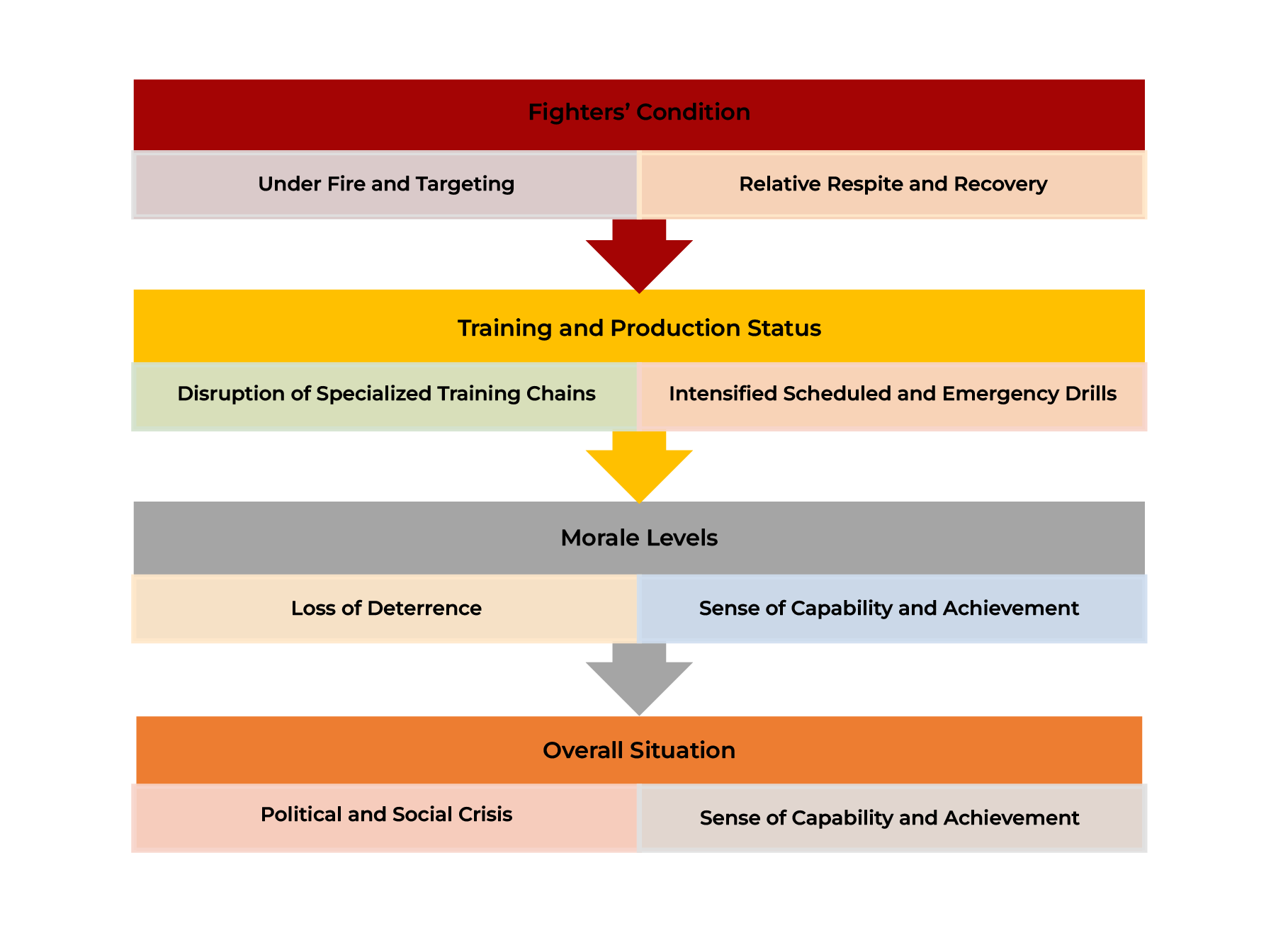
Hezbollah under constraint
Hezbollah and its men were therefore forced to operate under a severe imbalance: lost deterrence, deep wounds, an open security war, and a diminished arsenal of strengths.
They also faced a harsh field and security reality. Surveillance was constant — from the air, space, sea, and agents on the ground. Israel had restored the border-monitoring systems Hezbollah had worked hard to destroy during the support front, while American, British, French, and Arab intelligence activity in Lebanon intensified from the air and on the ground.
There were also building demolitions, sudden incursions, kidnappings, and captures. The South’s lower population density deprived the resistance of a human cover that had long aided its work. Large quantities of weapons were confiscated or destroyed, either through direct Israeli action or by international forces and the Lebanese army at American request. On top of this came political, security, and logistical restrictions imposed by the army and the state.
All of this came amid a difficult reality of armament and funding. Traditional funding and armament lines — Iran to Iraq to Syria to Lebanon — had been almost completely severed. Reliance on self-manufacturing was difficult, and major efforts were required to restore what had been damaged in previous confrontations, including the support-front war and Hezbollah’s 2024 Battle of the ‘Possessors of Great Strength’ — the name it gave to the ground battle in southern Lebanon.
There was also a full reassessment of the supply chain for military, security, logistical, and communications acquisitions, with the work governed by the principle of doubting everything until proven otherwise.
Costs had risen across the board: smuggling, direct military manufacturing, dual-use manufacturing, and other capabilities. This came amid severe financial pressure caused by the sudden and enormous number of martyrs, wounded, prisoners, and their families.
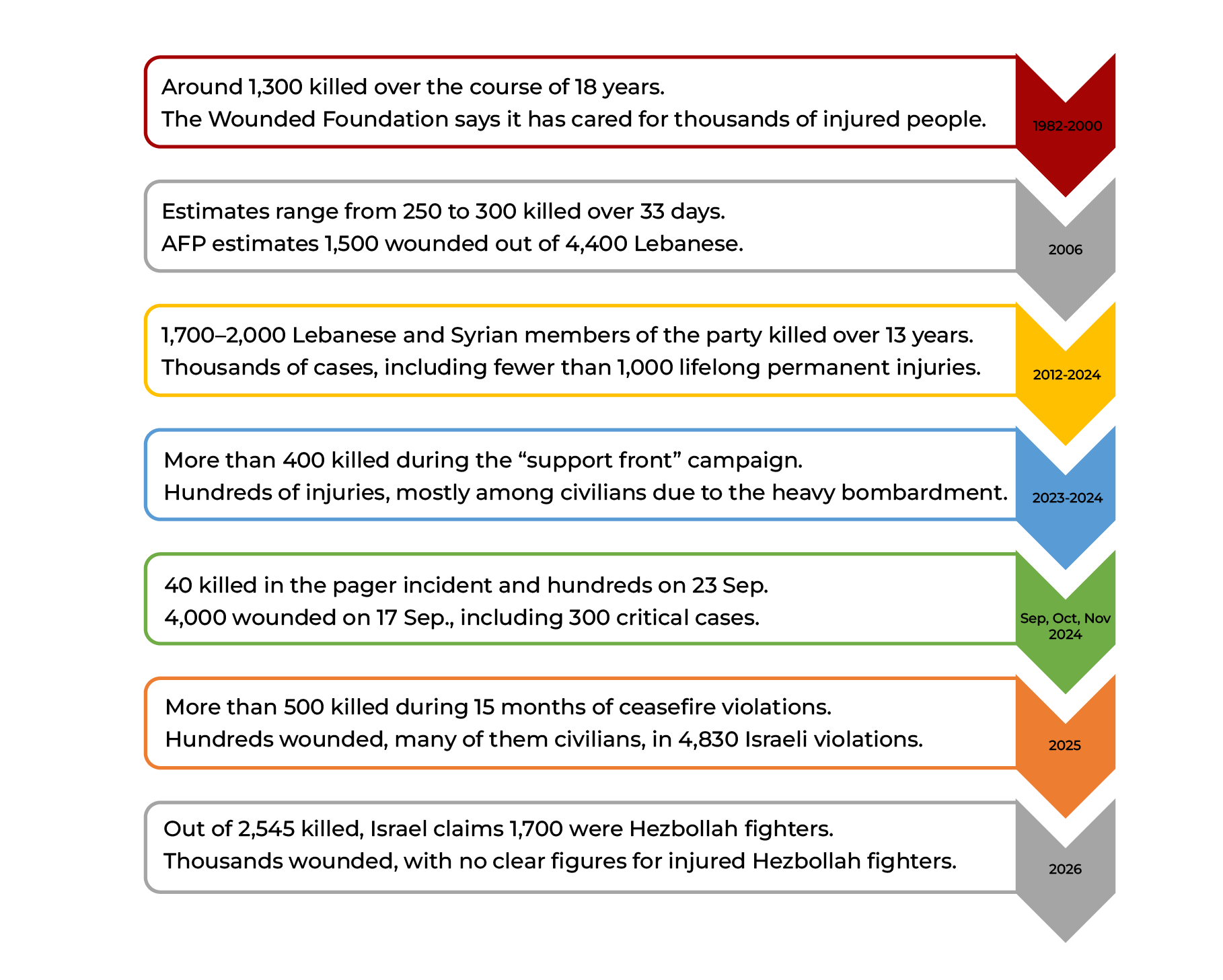
On this last point, military and civilian officials note an important detail: for the first time, Hezbollah faced a major obligation in the file of martyrs and wounded. In the war to liberate the south from 1982 to 2000, the party offered around 1,284 martyrs and thousands of wounded over 18 years.
In the 2006 war, around 1,200 people were martyred, of whom no more than 300 were resistance fighters, while the rest were civilians — around 900 — alongside hundreds of wounded among the resistance over roughly one month.
For comparison, the Israeli side exaggerated at the time by speaking of 600–800 Hezbollah fighters martyred, while estimates by the state and the UN stood at 500.
In the Syrian war between 2011 and 2024, fewer than 2,000 Lebanese and Syrians belonging to the organizational body were martyred, with thousands wounded, over roughly 13 years. In the ‘Possessors of Great Strength,’ at least 2,500 resistance fighters were martyred within 66 days, out of 4,047 Lebanese victims.
Thousands were wounded, including about 4,000 within days, between 17 and 23 September 2024, among them 300 critical cases and around 40 martyrs. They had been preceded by around 400 during the months of the “support front,” between October 2023 and August 2024.
In the ongoing war, there are no precise figures, but Lebanese estimates speak of fewer than 1,000 resistance fighters martyred out of 2,545 martyrs in Lebanon up to 21 April 2026, according to the Lebanese Ministry of Health, with more than 7,700 wounded. These were preceded by hundreds of martyrs during 15 months of the “ceasefire agreement.”
Alongside the heavy burden placed by the 2023 and 2024 confrontations on Hezbollah’s financial budget and its medical and hospitalization capacity, these numbers exceeded internal absorption capacity in a very short period. In proportional terms, the previous war became the most dangerous and punishing war Hezbollah has faced since its founding.
Beyond the assassination of commanders and the security strikes, the party gave in two months what it had not given in decades, all within a narrow geographical and temporal space.
“But by doing so, it prevented a breaking event: the reoccupation of the south after the major strikes and shocks. Today, it is entering the current war from the point at which it ended the previous one,” says an informed source.
This is happening while Hezbollah has deliberately worked in a way that noticeably reduces human losses in its ranks. While the “Possessors of Great Strength” battles resulted in more than 200 martyrs per day in their first weeks, the current confrontation has produced a different pattern.
It is true that Tel Aviv’s claims — the elimination of 1,700 members, at a rate of 37 per day — are exaggerated in this war. But even in the worst estimates, this number remains less than half the rates Israel claimed in the previous war: more than 4,000 members in 66 days, at a rate of 60 per day.
A conceptual sequence of the reality before the 2026 war: the right column for the resistance, the left for the occupation
Nasrallah’s survival plan
جهل العدو … هي قدرة الردع #السيد_الطبطبائي #القائد_الشهيد pic.twitter.com/EbF3SpStFd
— محمد علي خليل (@khalil_mohmdali) April 15, 2026
In this clip, the martyred commander Haitham Ali al-Tabtabai — assassinated on 23 April 2025 — speaks about redefining deterrence. Until his martyrdom, he was the first military commander responsible for restoration, drawing lessons, and preparing for the next war, with a prominent role also played by “Sayyed Sadeq,” the martyr Youssef Ismail Hashem, assassinated in early April 2026.
Behind this discussion, a former official recalls to The Cradle the 70–30 split that governed Hezbollah’s armament logic. The party sought to fill its depots with many times more than it needed, on the basis that the probability of the Israelis reaching a large part of them, through intelligence or military action, remained high.
On this basis, work proceeded according to recommendations from the party’s late secretary-general, Nasrallah: if the occupation reached 70 percent of the capabilities, the remaining 30 percent had to be sufficient to confront Israel for a long period.
After Israel — specifically its former minister of security, Yoav Gallant, in his professional capacity as the official responsible for precise assessment — announced the destruction of up to 80 percent of Hezbollah’s capabilities, and then lived for around half a year in the euphoria of this “achievement,” the “devastating news” reached the relevant Israeli circles in mid-2025.
At the time, Israeli escalation reached its peak in July 2025, alongside warnings by US envoy Tom Barrack of a war that would “leave nothing behind.” The deadline was then extended until 1 January 2026 because the first mission in Iran — the 12-day war — had not been completed, and Israel needed more preparation, especially since the Gaza war was still raging; its main momentum stopped on 10 October 2025.
Behind the Israeli frenzy, was the discovery that the ratio had been reversed: Hezbollah’s remaining capabilities were not below 30 percent, but above 70 percent. The party itself reached that assessment only after months of exhaustive work inspecting depots and facilities, identifying what had survived, what had been disabled or partly damaged, and subjecting everything to a full security review.
The figure circulated inside Hezbollah as a broad political assessment, giving senior officials and decision-makers a general sense of the party’s remaining capabilities without exposing the details. It later reached the Israelis. “The process took months because it was complex and difficult, not a simple inventory of warehouses full of goods,” a security source says. “It is natural for the Israeli to know the number — but not the details behind it.”
Israeli assessments nevertheless pointed to the same conclusion: Hezbollah was rebuilding. Reports cited renewed efforts to move weapons through Syria, maritime channels, third-country routes, and dual-use supply lines, while Israeli media claims suggested the party had already restored significant parts of its military capabilities.
In other words, the previous war, for all its severity, had failed to deliver the required outcome. For Israel, that meant another round was necessary.
The Israeli leadership did not tell its public this plainly. Doing so would have exposed a major failure just as Israel had entered its first direct, large-scale confrontation with Iran and drawn the US in alongside it. It also undercuts Israel’s posture of surprise at the Hezbollah now facing it. Officers and soldiers on the ground may indeed be surprised, but only because what their leadership told them does not match what they see in battle.
On the financial front, concerned figures say that before Operation Al-Aqsa Flood and after the Syrian war, Hezbollah’s leaders had reviewed the financial situation with the Iranians. The conclusion was that the “large expansion” in funding caused by the battles in Syria now required a pre-emptive plan to absorb later shocks.
As a result, reduction and austerity measures were decided on the assumption that a major event could occur soon, perhaps even affecting Iran itself. It was therefore better to begin reducing the budget early, voluntarily, and in peacetime, before the deficit itself became a major shock to the party, its cadres, and its supporters, according to the sources.
These sources recall a speech in which Nasrallah threatened to starve the Israelis if they decided to wage a war of starvation against the party. These sources also point to an incident they say was never reported publicly: an Israeli strike on crates unloaded from an Iranian plane in Damascus.
According to their account, Israel believed the crates contained weapons; they were carrying cash. For this reason, they say, “the Sayyed established a special deterrence equation at the time, and the incident was not repeated.”
Without that plan and the deterrence equation behind it, Hezbollah’s position today would be far more difficult, especially given the scale of care required for the wounded, the martyrs, and their families. Added to this is the prisoners’ file, which Hezbollah thought it had closed in 2006 but which has now reopened on a far larger scale, placing the resistance once again before the test of liberating land and captives.
From beneath the ashes
After the last war, Hezbollah entered a major internal review under the weight of difficult questions. The decision was to start again from zero. Everything was placed back on the table, including strategy itself and the meaning of defense. From that review came the plan for “how we will fight” in the next battle, after it became clear that the question was not whether another confrontation would come, but when.
“There must be fast learning and high flexibility. A mixture of everything must be blended,” military sources say. That was the first field lesson.
As for the second lesson, it was “building parallel bodies. In every mission there is more than one body: if one is eliminated, the second continues, then the third, the fourth, and so on. What matters is that the work does not stop for a single moment.”
Time was short, and the lessons were hard-earned: the lived experience of 2024 and 2025; the Gaza front, where Israel rapidly adapted its tactics and began fighting with methods closer to guerrilla warfare; and the surprises it prepared for battle, including quadcopter drones that exhausted resistance fighters.
Added to this were Israel’s operations in southern Syria, the challenges created by the Israeli presence there, and the wider war on Iran.
All of this opened weighty files for Hezbollah’s military command, alongside the Iranian officers responsible for assessment, training, funding, and cooperation.
Amid the pace of events, the continuing Israeli killings in Lebanon, and the local and regional pressures already described — including matters that can only be hinted at, or left entirely unsaid — Hezbollah had to draw the broad lines of the next battle.
In the end, through this mentality, the familiar resolve of Hezbollah’s fighters, and the impulse for revenge embedded in the Shia political experience, the party was able to rise again in this war and surprise friend before enemy.
Like the phoenix, it emerged from beneath the ashes. But what were the details of that war, and how was it prepared?