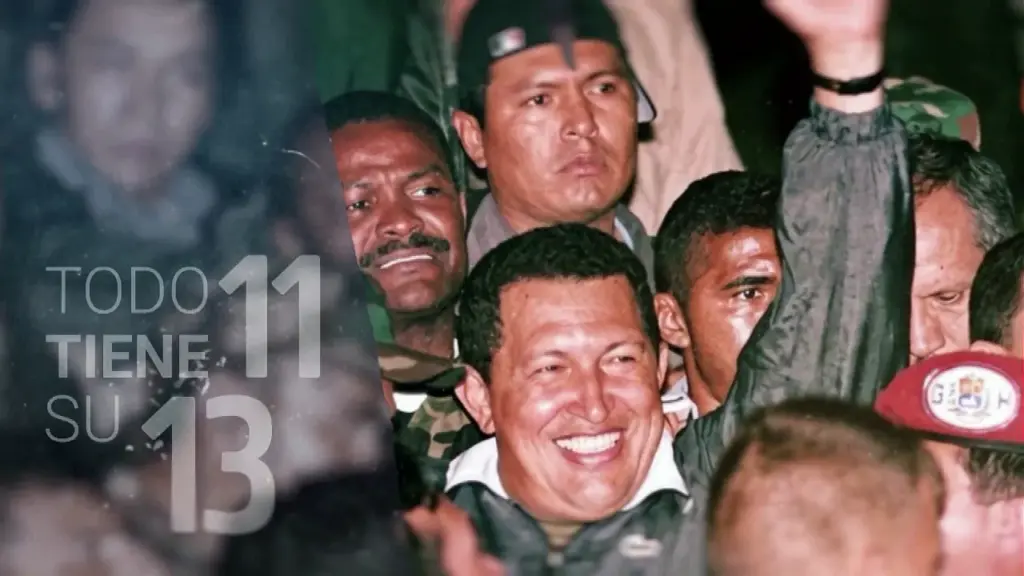
President Hugo Chávez upon his return to Miraflores Palace on April 13. Photo: Jorge Silva/Reuters.
President Hugo Chávez upon his return to Miraflores Palace on April 13. Photo: Jorge Silva/Reuters.
In Caracas, on Monday, citizens mounted a commemoration of the 24-year anniversary of the restoration of Constitutional President Hugo Chávez to his office after US imperialism, in collaboration with right-wing sectors within Venezuela, had carried out a coup d’état 48 hours earlier.
Leaders of Venezuela’s United Socialist Party (PSUV), including the party’s secretary general, Diosdado Cabello, participated in the demonstration commemorating the historic events that culminated in President Chavez’s triumphant return to Miraflores Palace on April 13, 2002.
The march set off from various points in the capital, including Parque Alí Primera in Sucre parish and Nueva Granada Avenue in Santa Rosalía parish, and headed off toward the steps of El Calvario in El Silencio.
April 13, 2002: a people in the streets
On the afternoon of April 13, 2002, approximately one million Chávez supporters thronged around Miraflores Palace to express their condemnation of the illegal coup and to demand the return of their beloved president. A day earlier, coup leader Pedro Carmona had proclaimed himself president and dissolved the Venezuelan Constitution, Venezuela’s National Assembly, and Supreme Court and suspended the nation’s Attorney General, Comptroller General, governors, and mayors under the terms of the infamous Carmona Decree. The decree was signed off by such Leopoldo López and Maria Corina Machado, among other right-wing and far-right figures.
April 13 became known as the Day of National Dignity. A handwritten message began circulating across Venezuela and the world via fax, stating that “I, Hugo Chávez Frías… declare: I have not resigned from the legitimate power the people gave me.” The message spread due to loyal members of the armed forces who had smuggled the message from the imprisoned president, and it strengthened the resolve of those mobilized in the streets.
As the message circulated, divisions emerged within the military. Officers questioned the alleged resignation and demanded clarity. Pressure from within the armed forces forced key figures of the coup to reconsider their position.
President Chávez had been taken to La Orchila, where efforts were made to force him to sign his resignation and leave the country. Although he refused, the coup leaders told the public that he had resigned.
Following the collapse of the coup, Diosdado Cabello, then vice president, assumed the presidency briefly before Chávez was restored to office in the early hours of April 14. President Chávez returned to Miraflores welcomed by the masses who had remained gathered outside the palace.
”A president without hatred’
Despite being detained and held incommunicado, President Chávez declared upon his return that he held no hatred toward those responsible.
“I do not come with any hatred or resentment against anyone,” he said, emphasizing the humanist and peaceful character of Venezuela’s Bolivarian Revolution. He called for calm and rejected any form of retaliation, insisting there would be no “witch hunts.”
Chávez highlighted the historic role of the Venezuelan people and the armed forces in restoring Constitutional order, describing the events as an unprecedented demonstration of popular consciousness and unity.
He closed his address reaffirming his love for the people: “If I loved you before, today I love you much more. Love is repaid with love.”
‘His Heart Beat as One With the People’: Venezuelans Commemorate 13 Years Without Chávez
(DiarioVEA) by Yuleidys Hernández Toledo
Translation: Orinoco Tribune
OT/CB/SL
Cameron Baillie is an award-winning journalist, editor, and researcher. He won and was shortlisted for awards across Britain and Ireland. He is Editor-in-Chief of New Sociological Perspectives graduate journal and Commissioning Editor at The Student Intifada newsletter. He spent the first half of 2025 living, working, and writing in Ecuador. He does news translation and proofreading work with The Orinoco Tribune.